I would wake each morning in Venice to the “laughing” sound of seagulls. Today I heard geese and I knew I was home!
Page and I were thrilled with the gift of breakfast foods at our home Sunday night from two couples! Such a relaxing breakfast on Monday morning! But we needed to go out and stock up for the rest of the week and then go get our mail at the post office. Since it was dark (around 8:00pm) when we got to Winston-Salem on Sunday, I couldn’t see what delighted me this afternoon. Daffodils all over including flowering Bradford Pear and Cherry trees, plus forsythia!
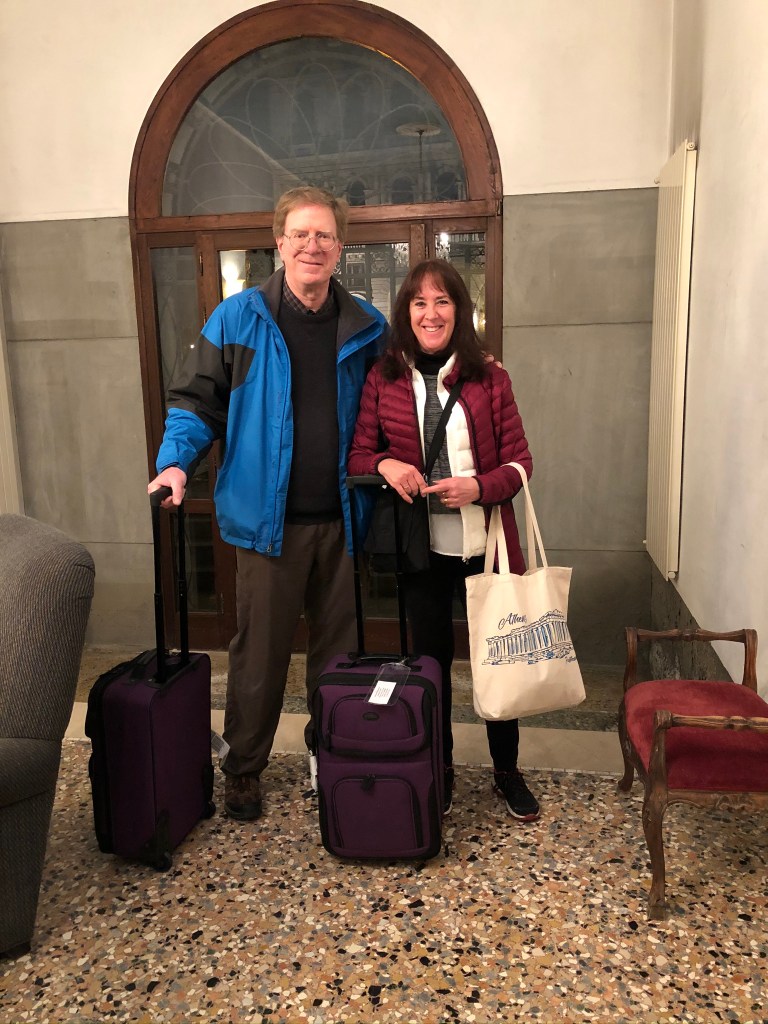
First feeling….we made it! Second feeling…the two bottles of olive oil and bottle of wine in my suitcase…made it! Third feeling….we were the Von Trapp family that escaped out of Austria in the middle of the night AND we got off the Titanic into a life boat (water taxi) before Casa Artom sank and we all went down with the ship. Oh wait! That was a bad dream mixed in with my jet lag!
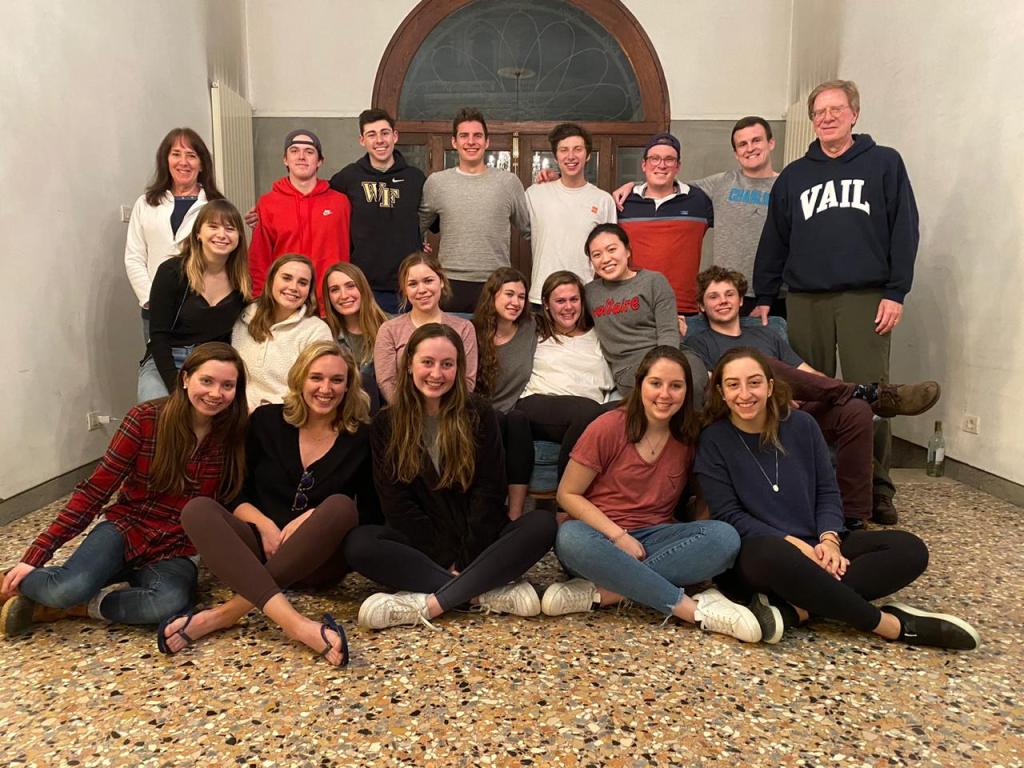
We took this photo on Friday night after we got the word we were all going home. It is hard to tear apart a family and this group really bonded. Some of the students asked if we could still get together in Winston-Salem for our “Family Dinners” on Wednesday nights. I volunteered my kitchen! On the flight home Sunday morning Page and I started to brainstorm how to make the remaining semester interesting. We have a list of Italian companies in North Carolina that he will look into and create field trips.
The students are unsettled, but after two weeks at home including Spring Break, they will return on March 15th to the main campus. Page and I will spend a week at our beach house. We will all rejuvenate, feel fortunate that the first half of this semester was in Venice, and feel glad that we “escaped” the big coronavirus! An adventure we will never forget!!
As of this writing (Sunday March 1) Linda and I are now back in the United States. Our final few days in Venezia were truly surreal.
Coronavirus started appearing in Italy about a month ago, with 2 cases reported in Rome. Then about 3 weeks ago a couple cases were reported in the Lombardy region, in small towns not far from Milan. 2 weeks ago Carnival started in Venice, attracting thousands of tourists from around Italy and from all over the world. 10 days ago the virus cases in northern Italy were reported to have taken off, with 100+ cases of infection reported in those same small Lombardy towns, and one case reported in a small town about 40 km from Venice. Veneto region authorities at that time closed universities and schools for a week, closed museums and cancelled school trips, and cancelled the last 3 days of Carnival. About 5 days ago the reported cases in northern Italy started increasing by 25% just about each day. Between yesterday and today the reported cases increased by 50%, to over 1600.
In Venice itself there are no reported cases of the virus. After the Carnival crowds left, life returned to a customary slow Jan / Feb pace. Few people wander the streets. Universities, schools, museums are scheduled to reopen tomorrow, Monday March 2.
Wake Forest had been in touch with me about the situation. We had collectively agreed to lay low and shelter in place for a few days, until the uncertainty of the situation from two weeks ago was further clarified. Since local universities were cancelling classes, the local Italian faculty started delivering their instruction remotely. I continued to conduct my classes normally, since we are a completely self-contained living and campus facility. Early last week Wake issued a policy to prevent Casa Artom students from traveling across Europe this weekend. Everyone was required to stay in the house. We still went shopping down the Zattere at the Conad grocery store. But it’s easy to avoid crowds and any possible exposure.
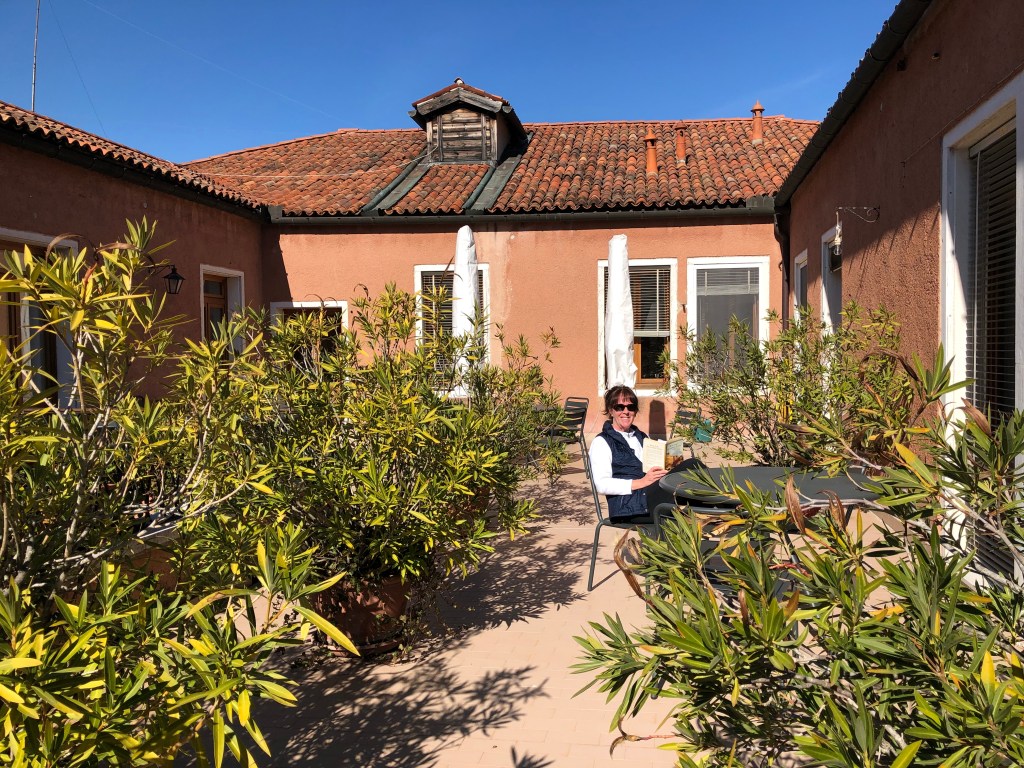
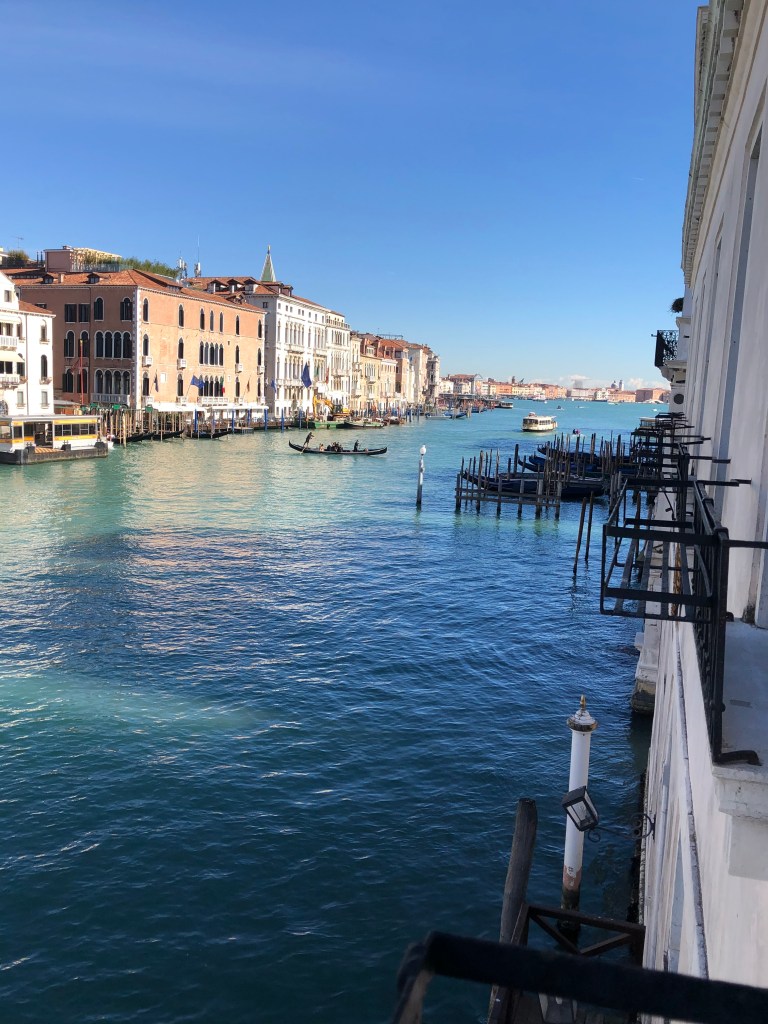
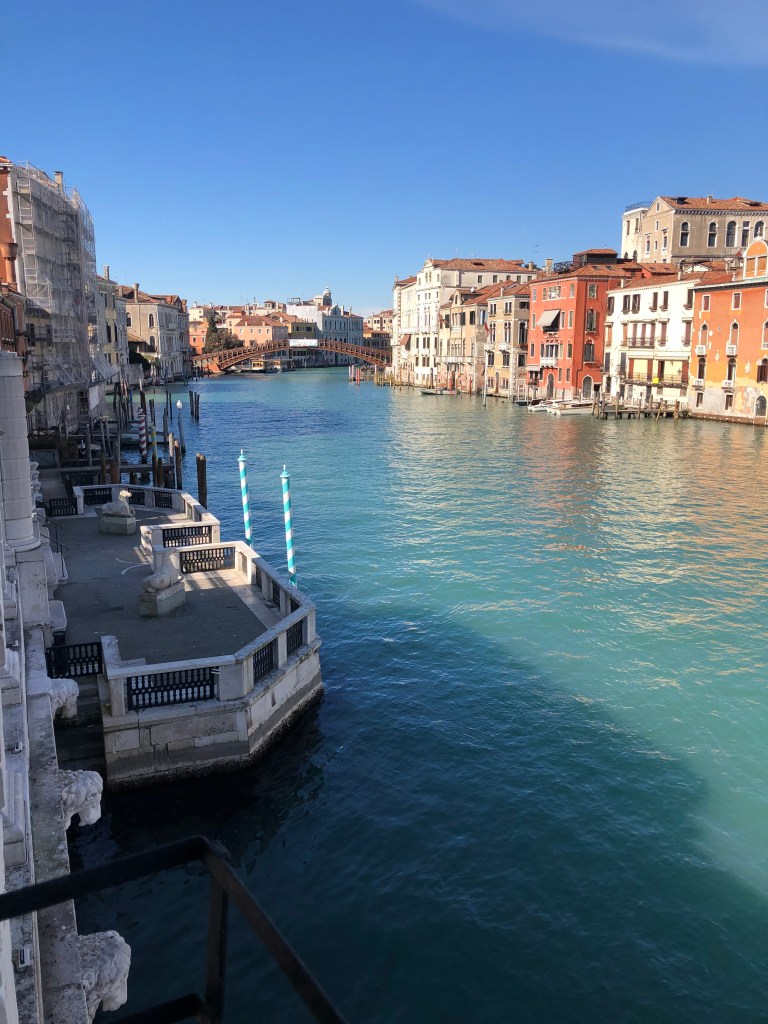
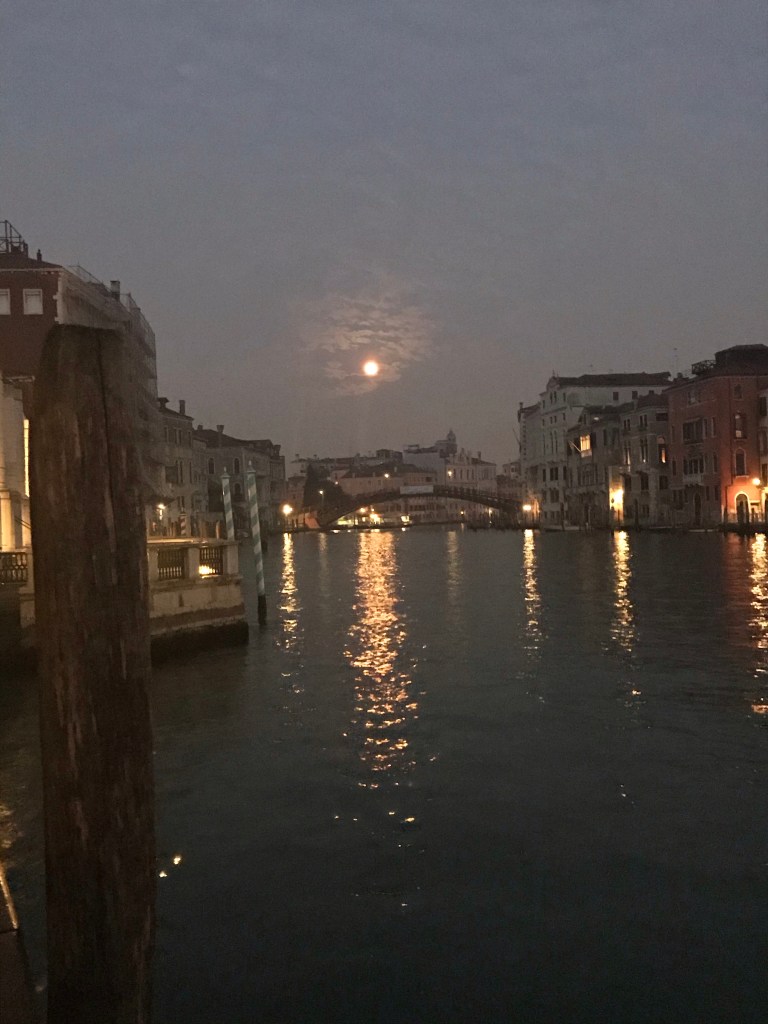
The sun came out in springlike fashion this week – warm and beautiful. We ate lunches in the back patio, drank cold beer, enjoyed the mellow Italian days. The Grand Canal water was a spectacular shade of green/blue – green because it’s still cold but bluish because warmer weather is not far off.
In America only a small number of cases had been reported. And the news media had some other things to occupy their attention for all these days – the impeachment hearings, the Democratic caucuses and primaries, the Mike Bloomberg entry, a possible peace deal in Afghanistan with the Taliban. But all of this became olds, not news, so the media organizations started in on the virus. From afar with our daily streaming of NBC Nightly News, we watched the virus story rise from 4th item covered, to 3rd, then 2nd, then finally it became the main deal taking up half the show. We also read opinions (and not on Fox !) that news orgs believed Trump might be vulnerable for slow response to the virus, another reason supposedly for its suddenly much-increased visibility.
With increased US media attention, for the first time parents of Casa Artom students became increasingly vocal about what was going on, what might be going on. We watched the volume level increase in parallel to the rise of the story in the media to top story. Even though US infections had not changed, and there were still zero cases in Venice. Parents started calling Wake Forest senior administration daily, and writing long letters. Phrases like “in locus parentis” and questions like “if it was your son there, what would you do” mounted unbearable pressure on senior administration. NYU, Syracuse, BU and other programs in Florence were cancelled, which ramped up the pressure enormously (very different circumstances since those programs all house students in apartments around the city and require them to use public transport to get to classes).
Back in Venice I was receiving daily calls and emails, and providing daily updates in status. Nothing had really changed, although the students had a little cabin fever after being inside for a few days straight. We arranged for a special bike excursion on the Lido, picnic lunch away from crowds, a catered dinner, and other plans in the works. A couple remained semi-anxious, but nearly all were perfectly content to ride it out for a few more days until we knew more.
Thursday night the provost’s office held a conference call with about 7 people including me. The decision was made to terminate the Venice program, bring everyone home right away, and continue classes back in North Carolina in March. I prevailed on the group to delay the announcement until I could hold a house meeting on Friday morning. So at 10 am Friday (just 2 days ago !), the decision was announced to students sitting in our beautiful living room overlooking the Grand Canal, and simultaneously emailed to parents around the U.S. Students started rearranging all their flights, working out housing and meal plans for when they return, and asking a million more questions.
Late Friday a group of parents started calling the provost office with a waiver agreement in hand, signed by a number of the students in the house. About half wanted to stay, and wanted to do so while others could leave. They wanted us to conduct two Venice programs – one there and one back in NC. One of the students came to me and asked me to endorse the waiver agreement and convince other non-signing students to join. This I did not do, refusing to take sides with one group over another.
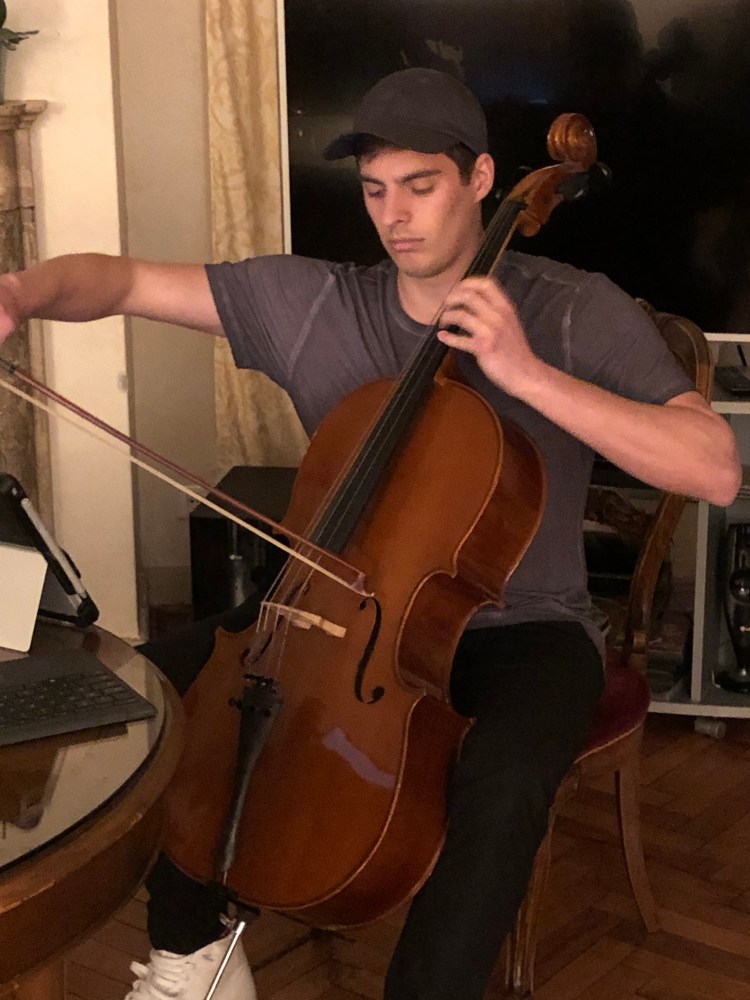
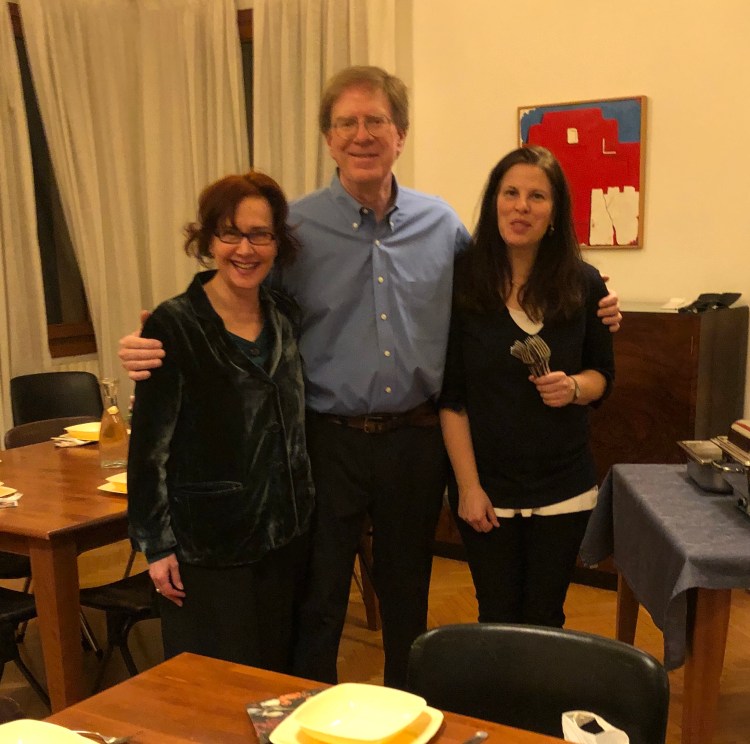
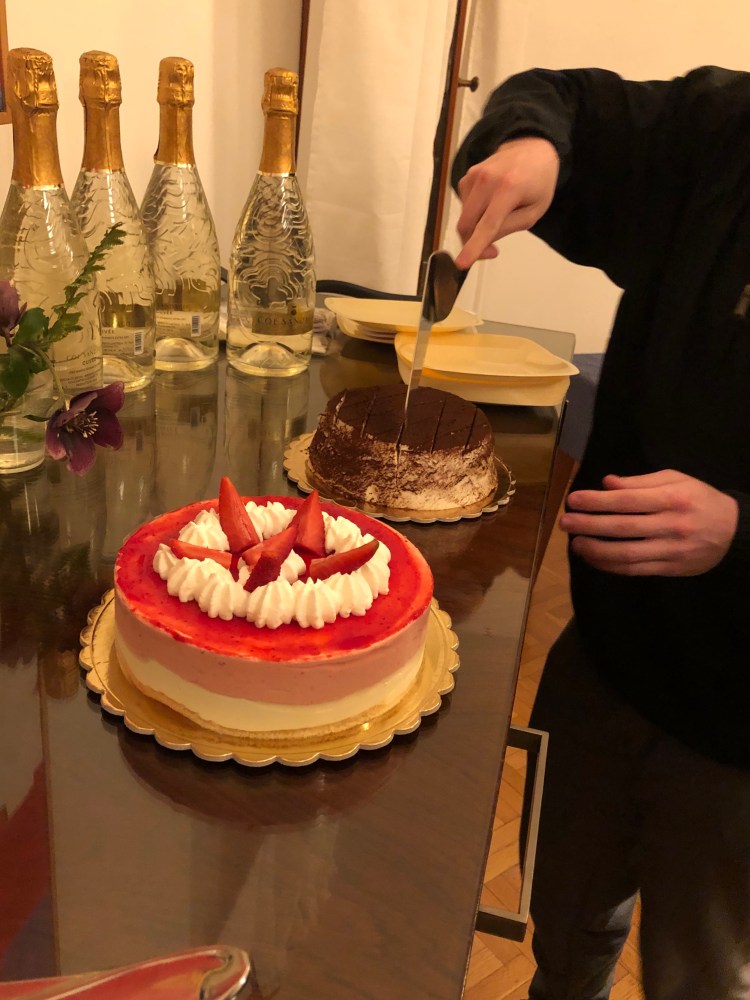
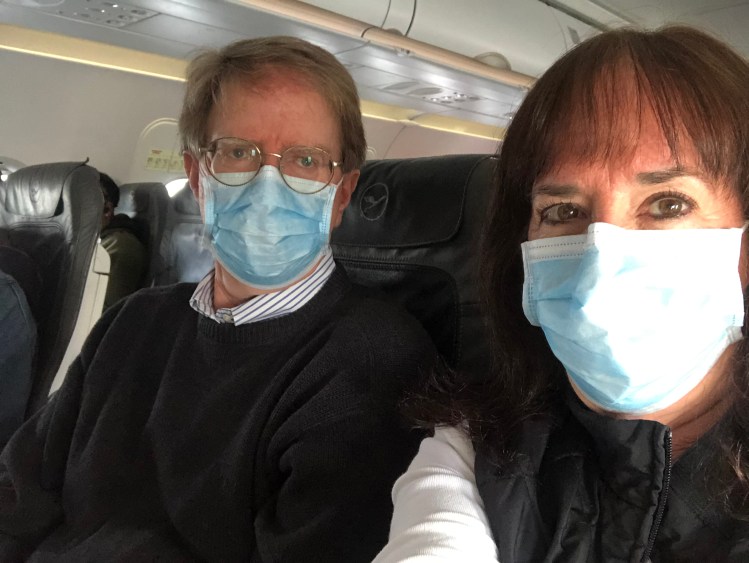
Saturday night we all enjoyed a delicious dinner catered by water taxi to the house – fresh seafood, patatine (potatoes), artichoke casserole, tiramisu dessert, nice Prosecco, and dessert wine. One student from Raleigh, Ben, provided a solo on the cello as a prelude to the meal. Toasts were made and small tokens of our appreciation for Laura and Roberta, our two house administrators, were presented. Then everyone finished packing. The last student left this morning at 10 am. They are all going home, and will then return to campus March 15 after the Wake Forest spring break. Linda and I caught a water taxi to the airport at 5:15, flew to Frankfurt at 7:30, and caught a Dulles bound United Airlines flight at 11:10. We arrive home tonight, stunned at the rapidity with which our circumstances changed and our entire agenda for March and April was cancelled.
Is this Lent? Sheesh! Normally you give something up or do something extra. Well…. we have! We have decided to shelter-in-place here in Casa Artom. Other than going out to buy groceries, we are staying in and having the five Italian professors teach online or Skype in the classroom instead of showing up. Page continues to teach his two classes on Mon. & Wed.
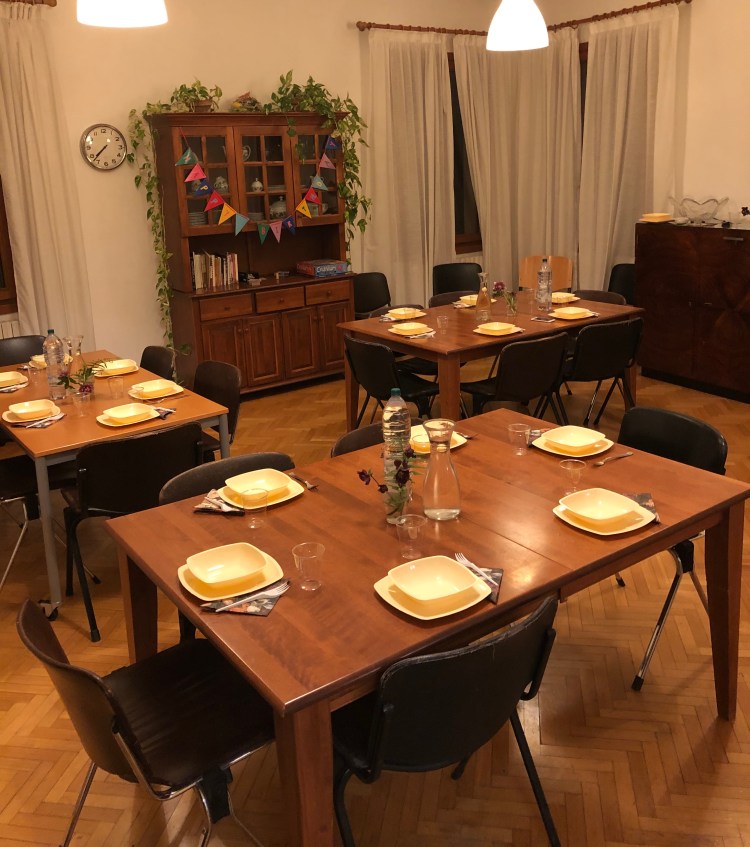
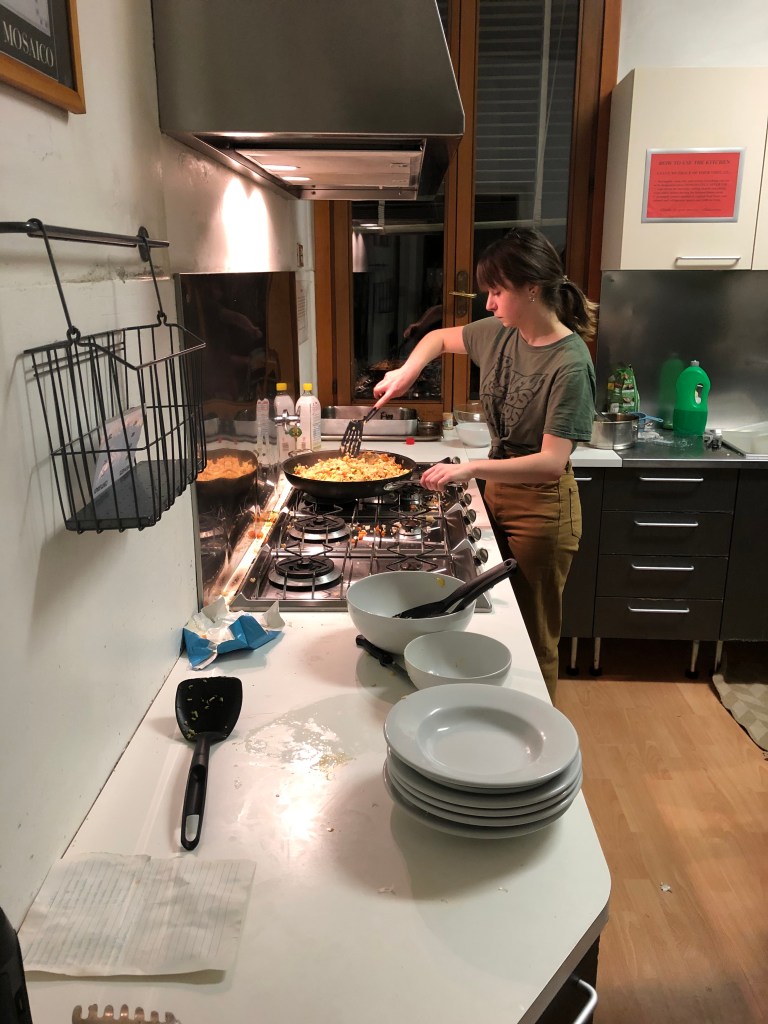
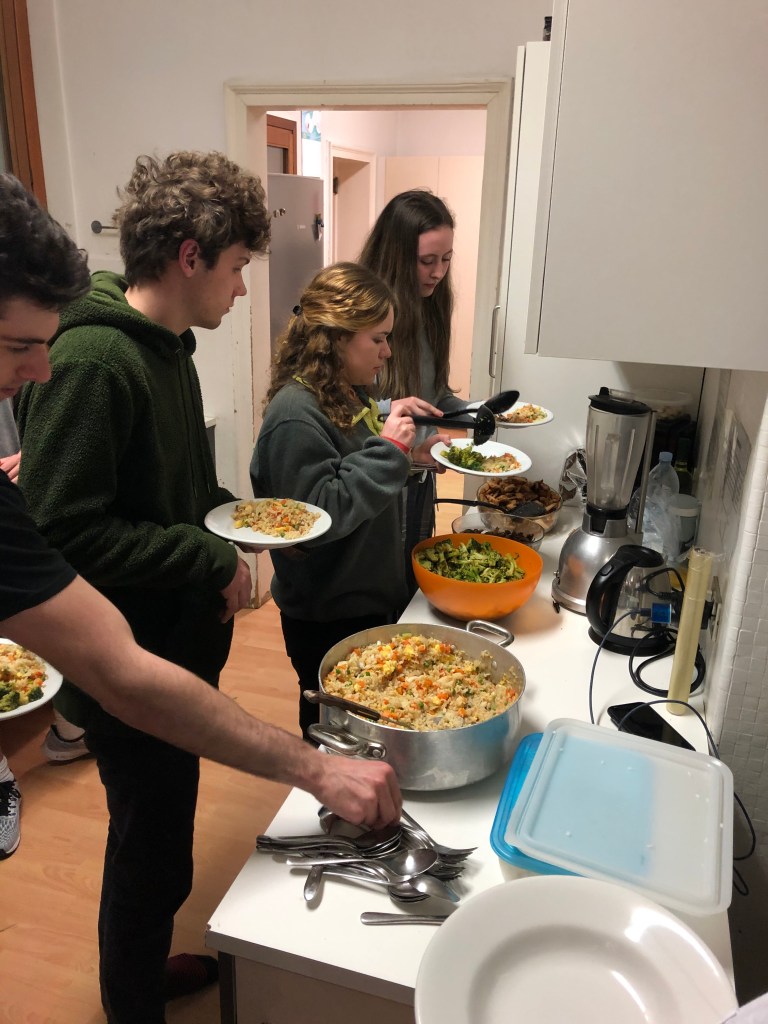
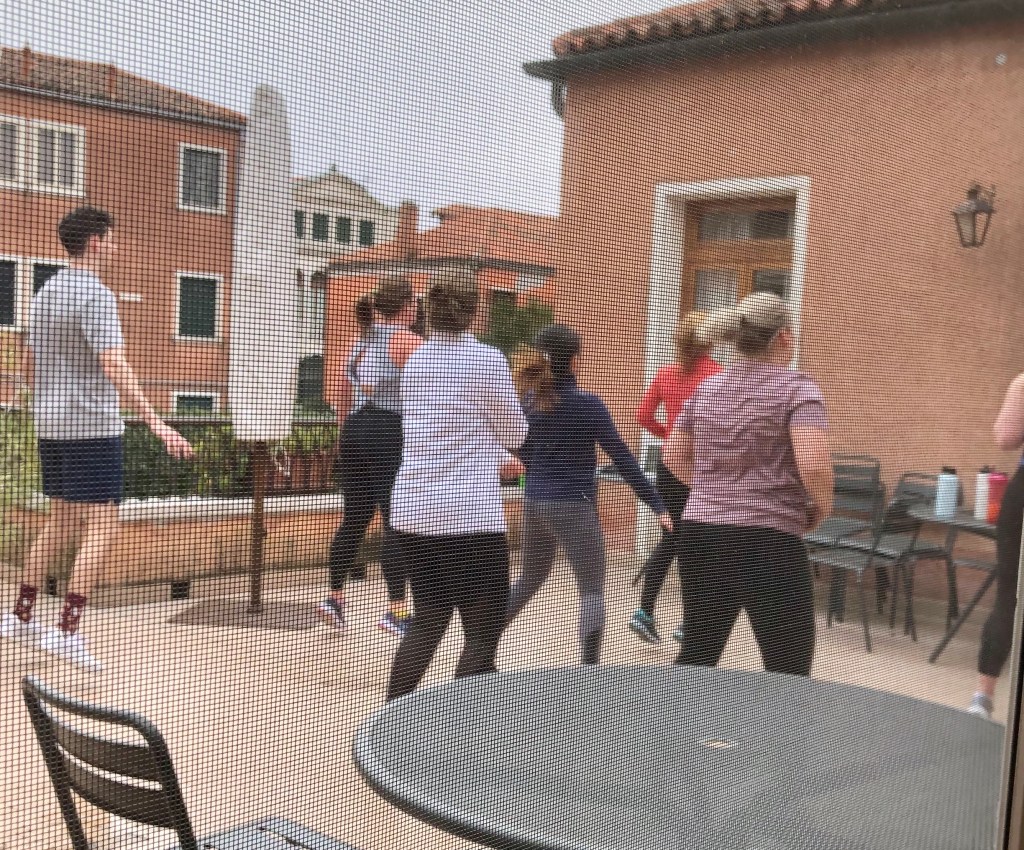
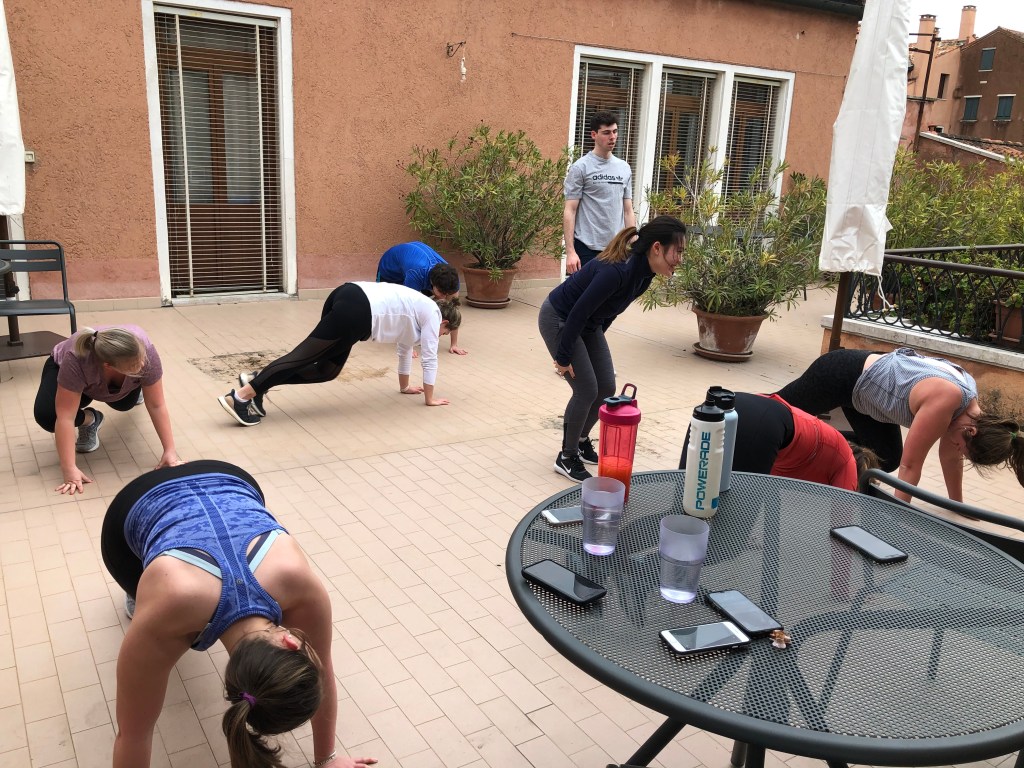
It has been a long week (It is only Thursday!), but Friday – Sunday we have activities planned. Friday – A bike riding and beach day out on the Lido; Saturday – A fancy catered dinner in the library followed by game night in the dining room; Sunday – A movie day with popcorn. The students usually travel on the long weekends. But, our students are troopers! Some have organized exercise classes, box game tournaments, and group cooking! It is hard to stay inside when nobody is sick.
Many study abroad programs in Italy have been pulled because those students live in the community and go to public universities. We are lucky here! We have a house with classrooms! As one of my daughters suggested, “Just pretend you are snowed-in at a Villa…or the Grand Canal.” Outside we see Venice carrying on as usual. The Italian perspective is more lenient.
The USA has really been putting the coronavirus on top of the newscasts. We are ok and appreciate all our family and friends reaching out to us.
Yes! It’s not just us! Look who also is laying low while working here in Venice!
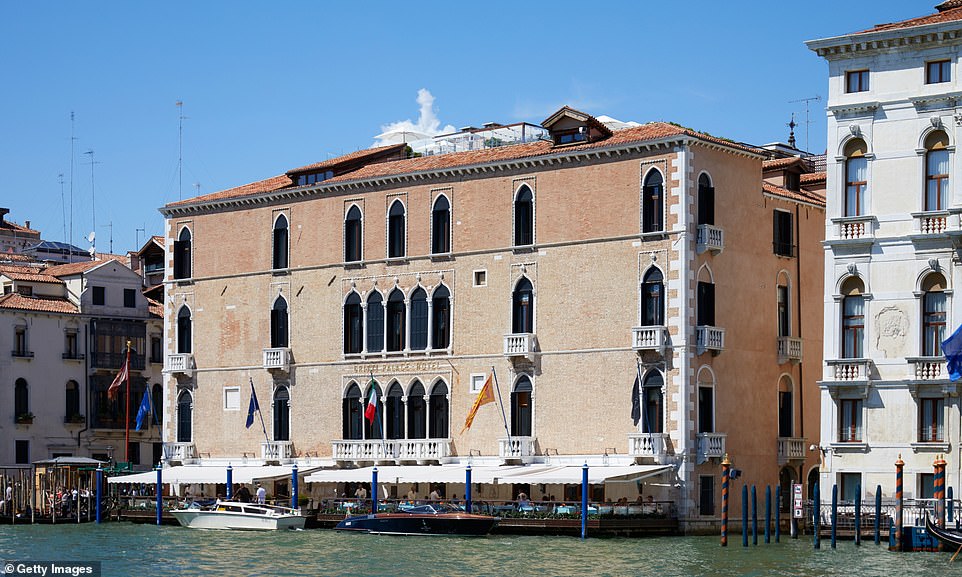
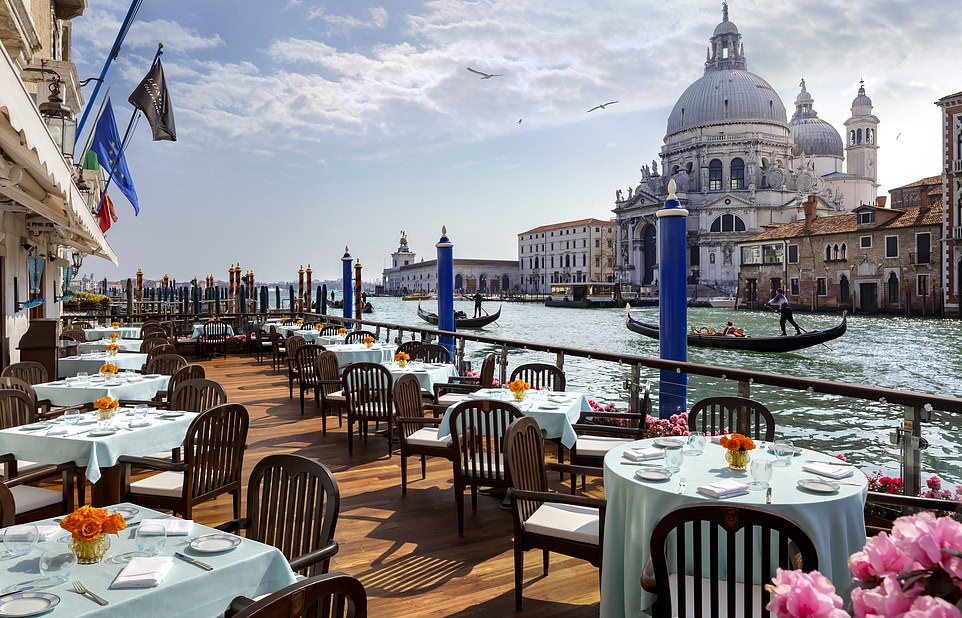
Tom Cruise has been forced to hole up in a luxury hotel in Venice when the filming of Mission: Impossible 7 was halted after an outbreak of coronavirus in Italy. He is staying across the Grand Canal from us at the 5-star Gritti Palace Hotel. He was set to take a gondola through the city’s ancient canals and stage scenes in various medieval squares that are also popular tourist sights.
Gritti Palace HotelDining terrace at the Gritti Hotel
Cruise arrived Feb. 20 and is now stuck until March 1st awaiting a decision on the future of the project. The movie is set for the summer of 2021. We are in good company! Now….if only Page can figure out how to get him to come over and meet our students! In London our next door neighbor was John Lithgow temporarily living there to film “The Crown” and we ended up getting to know him well!
Not much happening this week since all museums, universities, schools, large gathering places have been cancelled. I’ll just be watching out our windows!
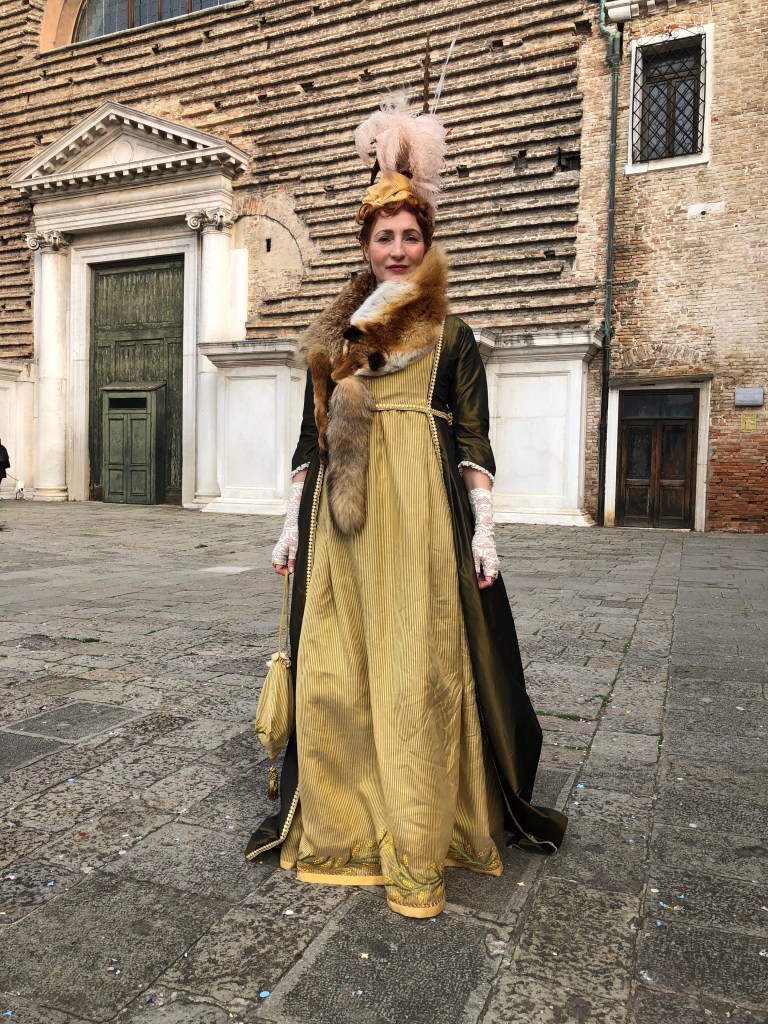
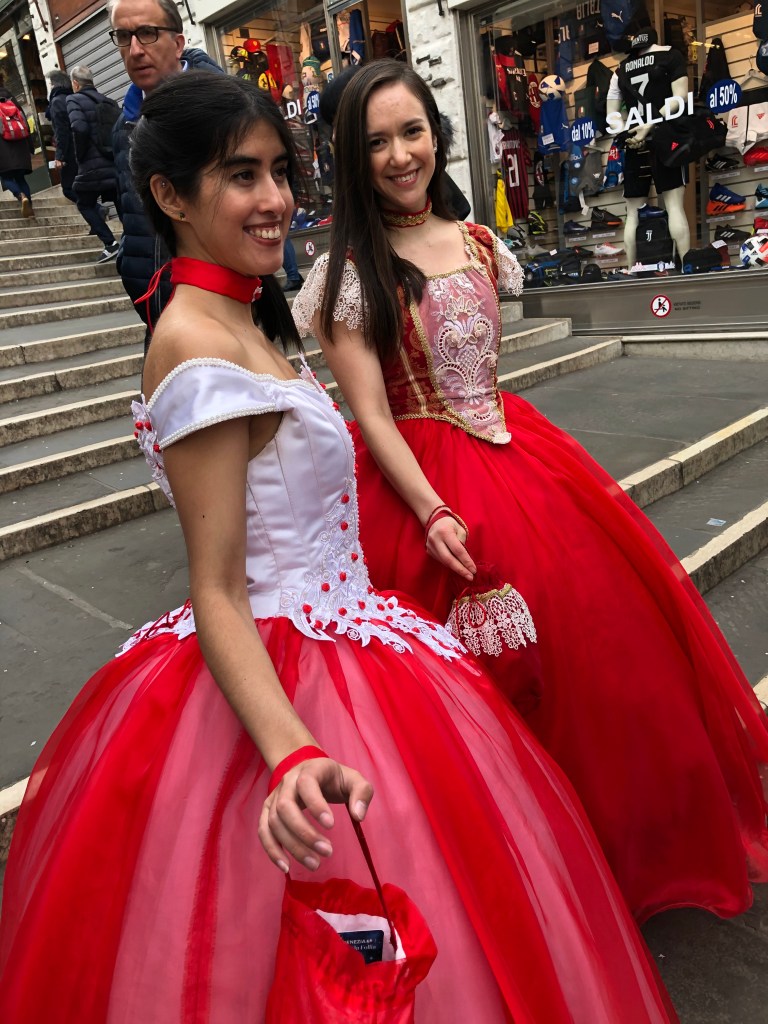
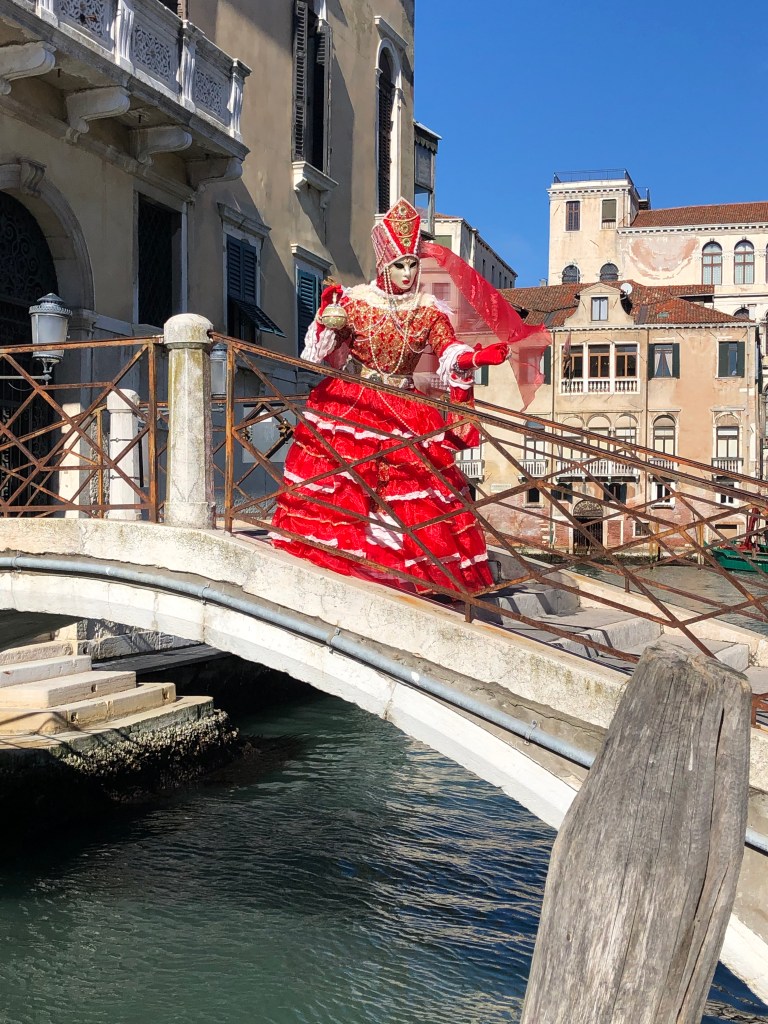
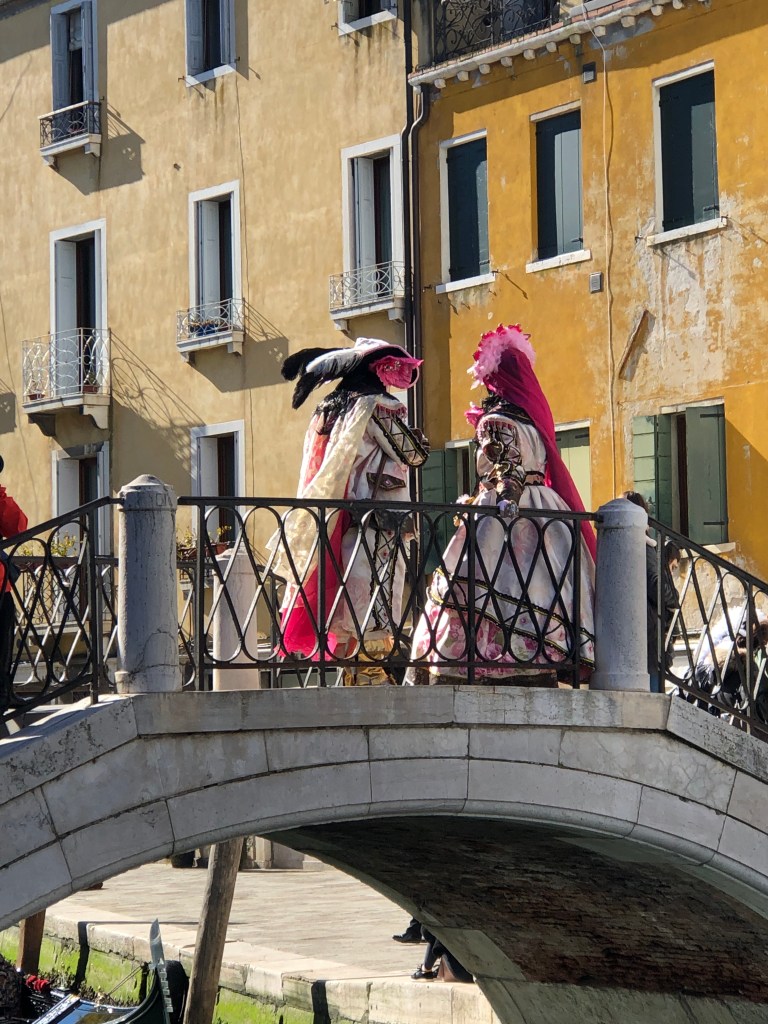
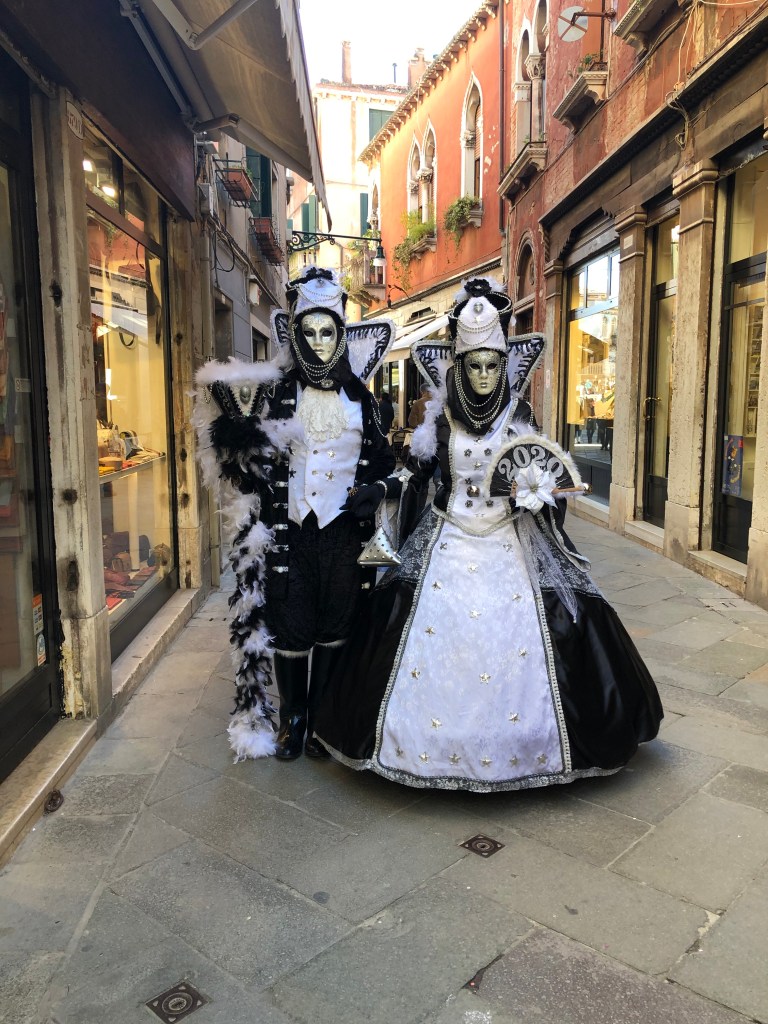
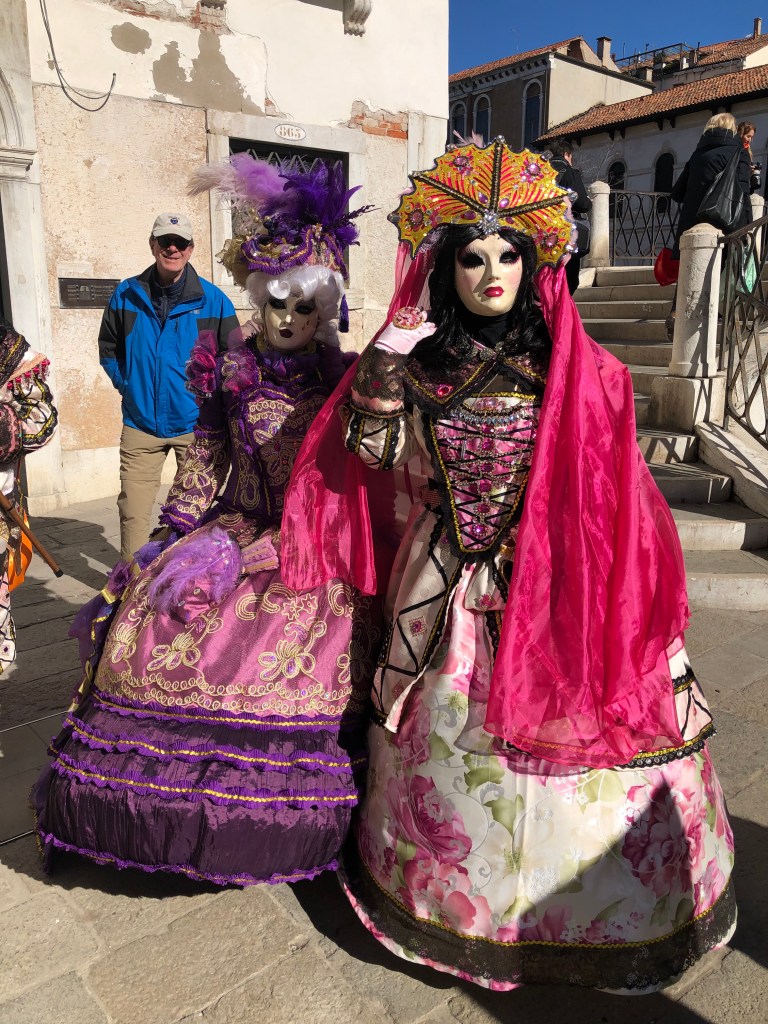
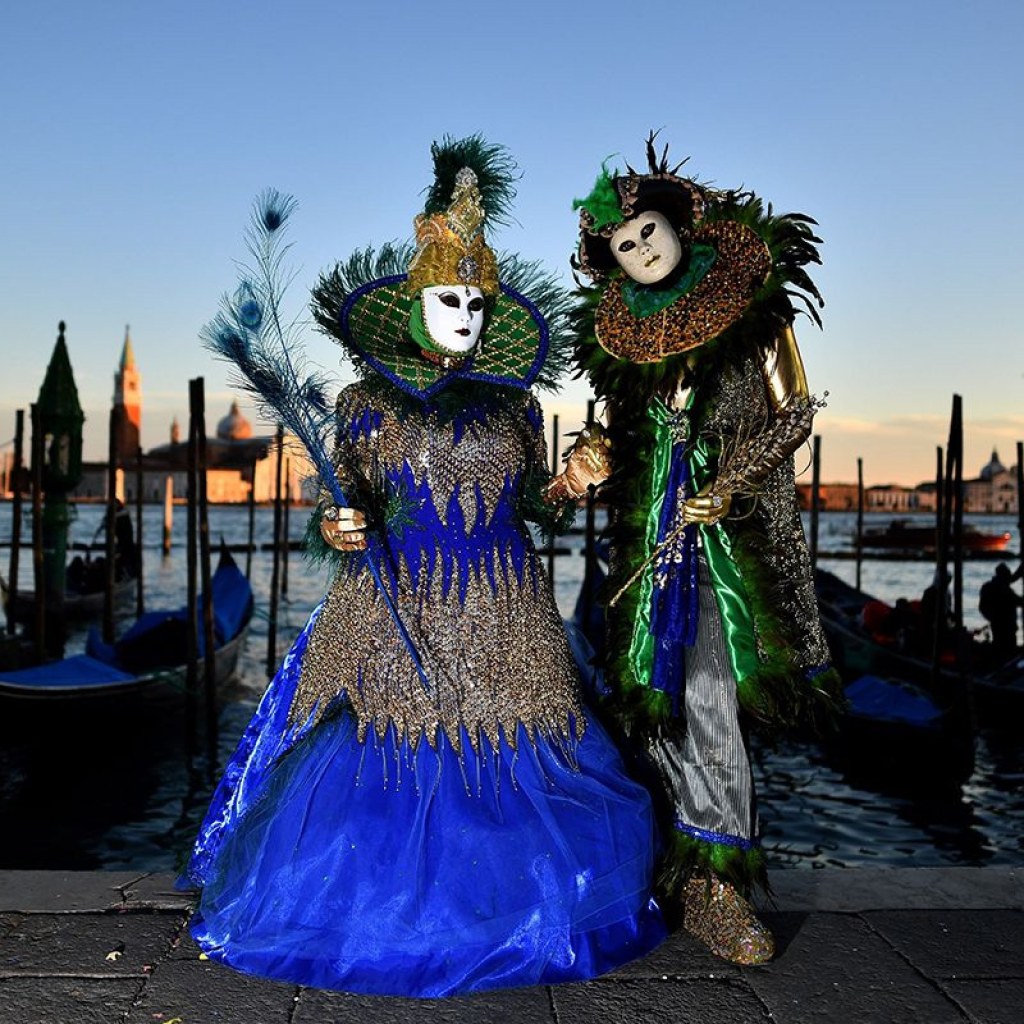
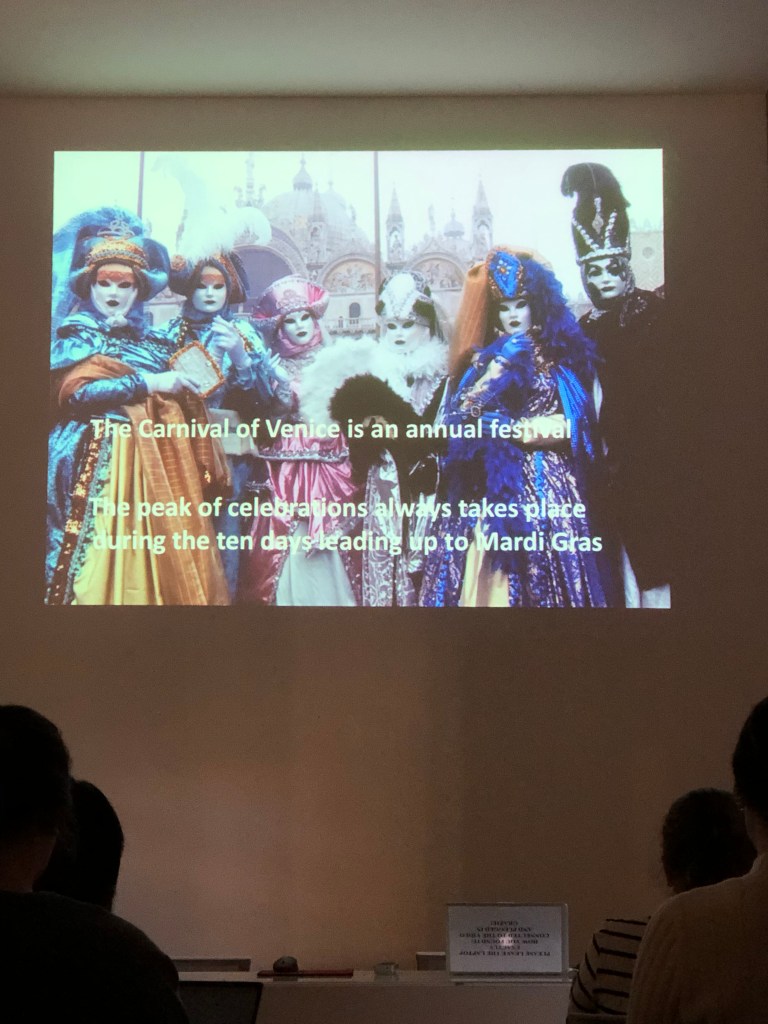
The tradition of Carnival in Venice began in the 11th century and declined by the 19th century. It was revived in 1979. This year it started on Feb. 8th and ends on Feb. 25th (Fat Tuesday). However, we just got word today that it is being cancelled early due to the Coronavirus.
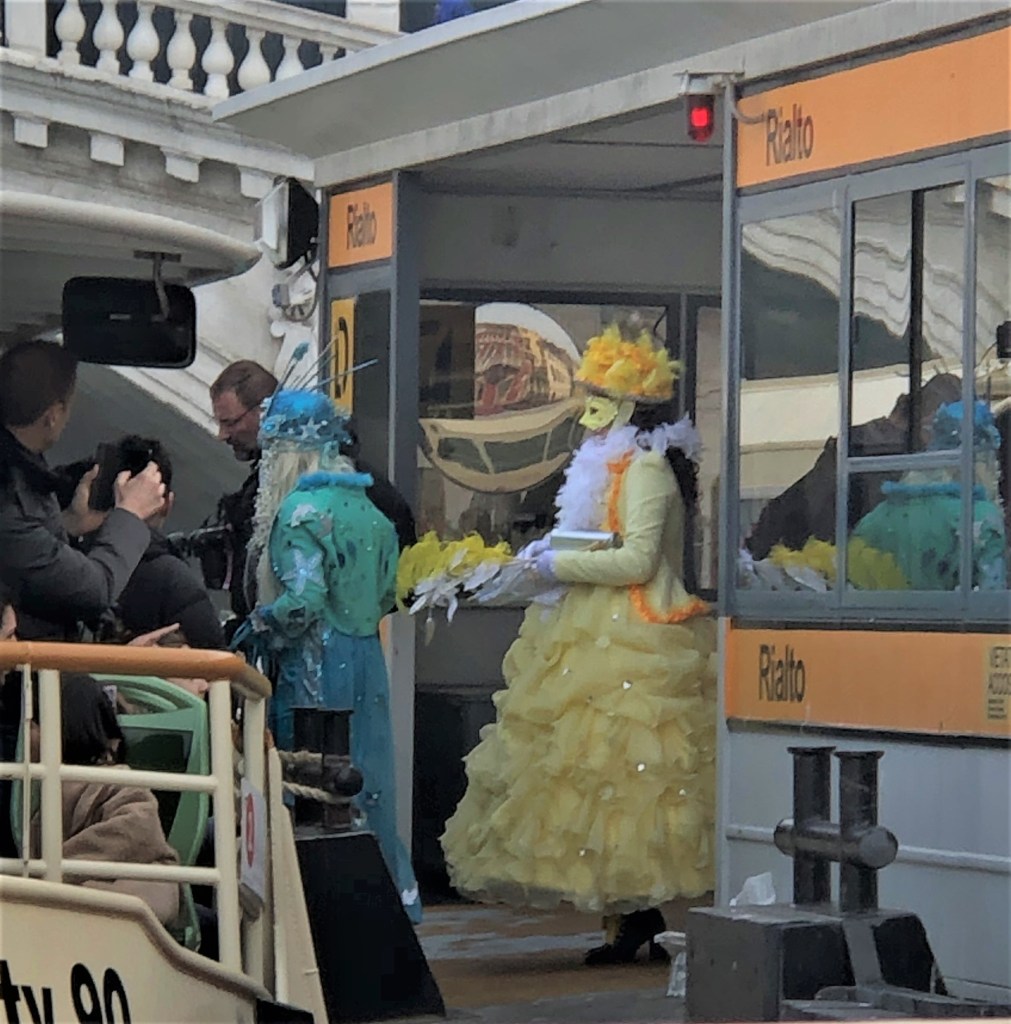
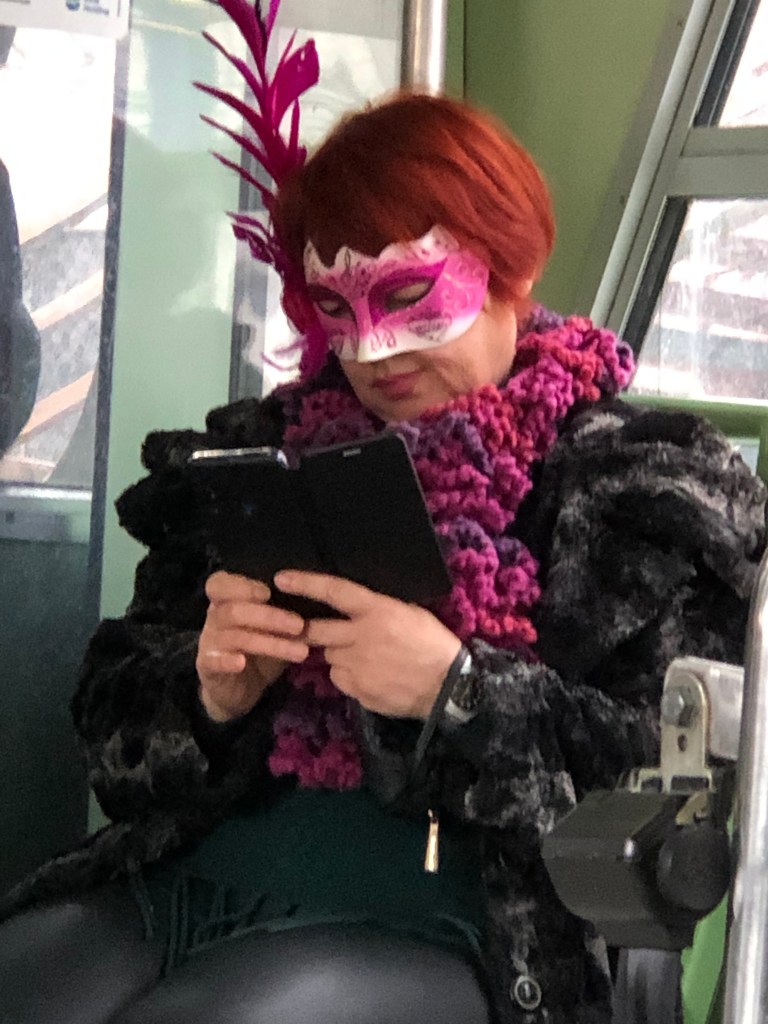
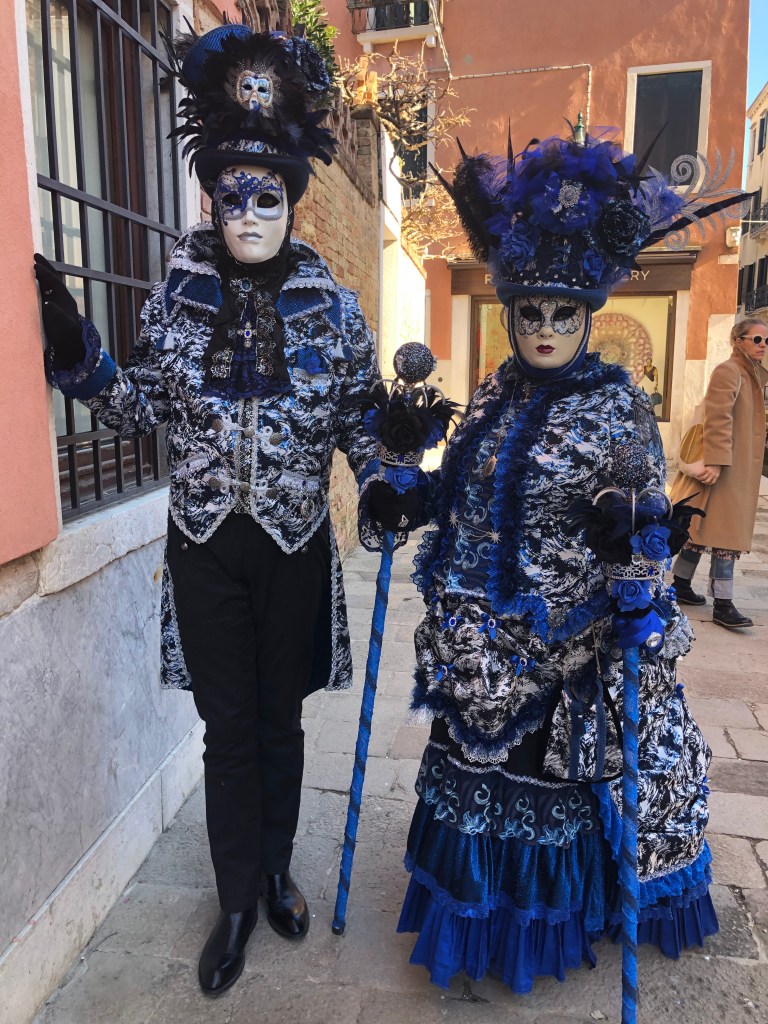
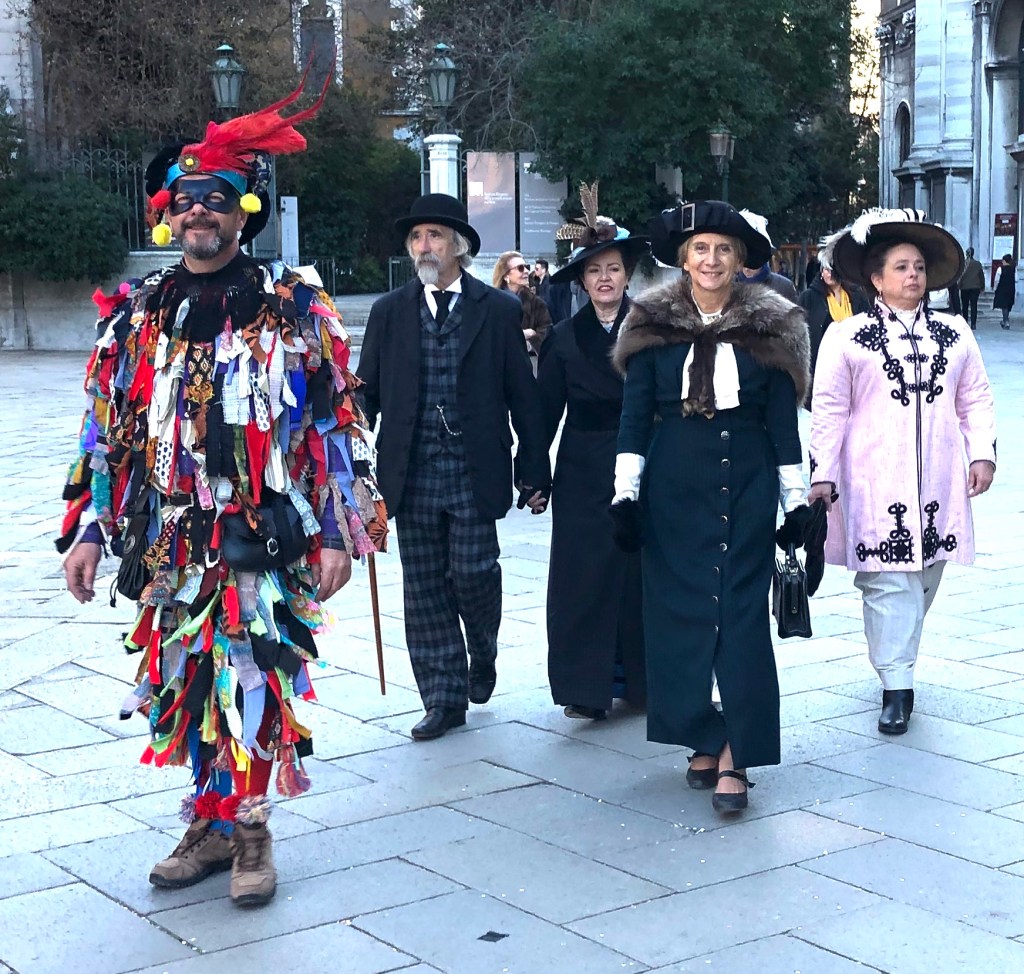
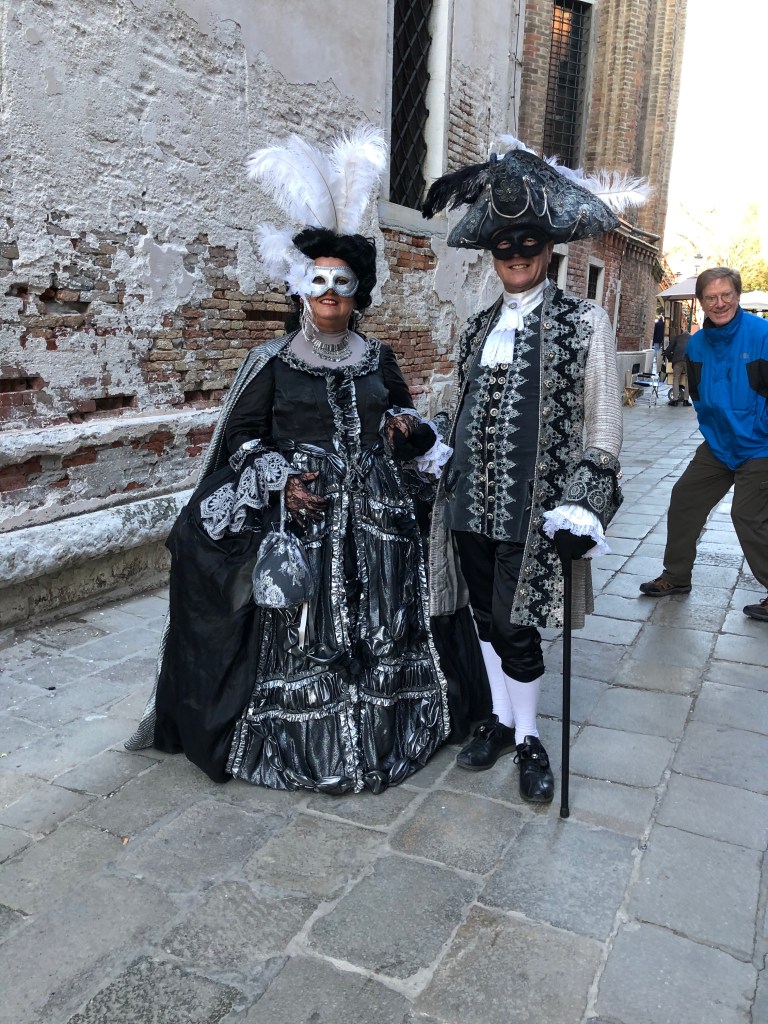
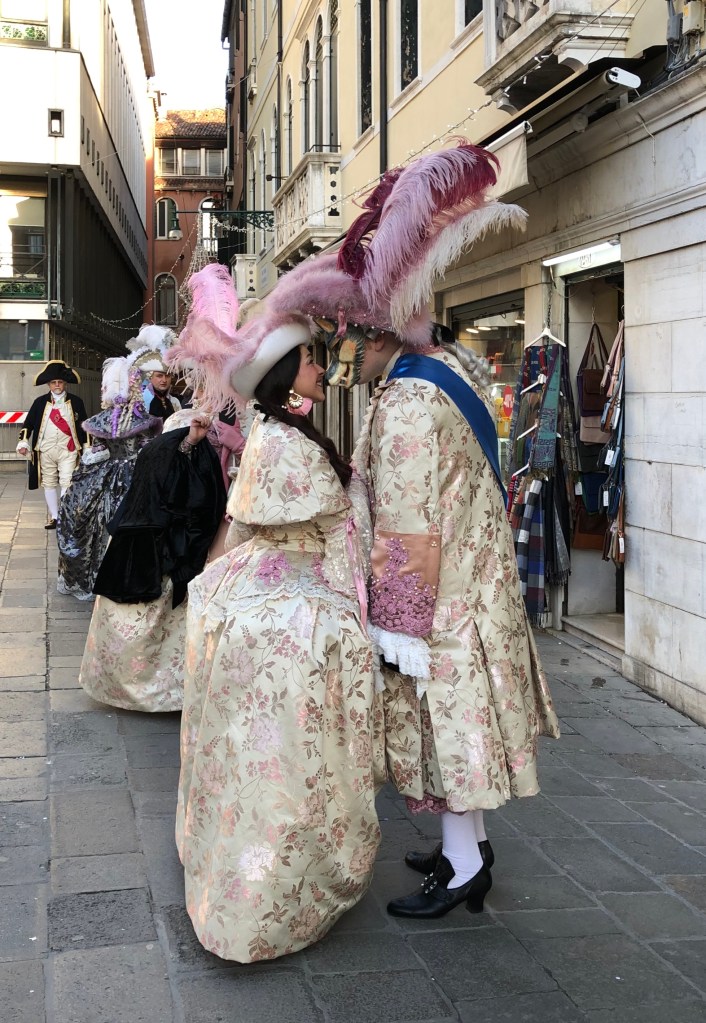
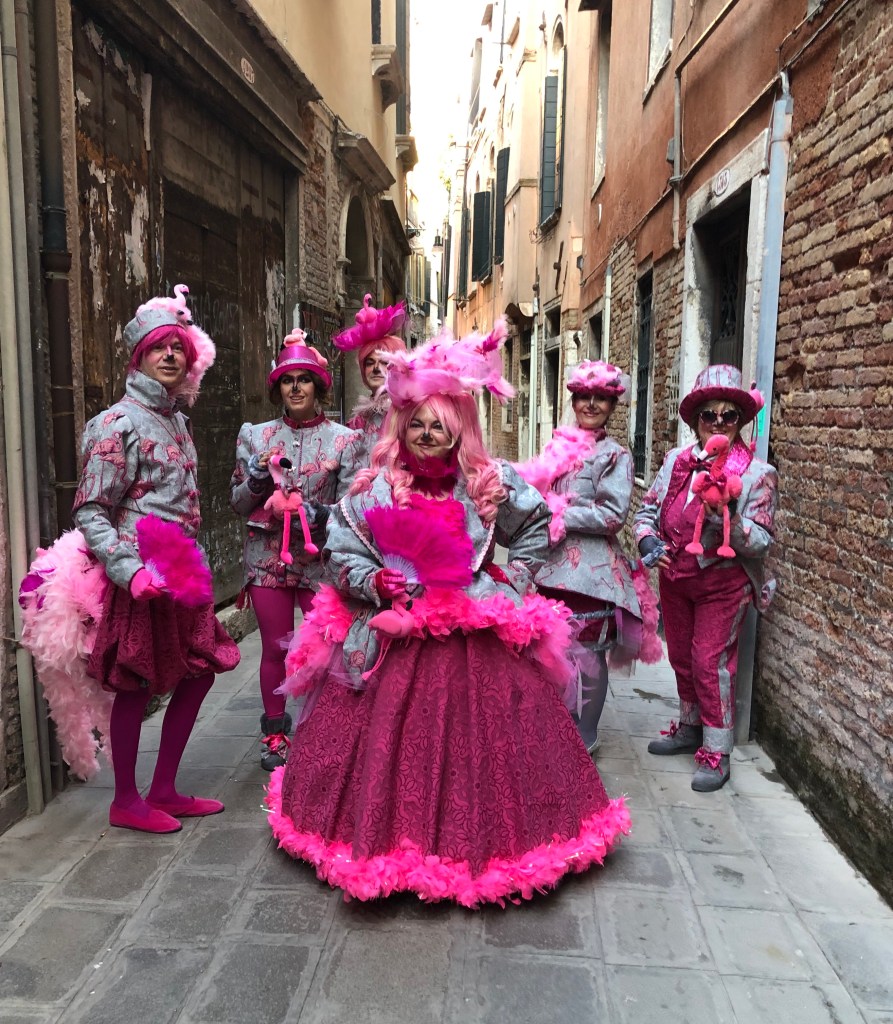
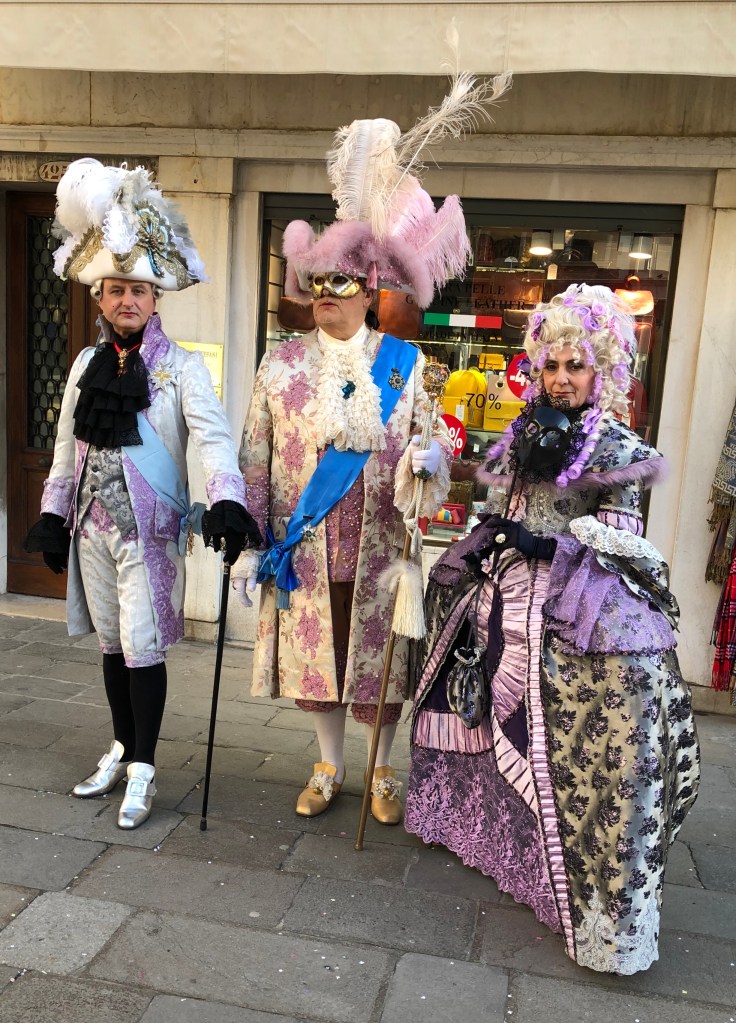
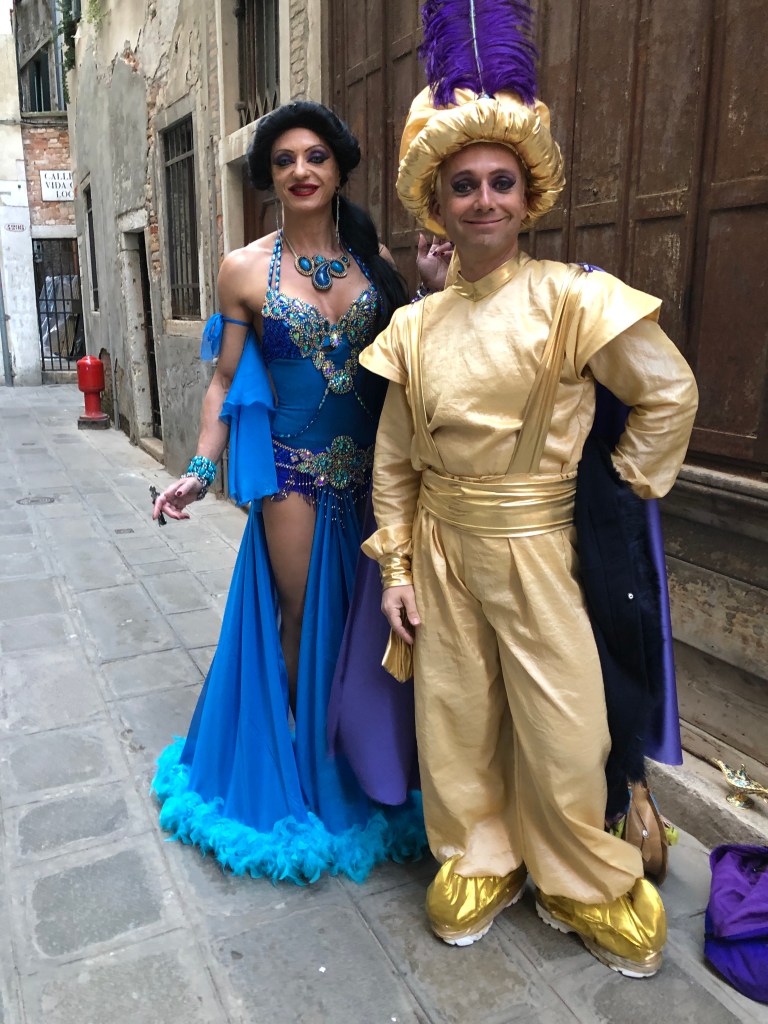
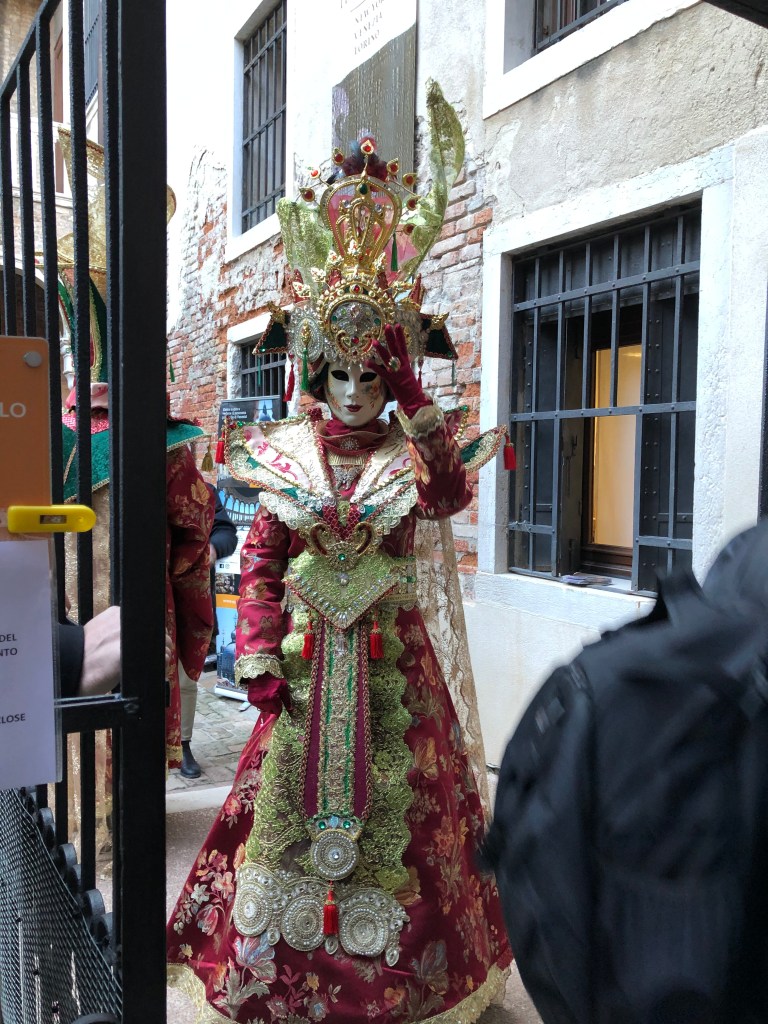
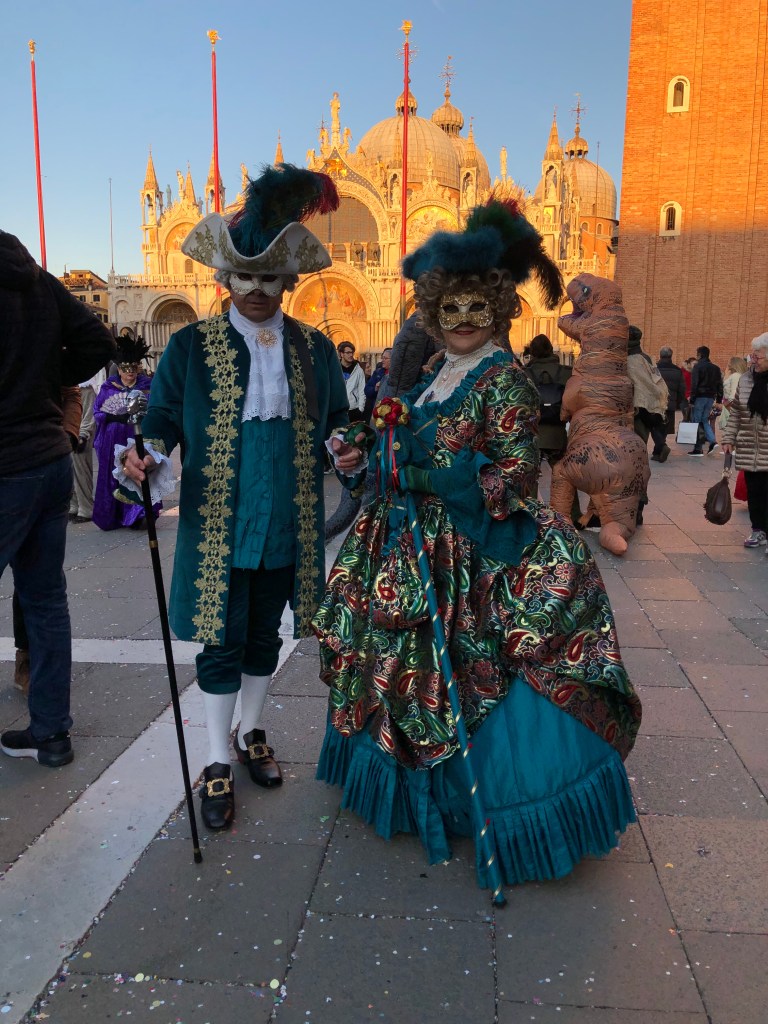
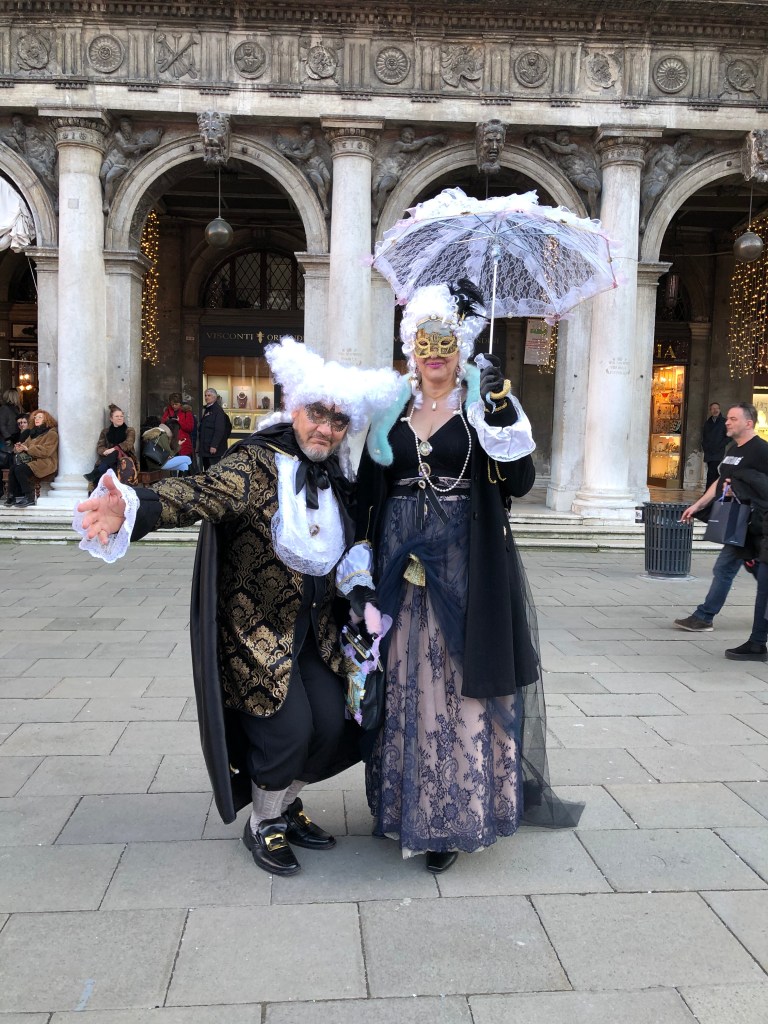
Much like Mardi Gras or…Halloween on the Pearl Street Mall in Boulder, Colorado, people go all out with their costumes. In Venice this year 150 events have been planned with 50 performances, theater plays, parties, concerts, film screenings, exhibitions, guided tours, and workshops.
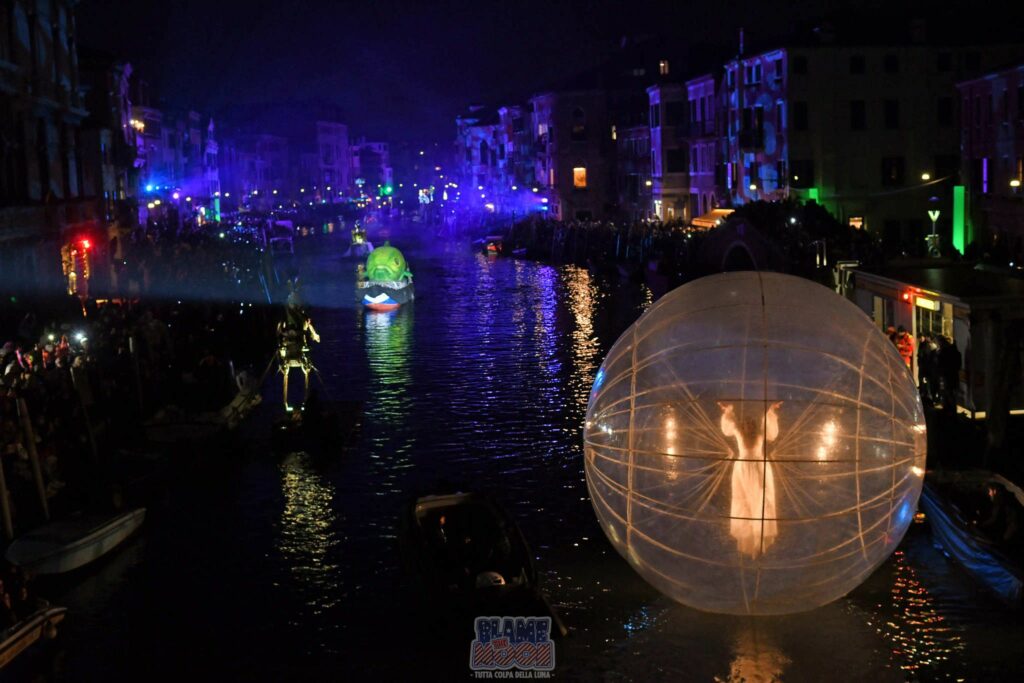
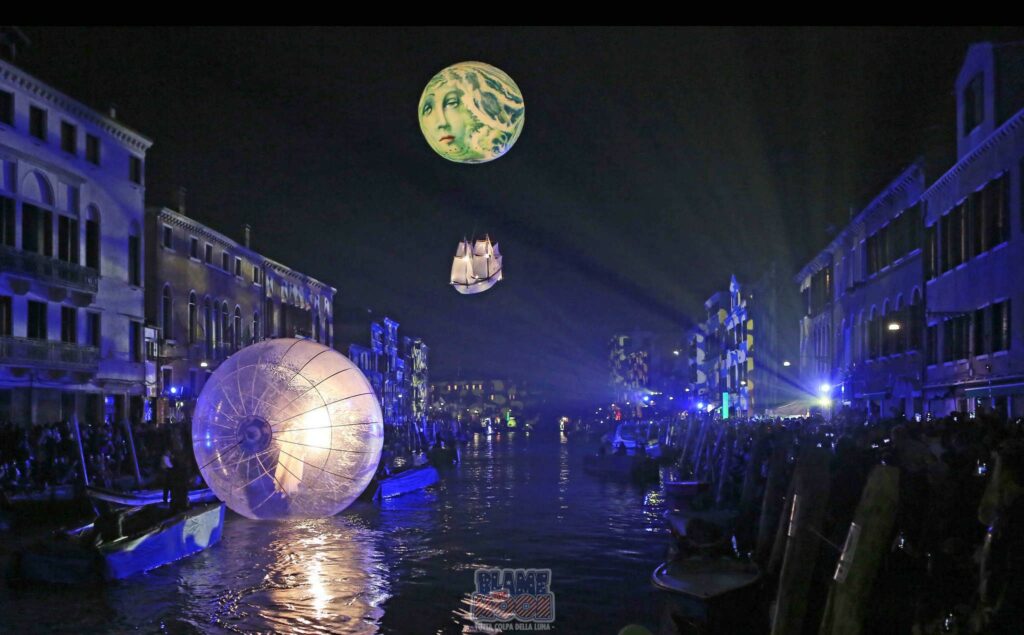
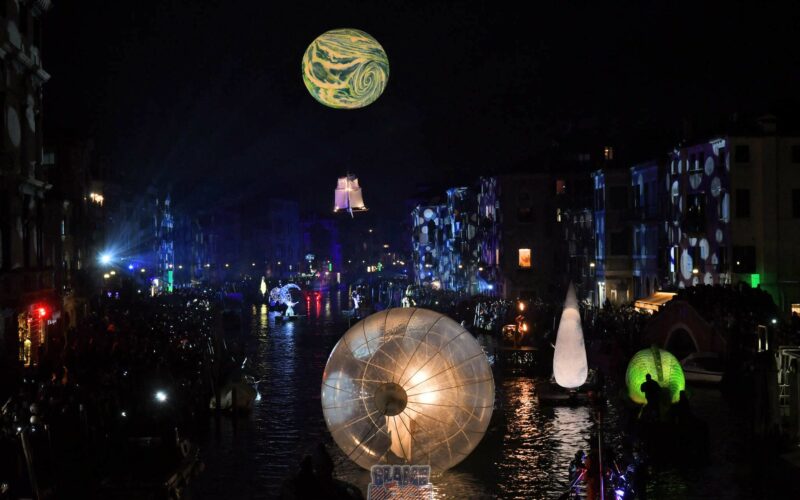
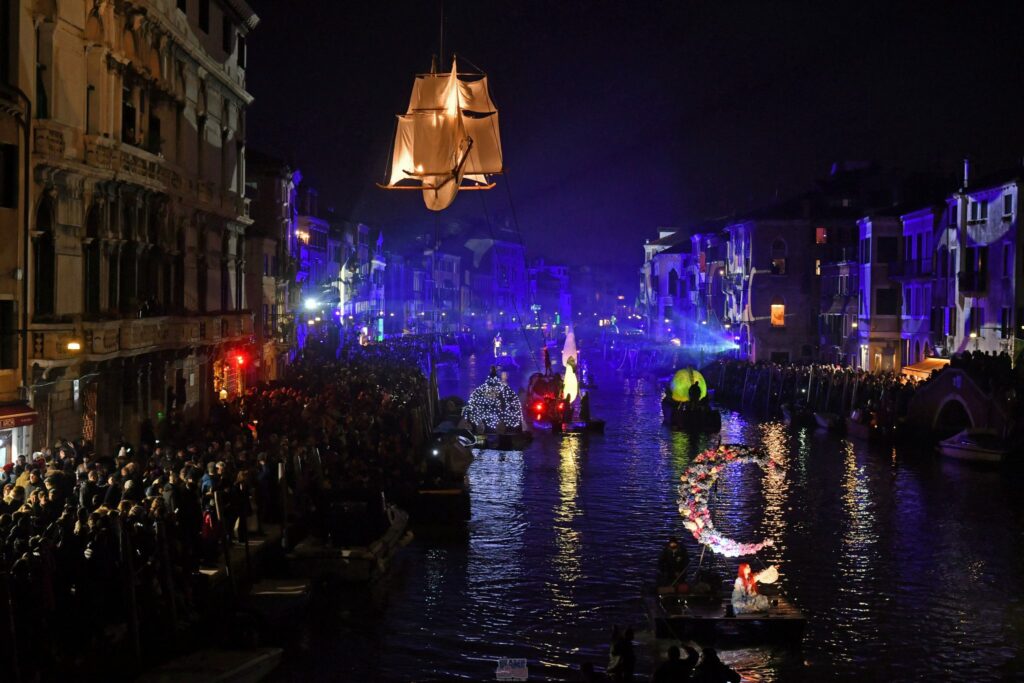
The first event for 2020 was a water parade on the Rio di Cannaregio canal.
These are a few pictures I took this weekend.
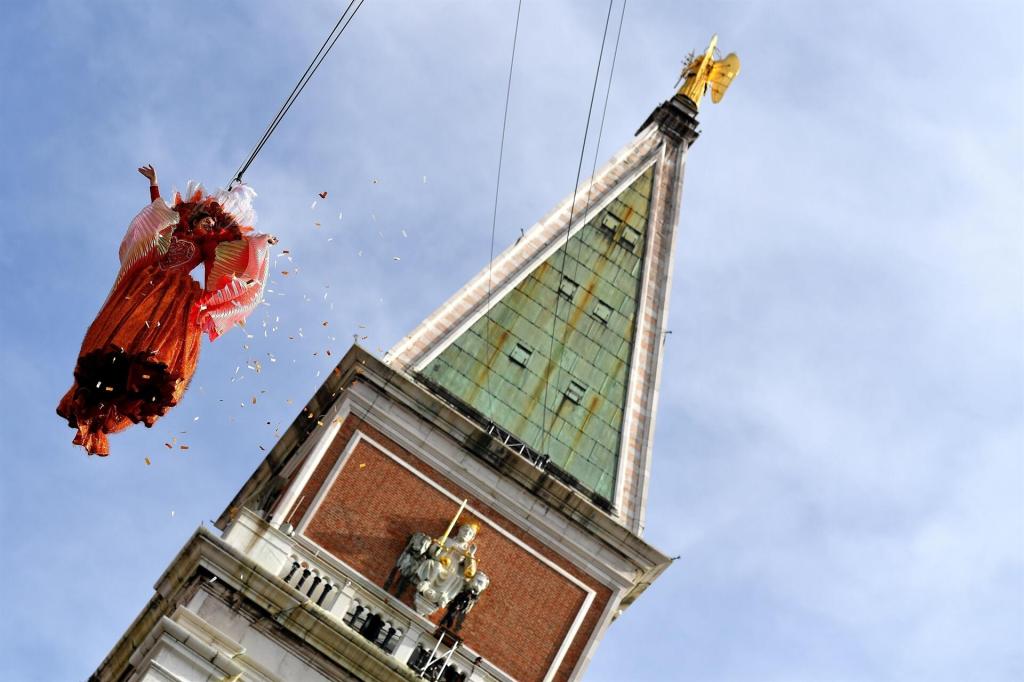
The Flight of the Angel
For centuries this “party” lasted for 6 weeks (Dec. 26 – Ash Wednesday) and always took place in St. Mark’s Square. Costumes are a memory to the past. The Latin term “carnem levare” (Carnival) means refusing meat or farewell to meat. We all know about the 40 days of Lent and fasting before Easter. The word “Carnival” first appears under the ruler Doge Vitale Falier in 1049. The idea was to give the lower classes a time of fun and parties. By 1162 the victory of the Republic against the Patriarch of Aquileia allowed dancing in the square. In 1296 this festival was declared a public holiday. By the 17th & 18th centuries it became official in the Renaissance as a way to save the prestigious image of Venice. After the fall of the Republic in 1797 there was an abolition of many traditions, and so Carnival in Venice died….for 200 years! Then….in 1979 it was revived since there are 3,000,000 visitors a year here!
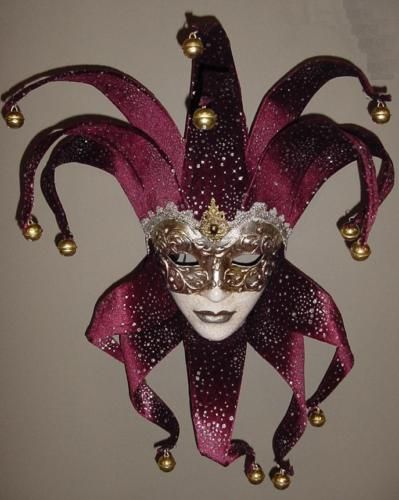
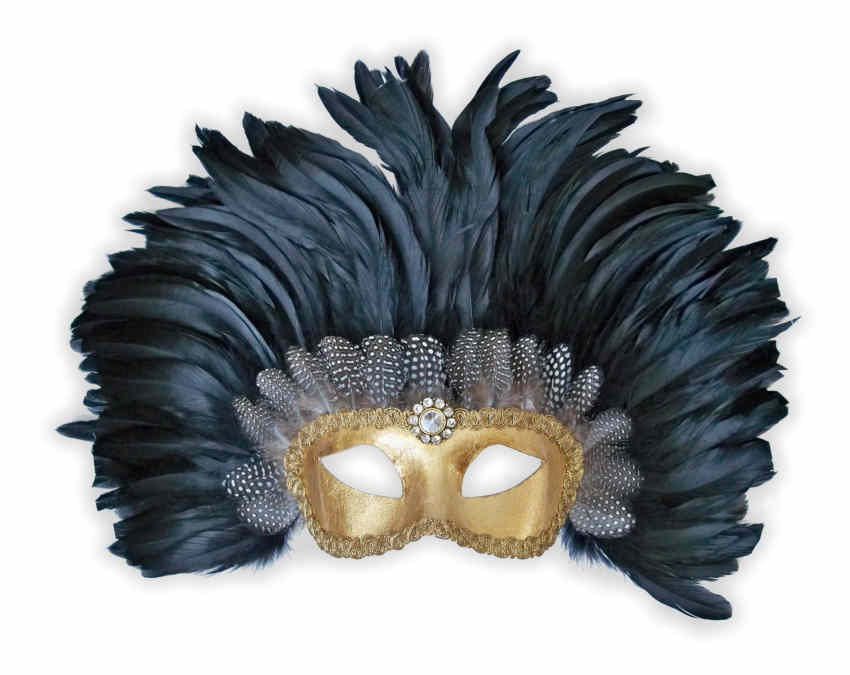
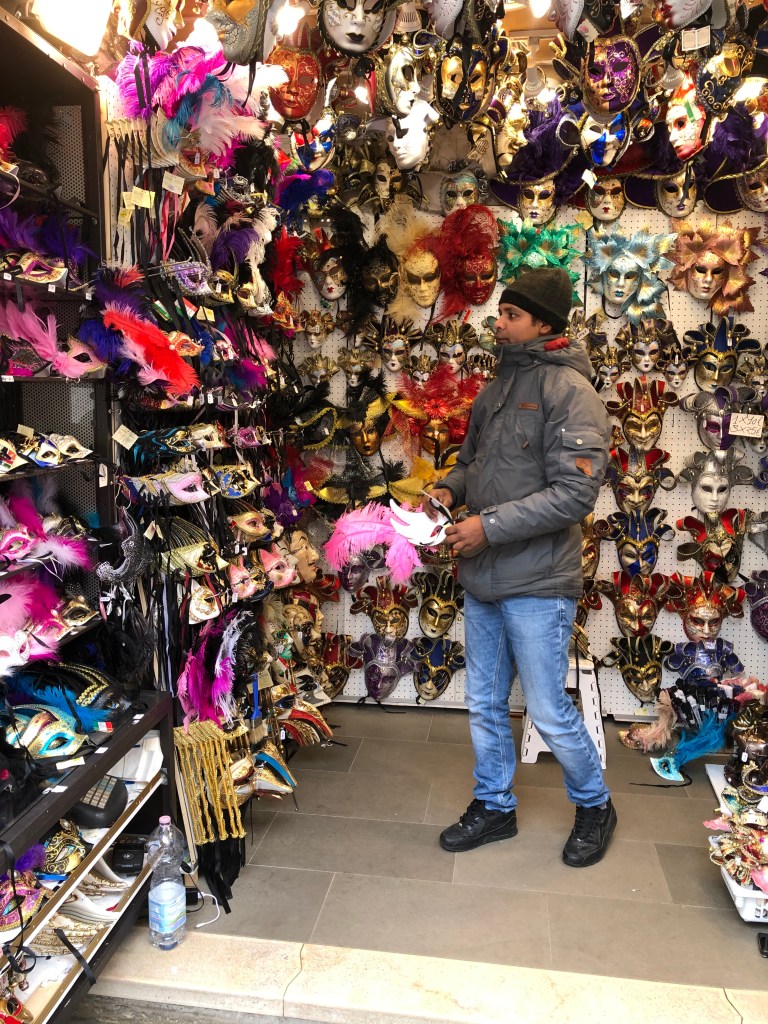
“The Most Beautiful Mask” contest happens each year. Because of this necessity, the art of mask-making has been revived. During the peak of Carnival, masks offered people the opportunity to be anonymous. Classes could mix! Mask wearing was happening from the Ascension to mid-June, during major events, and elections of doges. Then people figured out they could vent tensions, hide weapons, and commit crimes. Laws were then made. In 1339 there was a ban on masks at night. Men could not dress as women to enter convents and commit indecent acts. There are records that a decree was made in 1458 to stop that! Finally, by August 1608, a decree was made that masks were no longer permitted except during Carnival otherwise men faced two years in jail and women were whipped! Huh!
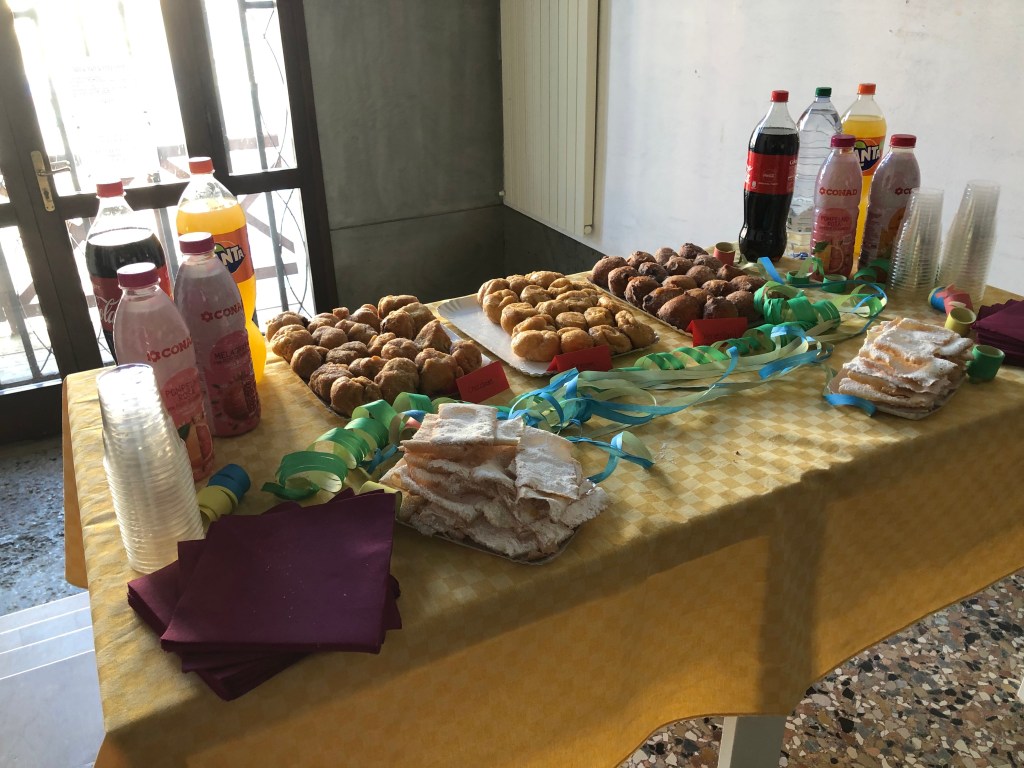
Our History of Art professor gave a power point presentation and a surprise of sweets on Thursday!
Common costumes:
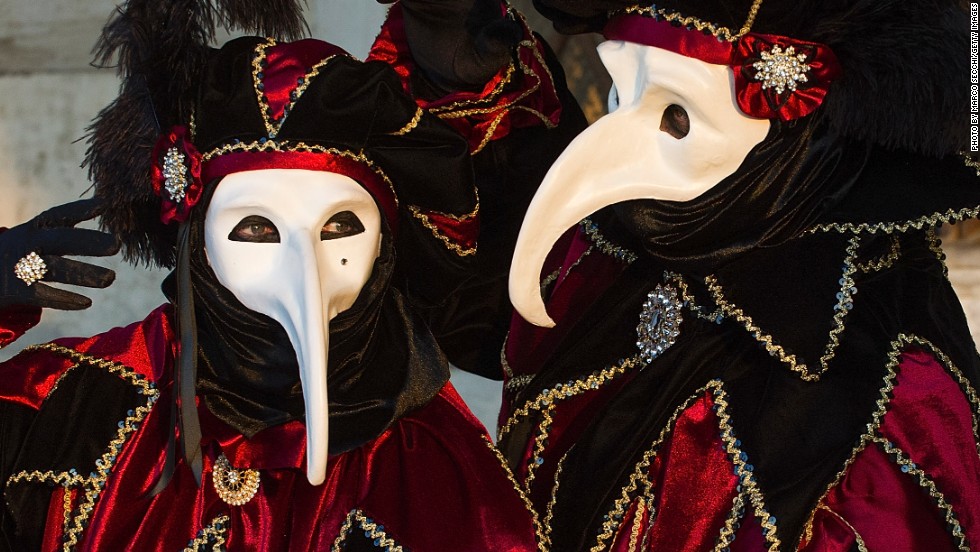
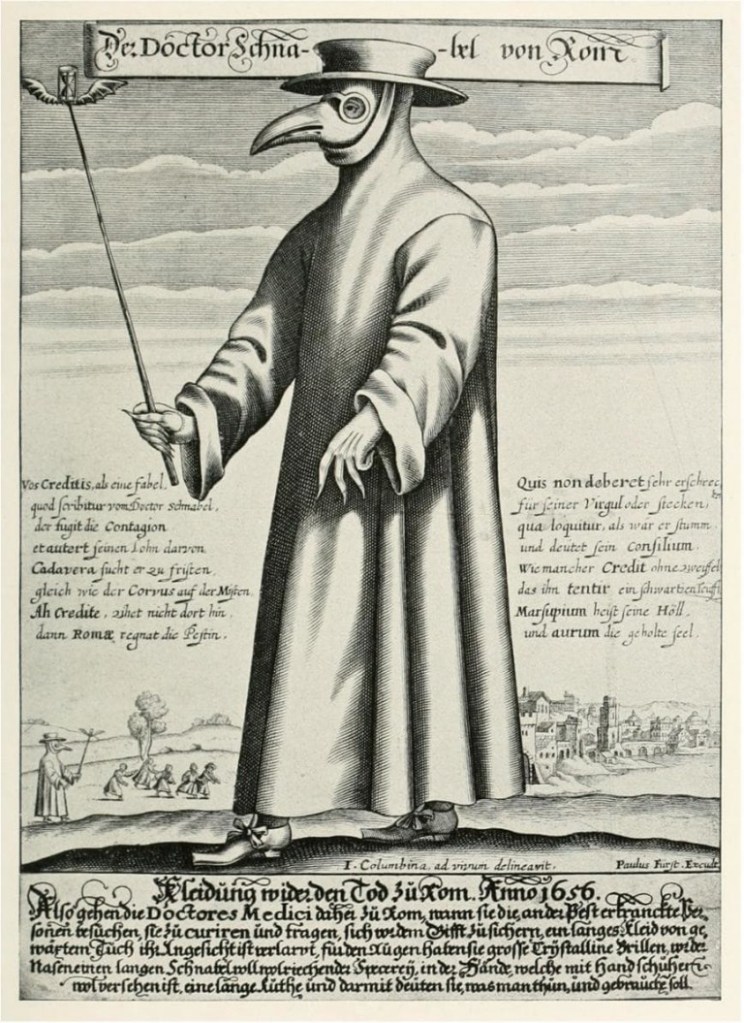
The Plague Doctor – black cloak, black three-cornered hat, white gloves, white mask with beak that doctors actually wore these outfits during the plague
Moretta – oval mask of black velvet for women
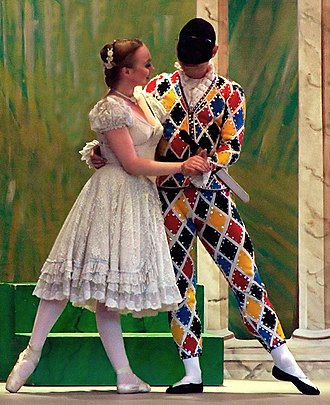
Harlequin – a funny character who wears a mask and a distinctive diamond-patterned costume
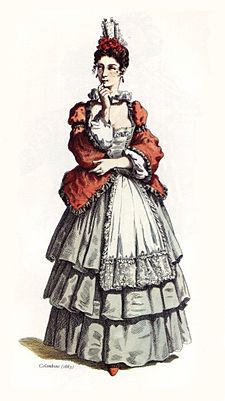
Colombina – Harlequin’s mistress, a comic servant playing the tricky slave type
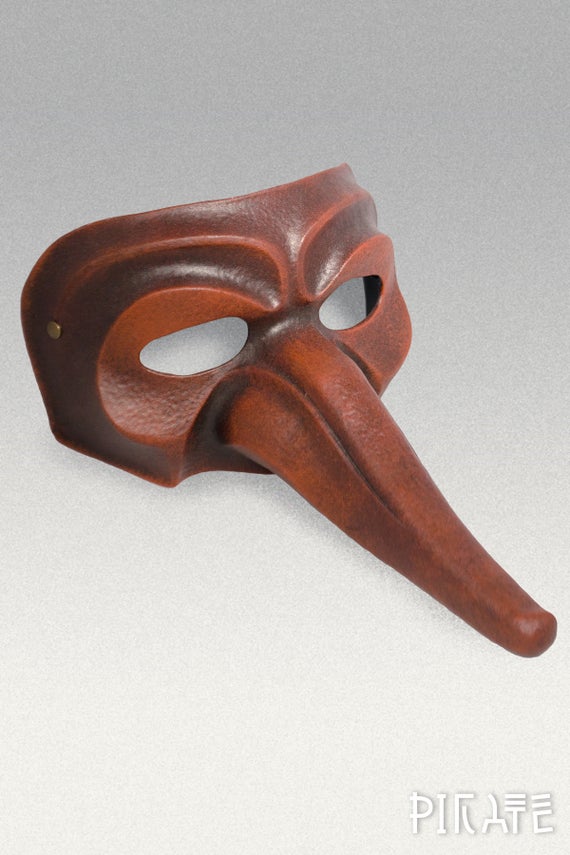
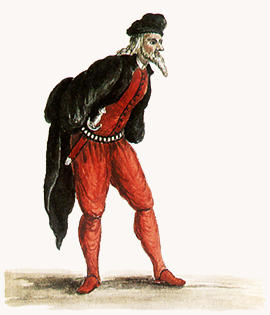
Pantaloon – an old rich merchant half-mask with accents on bony structure, big bushy eyebrows, a long hooked nose, a mustache, and a long pointed goat beard
Events and activities during Carnival: tightrope walkers, bull fights, cart racing, costume parties, “the walk” to show off masks
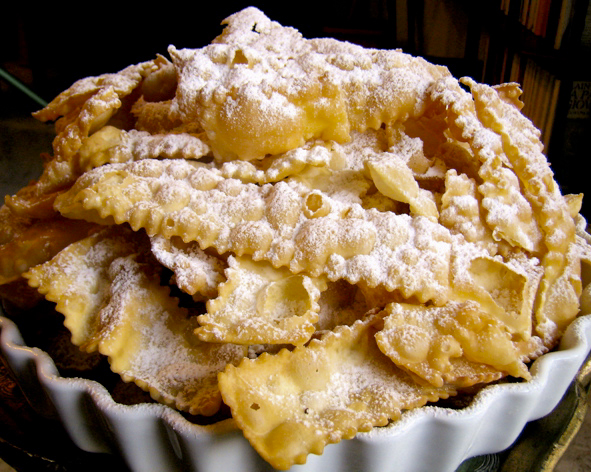
Food: Frittelle and galani (strips of pasta cut in the shape of ribbons and fried in fat)
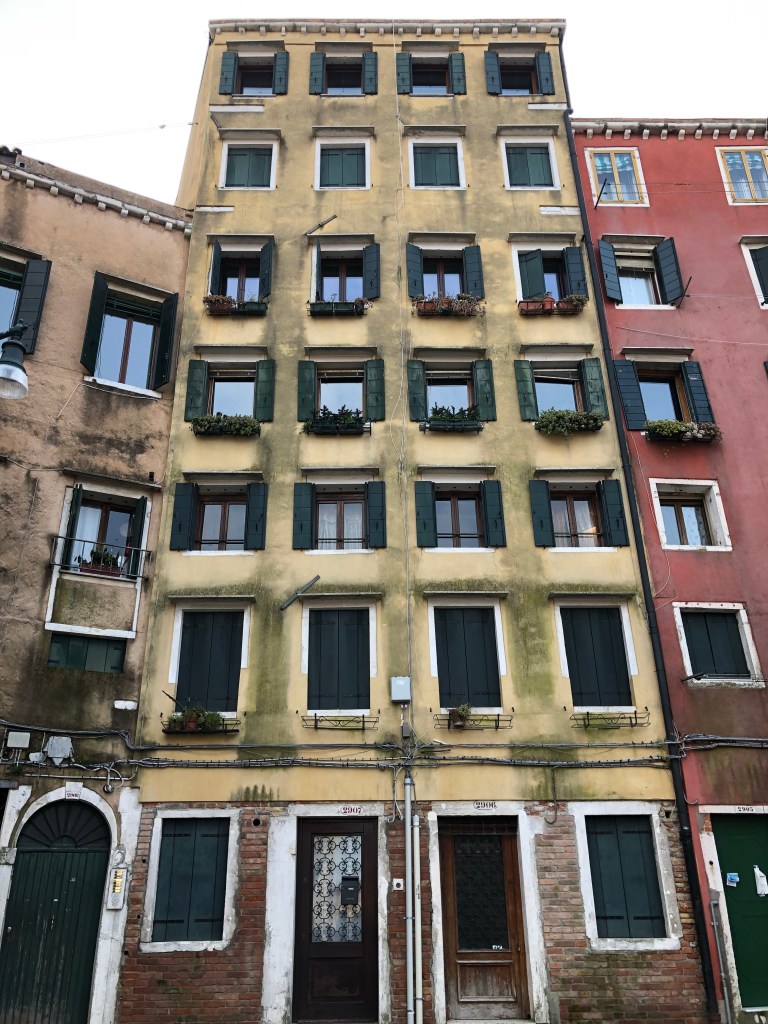
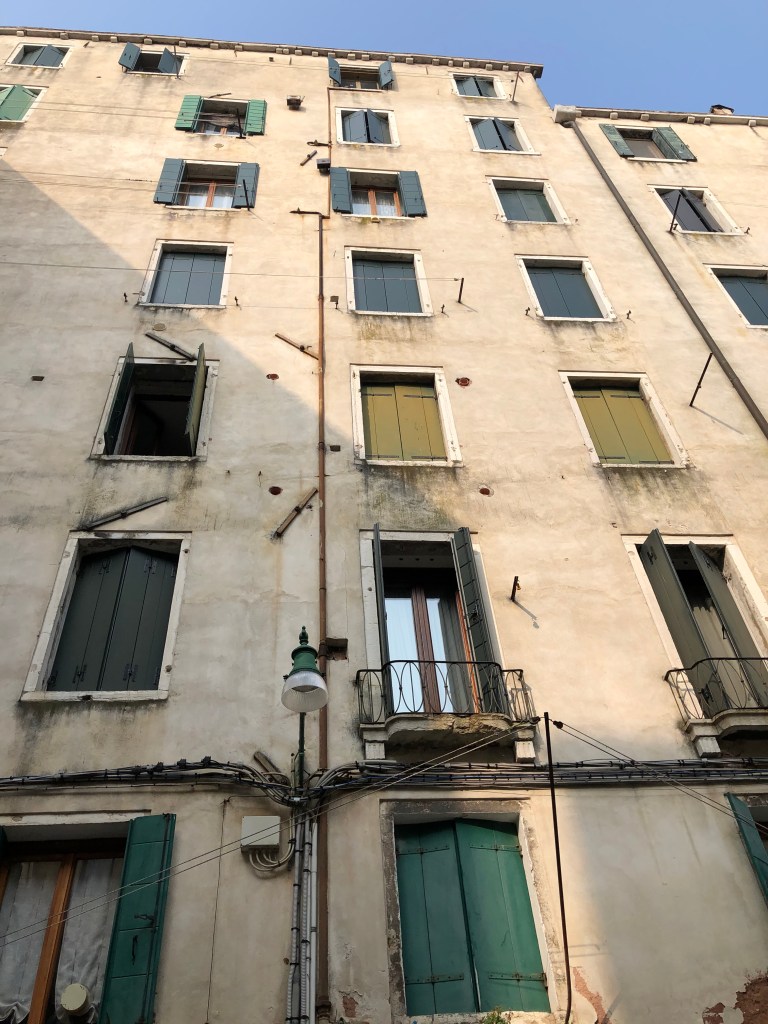
In 1516 all Jews in Venice were confined to an area in Cannaregio. This is the world’s oldest ghetto. Christian guards manned two water gates to this islet. The name “ghetto” was used after a foundry that formerly occupied the site. Eventually, all Jewish neighborhoods throughout the world were called ghettos. The Jews were allowed out of the Ghetto during the day. The only trades they were allowed to pursue were textiles, money lending, and medicine. They were not allowed to own property. Even back then they had to wear identifying badges and caps. As their numbers grew the Ghetto had to expand so buildings rose vertically. By the mid-1600s they numbered over 5,000 people. It was not until 1866 that they were granted their freedom. Of the 500 Jews now in Venice, about 30 live in the Ghetto.
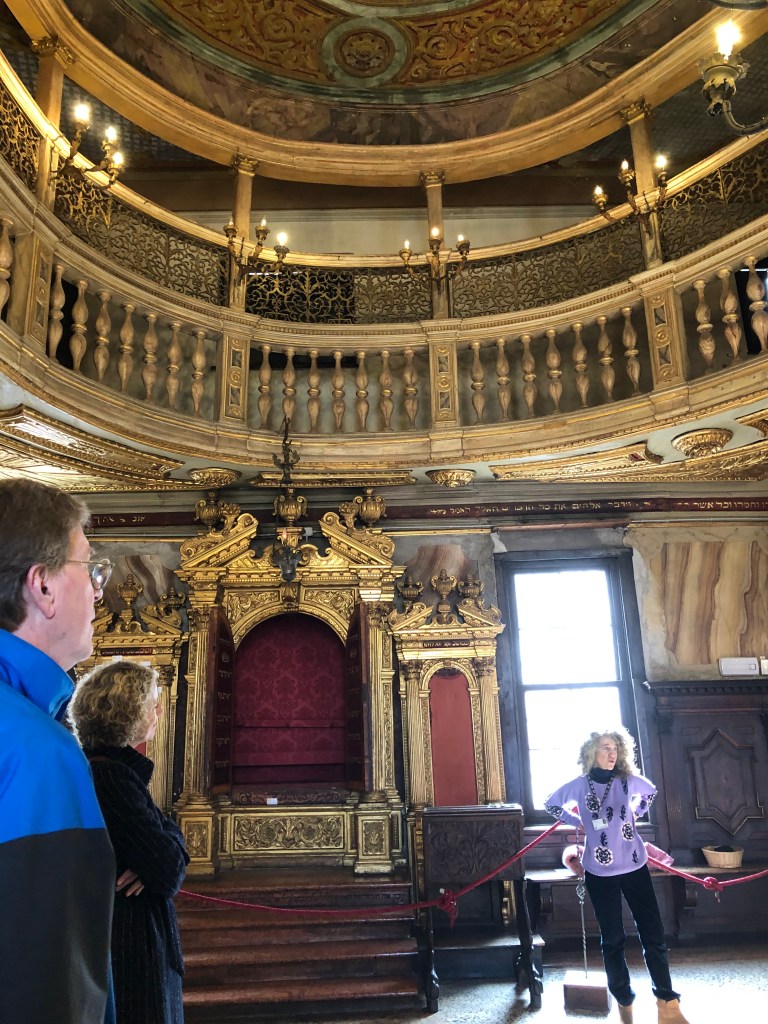
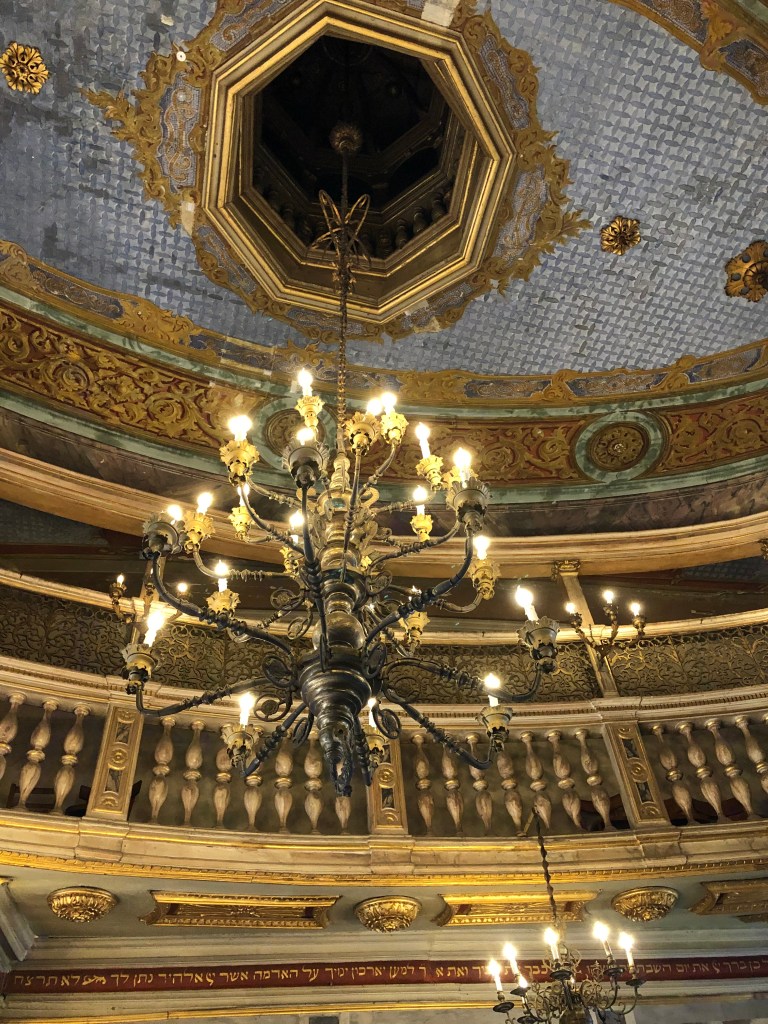
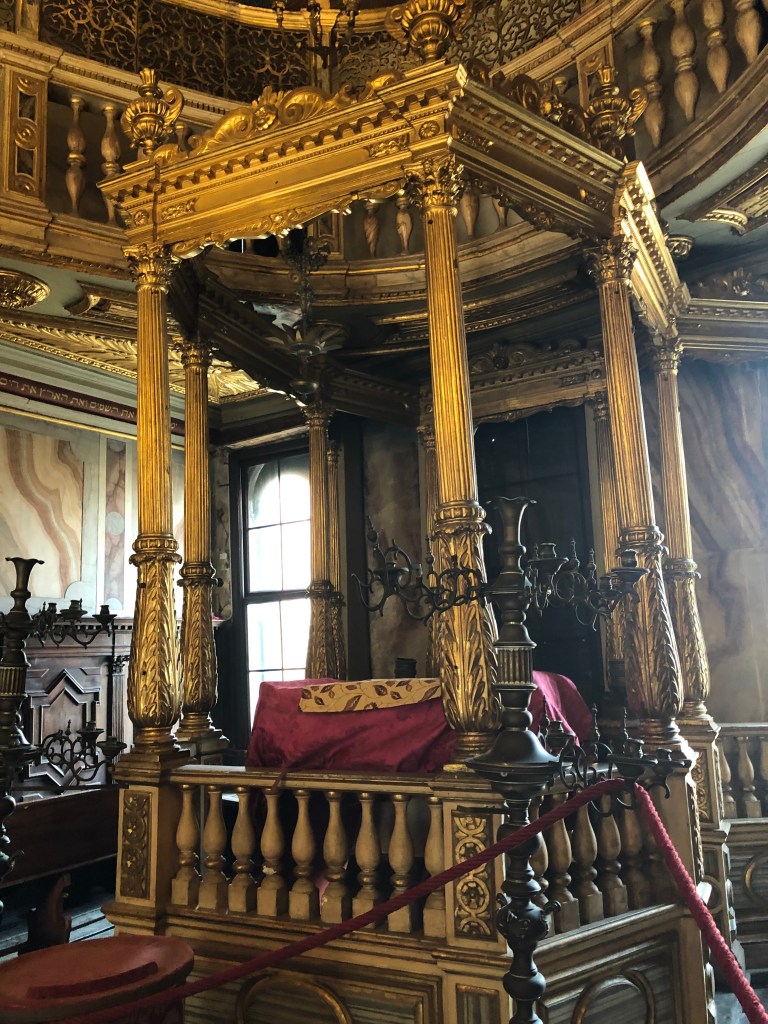
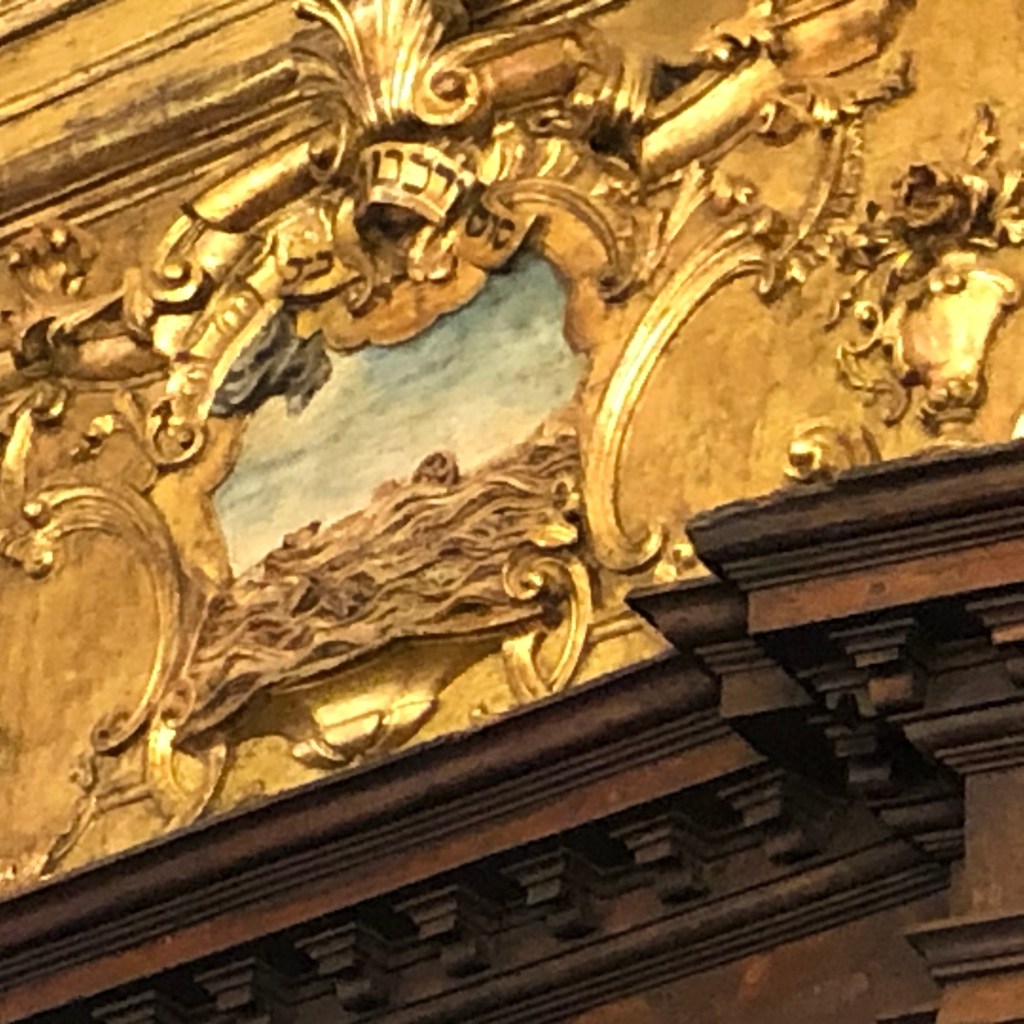
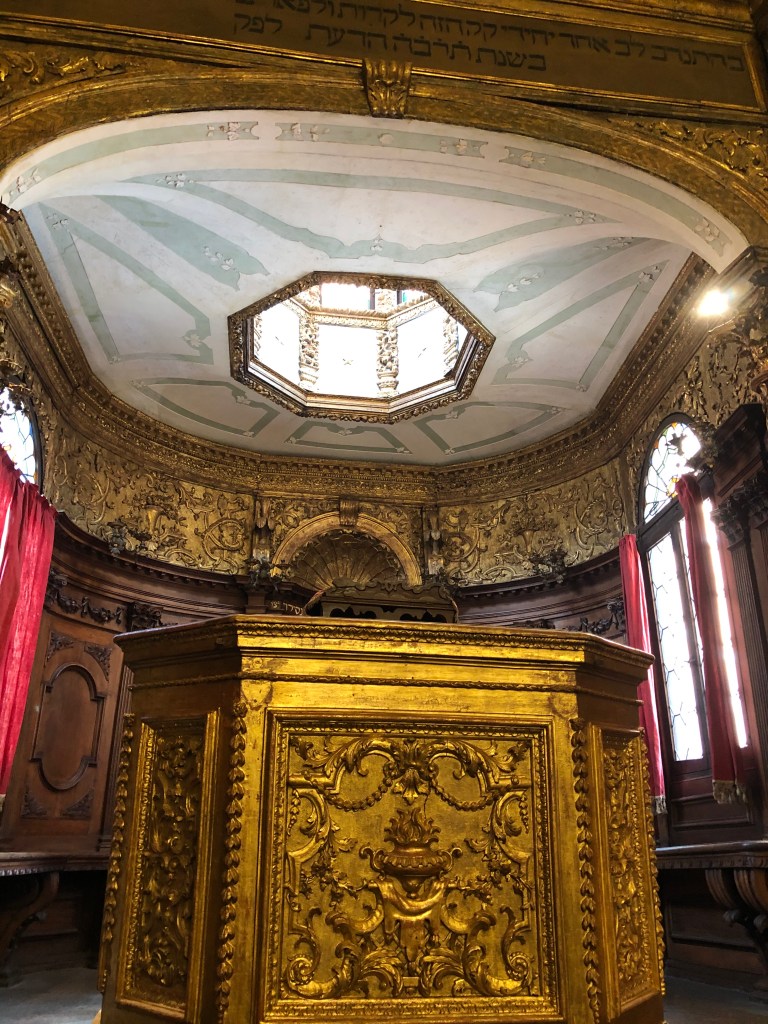
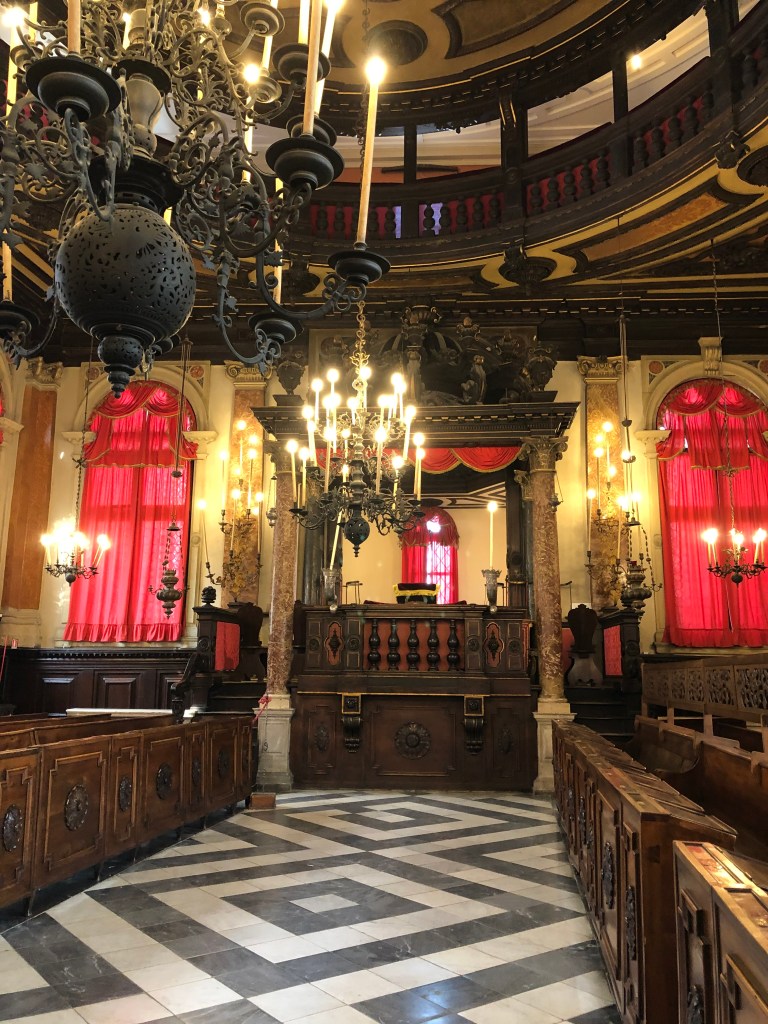
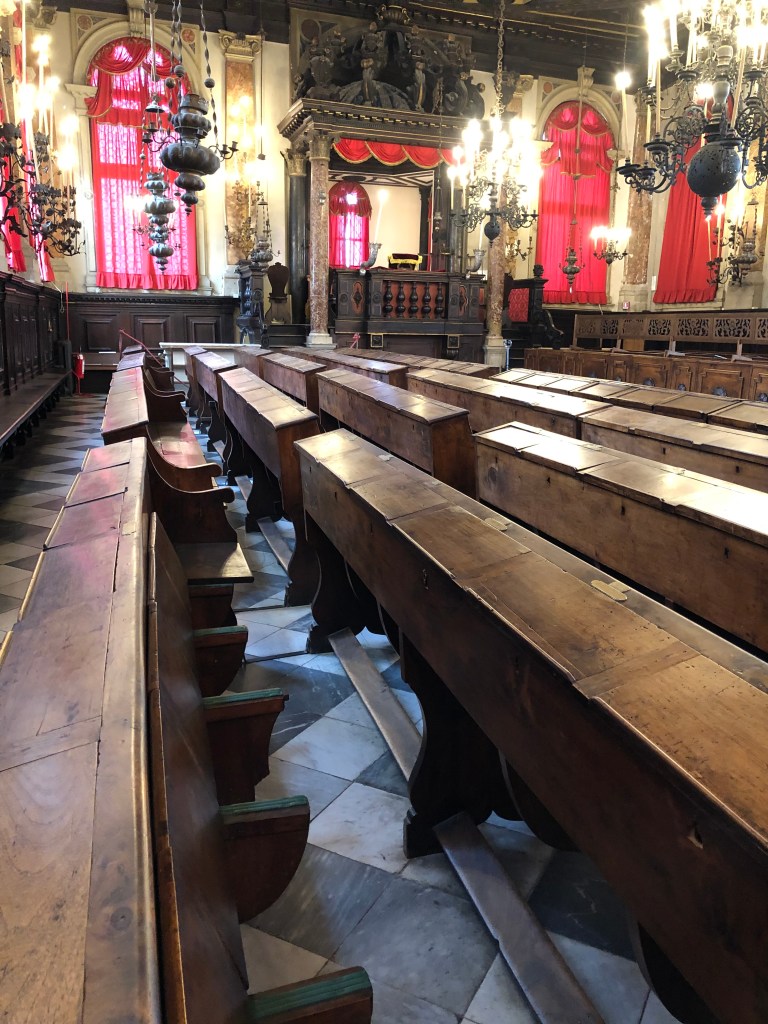
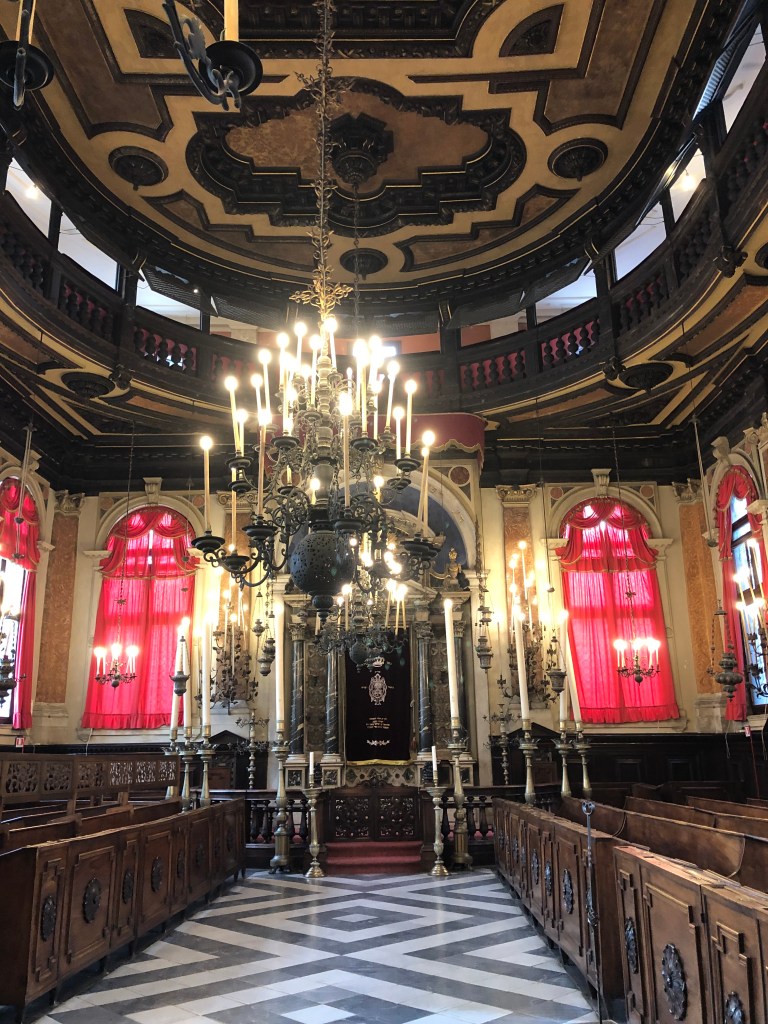
We entered the small Jewish Museum to see artifacts and two centuries old synagogues inside two tall old buildings. The elaborate décor hidden inside would never be revealed from the outside of the buildings. This room was built in 1528 with gold and fake marble. Women could only be up in the balcony.
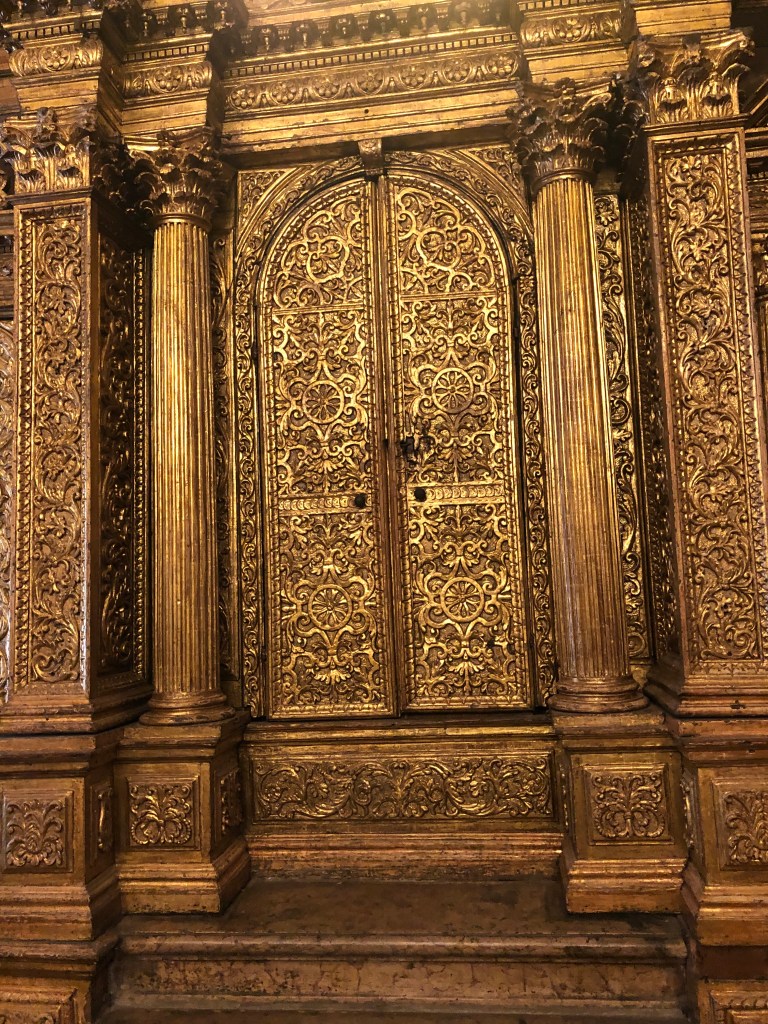
This room was built in 1531 as a French synagogue. There were images of the Exodus on the walls, but never images of people.
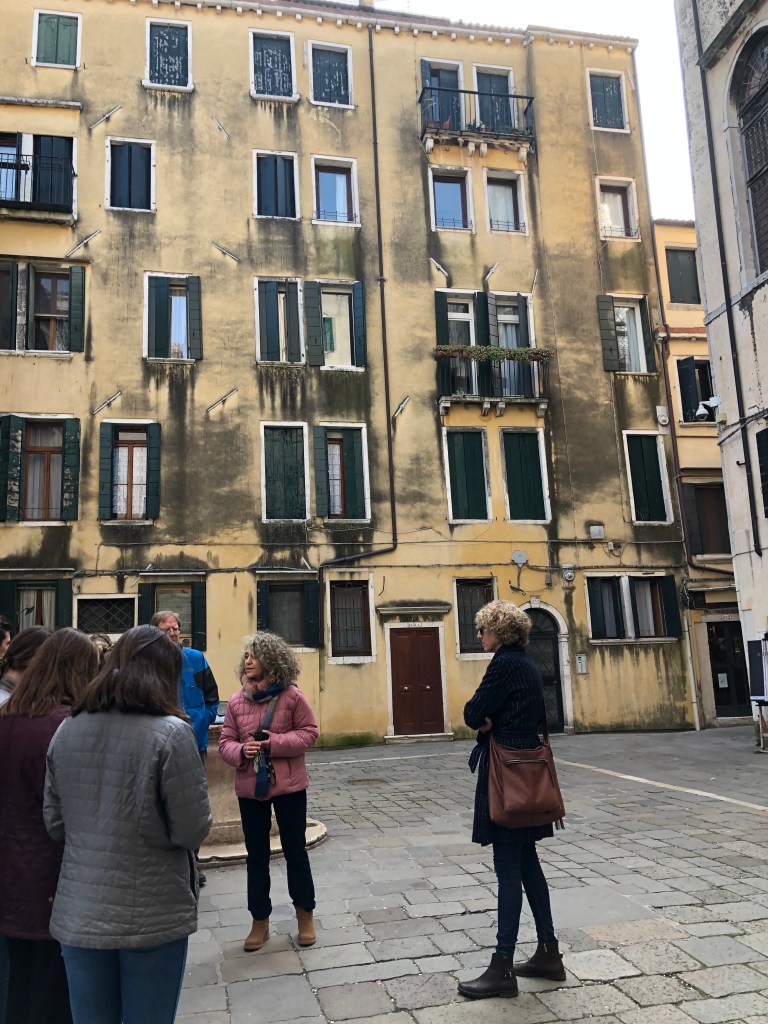
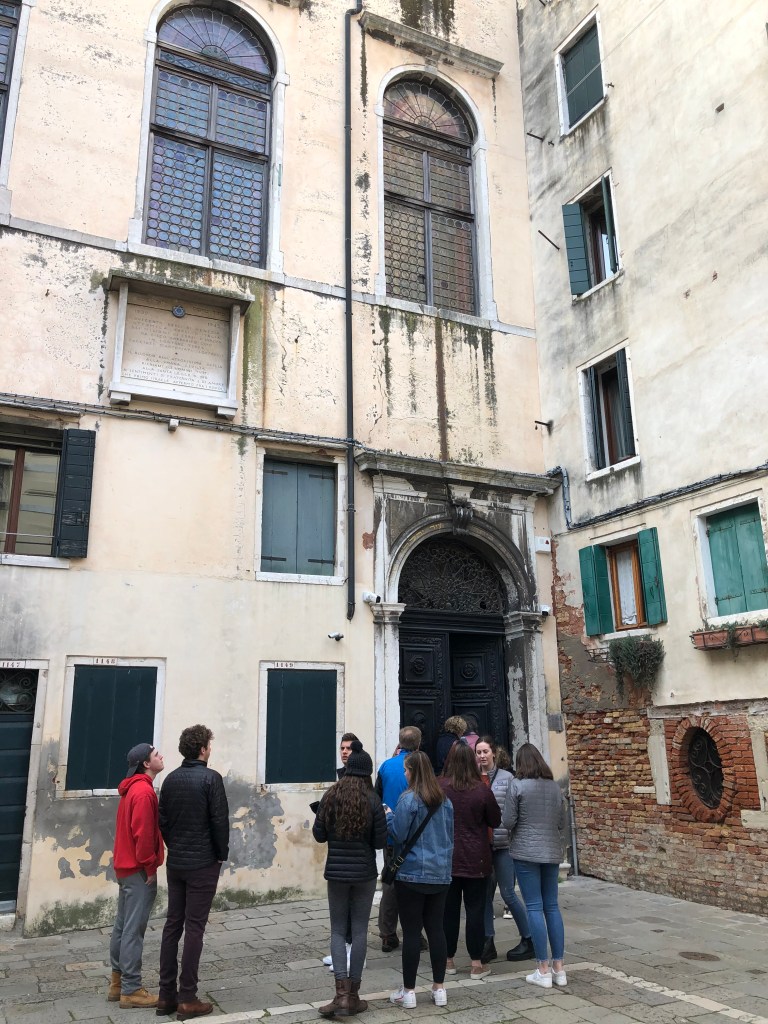
You would never guess such a beautiful synagogue, Scola Levantina, would be housed inside this building. Here our group is gathering by the front door. The following pictures are the inside!
It’s pretty tough finding your way around Greece, if you do not encounter anyone who actually speaks English. I belonged to a Greek society in college, but knowing the call letters for my frat, chi psi, in no way prepared me to get about Athens.
I did manage to learn how to say thank you, as something like “ef churiasto.” Otherwise known as σας ευχαριστώ. OK.
On the other hand, we did learn that many words and phrases we use today had their origins in Greek, the language today that is the same language approved as the official language way back when. Seriously, Alexander the Great issued an edict in the 4th century BC about what language would be spoken across Greece and its neighboring provinces. That is still spoken today. Turns out the Latin-based languages, of which English is derived, were often based on Greek roots.
I mentioned in an earlier post about “acropolis” meaning high city. Hence we have acro-bat, or acro-phobia, each representing things having to do with high. Then I also mentioned that “stoa” was the place where people shopped, what we now call the store.
There are other words that fascinated me.
Barbarian. The Greek language is loaded with hard consonants and often spoken gutturally. Sometimes hard to listen to when it is spoken fast. Greeks used to call foreigners who did not speak Greek by the word “barbar,” which insinuated those from someplace else who spoke with softer words. So barbarian was a foreigner. It was only later in history that it came to mean an evil foreigner.
We visited a burial mound in Mycenae called a “tomba.” Hence, our word tomb.
The Greek word for abode – actually floating house, referring to boats and such – is something akin to “naus.” Hence, our aurally familiar word house.
The town of “Delphi” was named after Apollo turned himself into a dolphin.
The Greek letter “delta,” which we use to describe the change from the river to the sea, when used in science stands for change.
When we visited Epidaurus and saw the huge outdoor amphitheater, it was explained to us that the actors in the comedies and tragedies performed there used to step into a tent set up just behind the stage, for changes of costume. The tent was called a “skene,” and today we know this as scene. Since there were no real sets in these original plays, the actors coming on stage in new costumes set the scene.
“Kylix” is the Greek word for cup, which became our chalice.
And when we heard about democracy and voting techniques in ancient Greece, occasionally there were votes to “ostracize” some member from a community. The votes were cast using small pieces of broken vases, called “ostracon.”
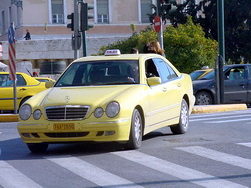
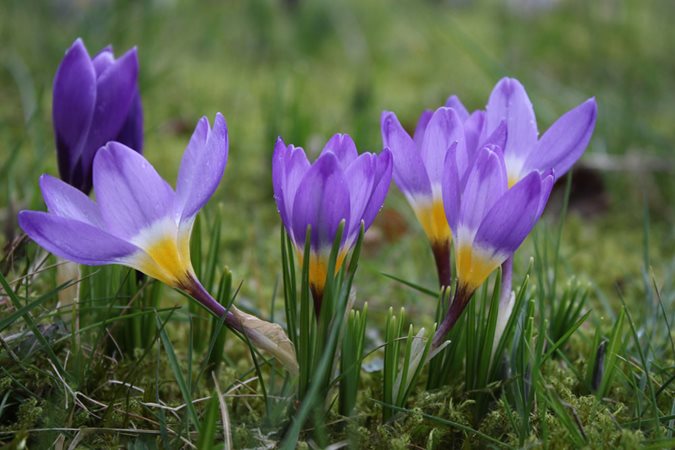
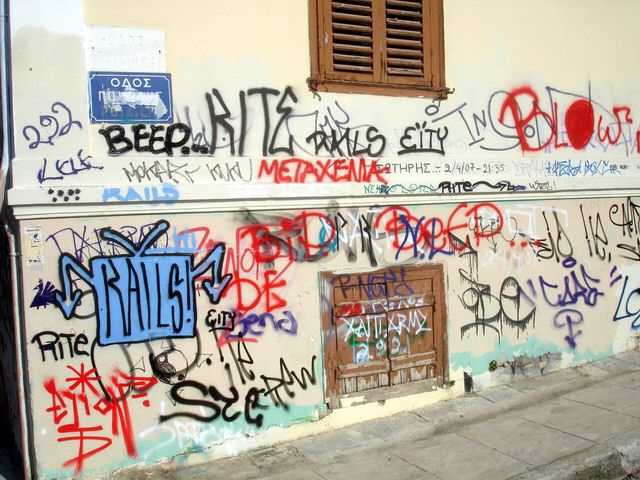
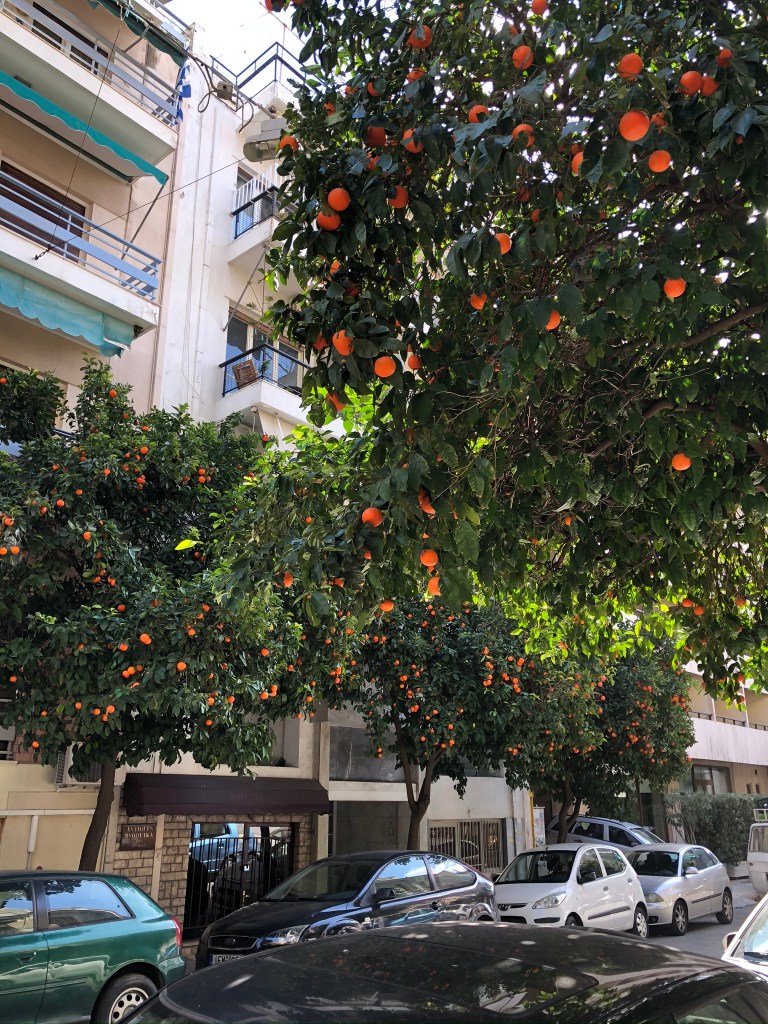
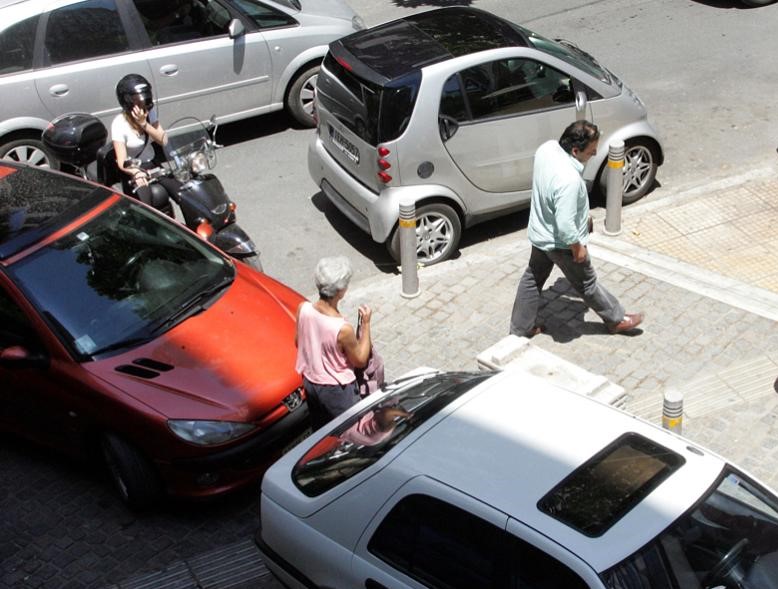
It was early spring when we were in Greece. Crocus were popping up! Athens was full of pale yellow taxi cabs, motorcycles, Smart cars, and all of them parking anyplace along the streets. Sadly, graffiti was everywhere! However, orange trees lining the streets were a lovely contrast.
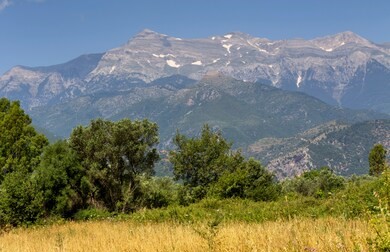
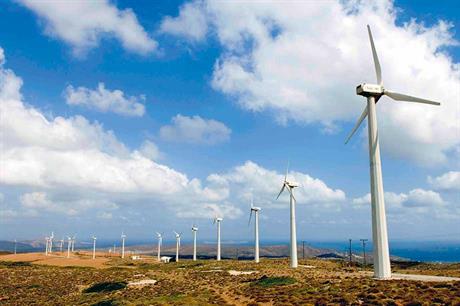
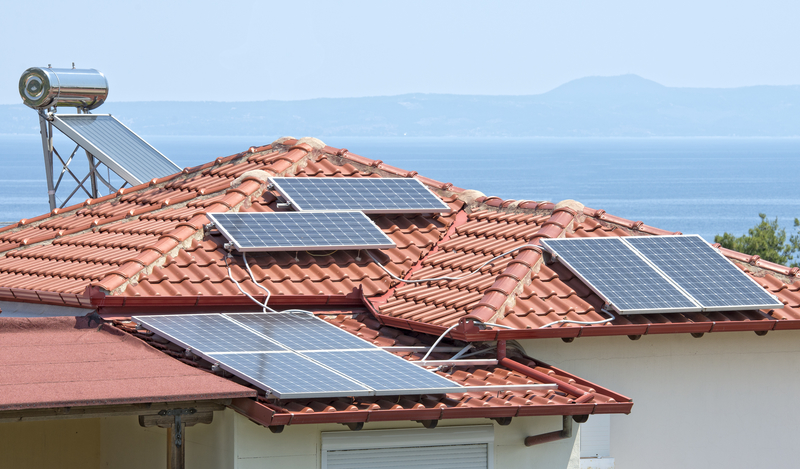
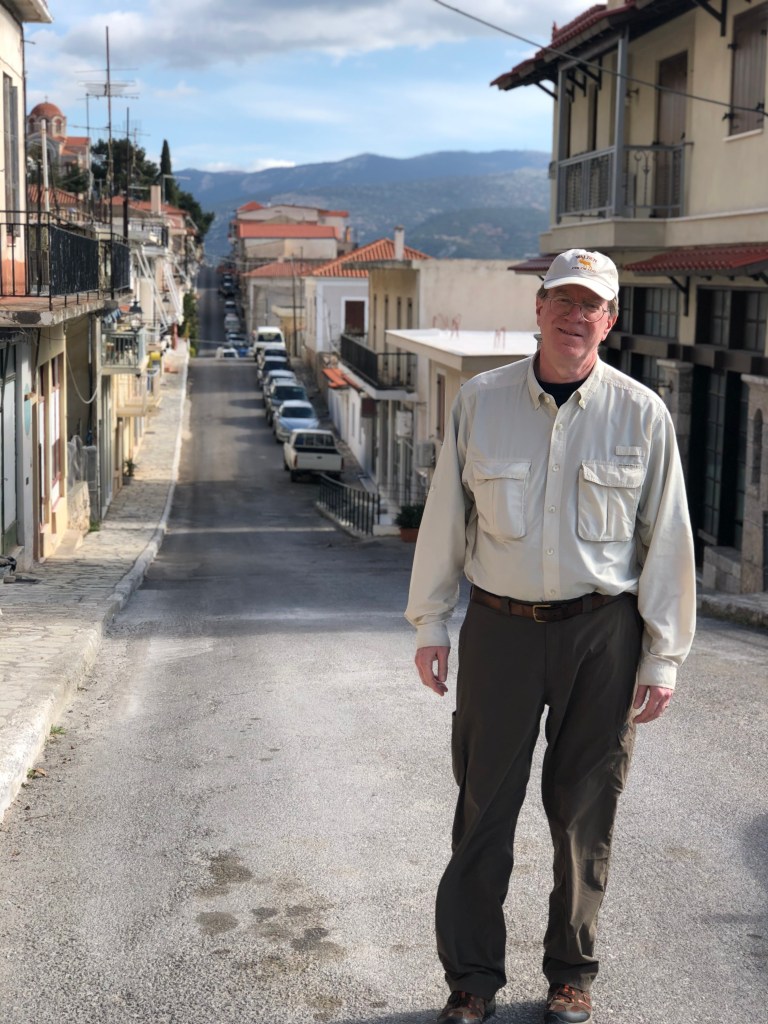
Out in the country it felt like the desert being very dry with scrubby bushes, groves of olive trees, dried up rivers, greenhouses instead of farm land, and mountains everywhere. Small towns had stucco cube shaped houses with wrap-around balconies and red tile roofs. Businesses were deserted. Stray cats and dogs looking for food was depressing. Yet modern wind turbines and solar panels looked encouraging.
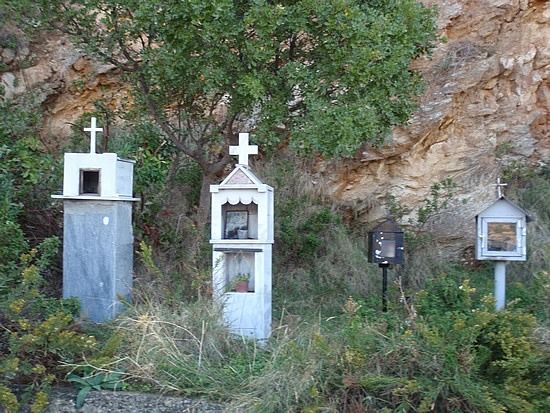
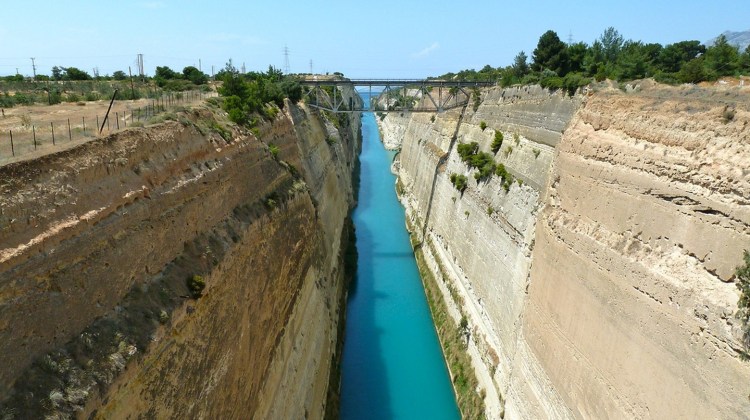
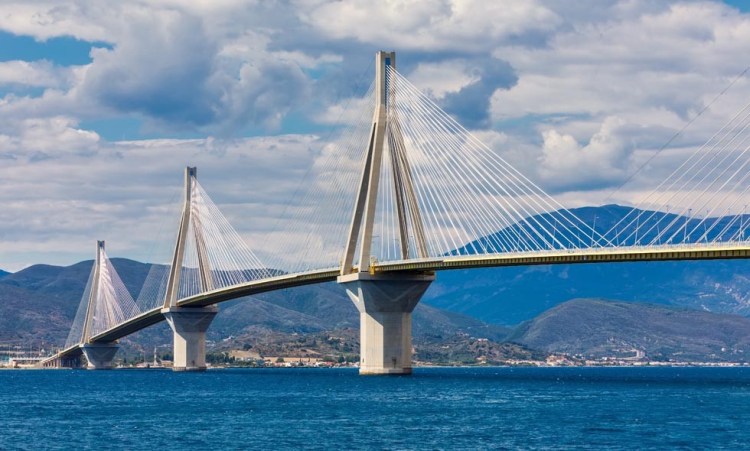
Why were there so many BP gas stations and no others? Religious roadside shrine icons that looked like free-standing mail boxes were interesting. The Rio Bridge and Corinth Canal were stunning, but the Parnassus Ski Resort was without any snow!
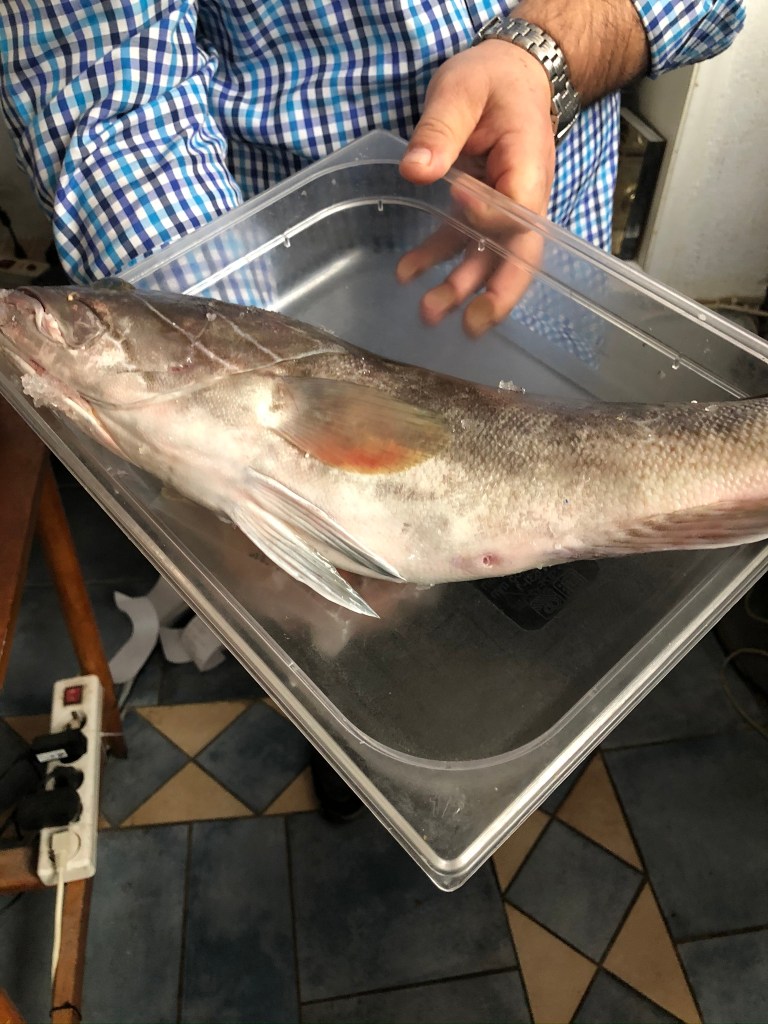
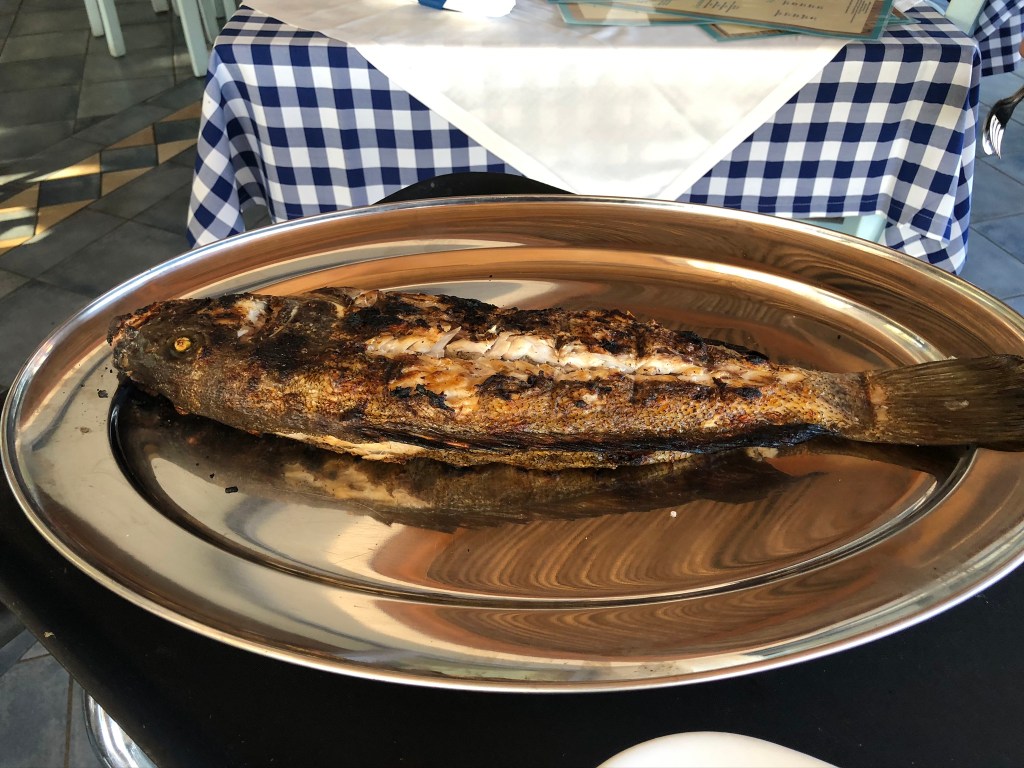
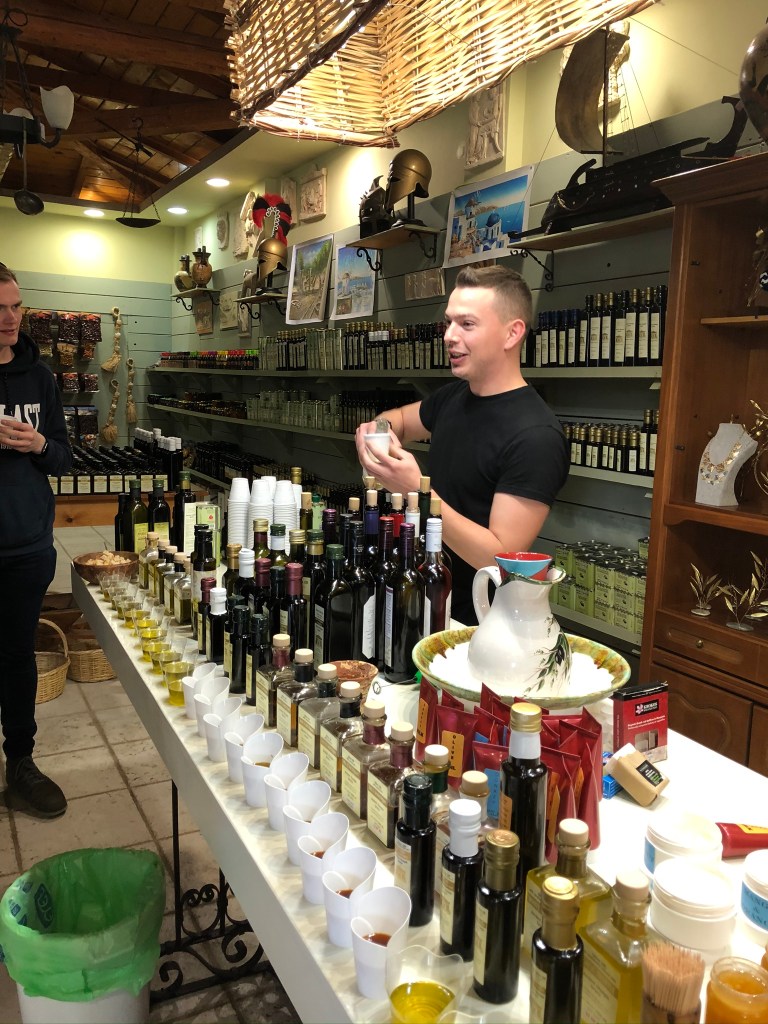
The food was wonderful: feta cheese, moussaka, lamb, gyros. Check out this grouper we had for lunch one day! Just caught that morning in the Aegean Sea!
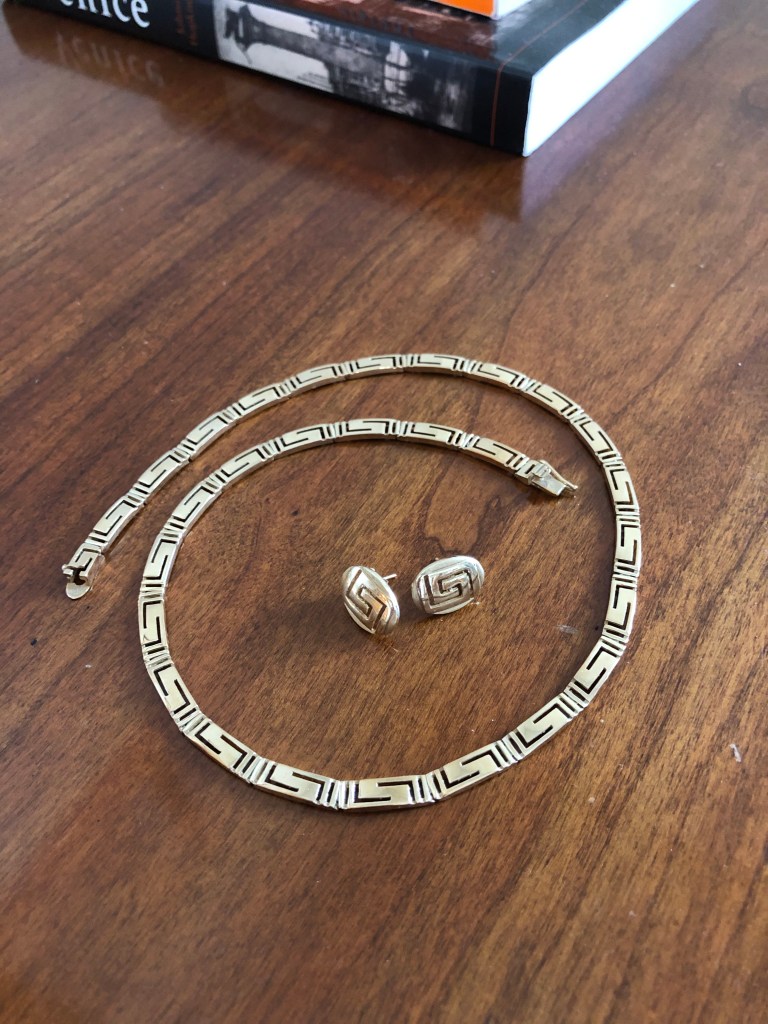
The Greek gold key link jewelry that I saw in the jewelry store satisfied my desire to buy something. Turns out my mother-in-law bought it all for me years before I made my trip. I inherited quite a bit of her jewelry and not knowing its origin, I am happily surprised when I find it in other countries. Just a coincidence that I brought this necklace and earrings with me on this trip!
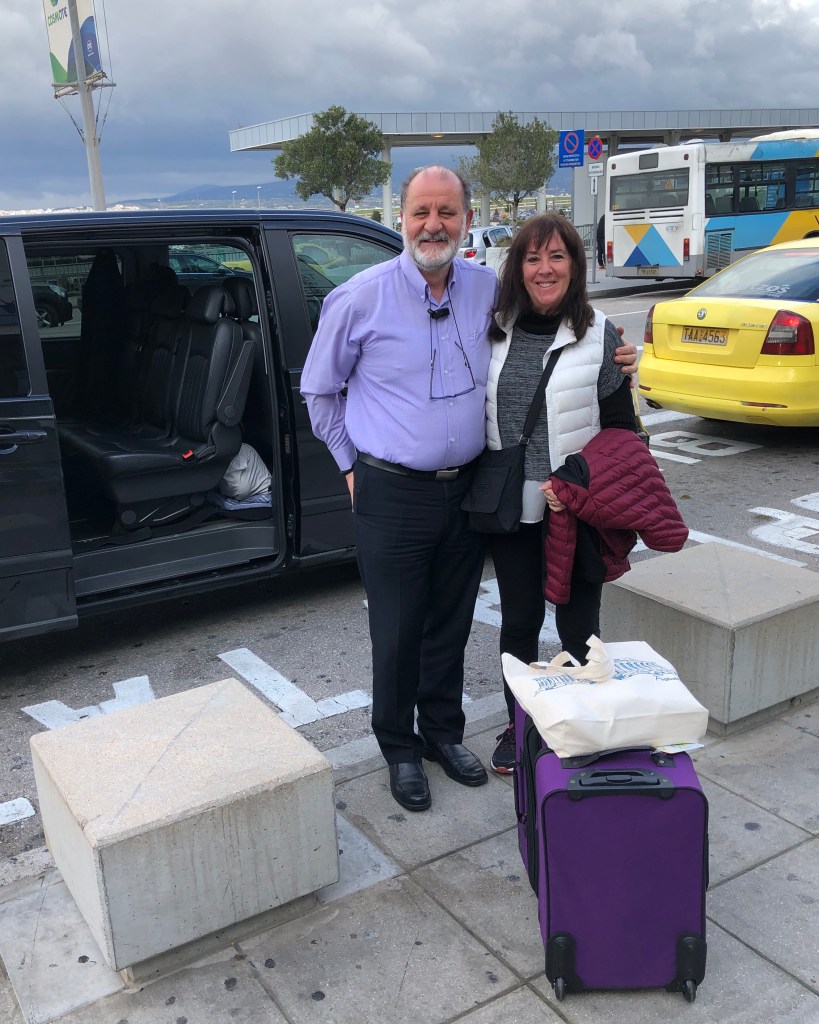
Our future vacation in Greece will include the islands, but I was pleased with my first visit to this fascinating place and all its history. George brought us to the airport and Joy let us in the waterway entrance to Casa Artom when we got back to Venice. Now back to reality. Really? Carnevale is going on now!
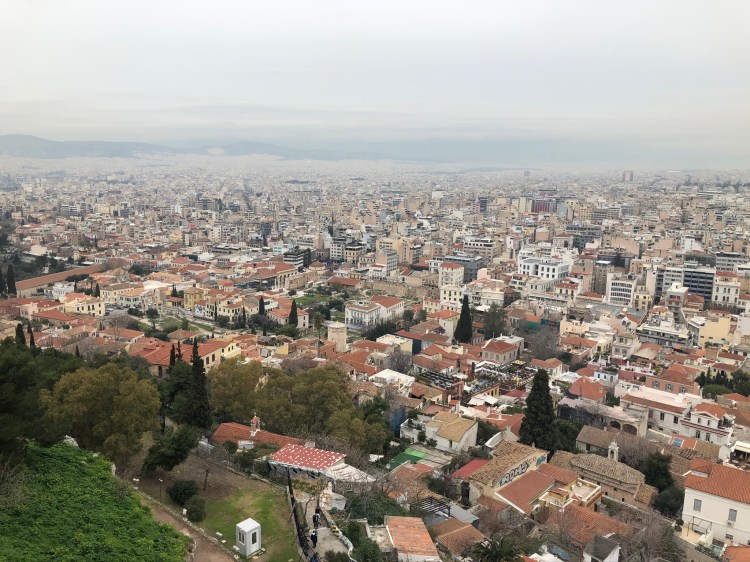
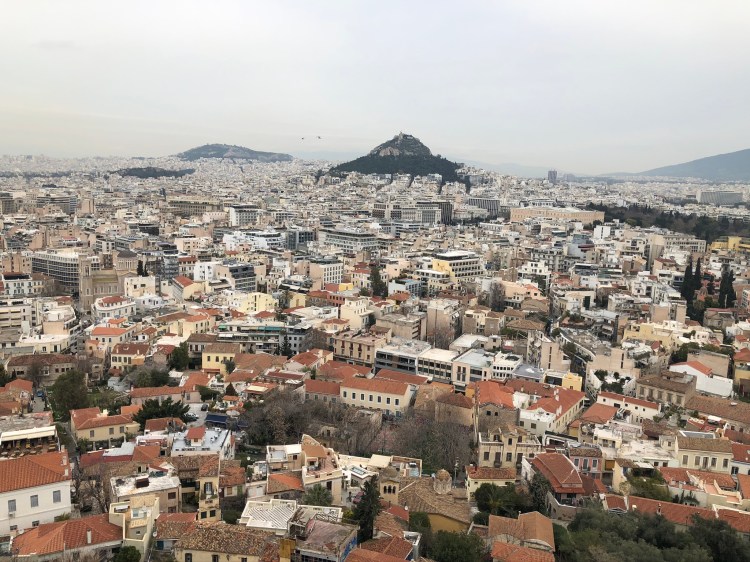
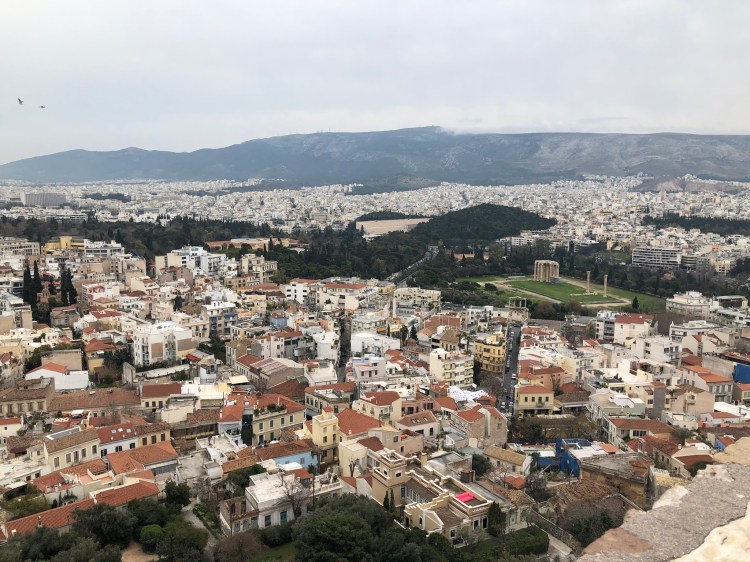
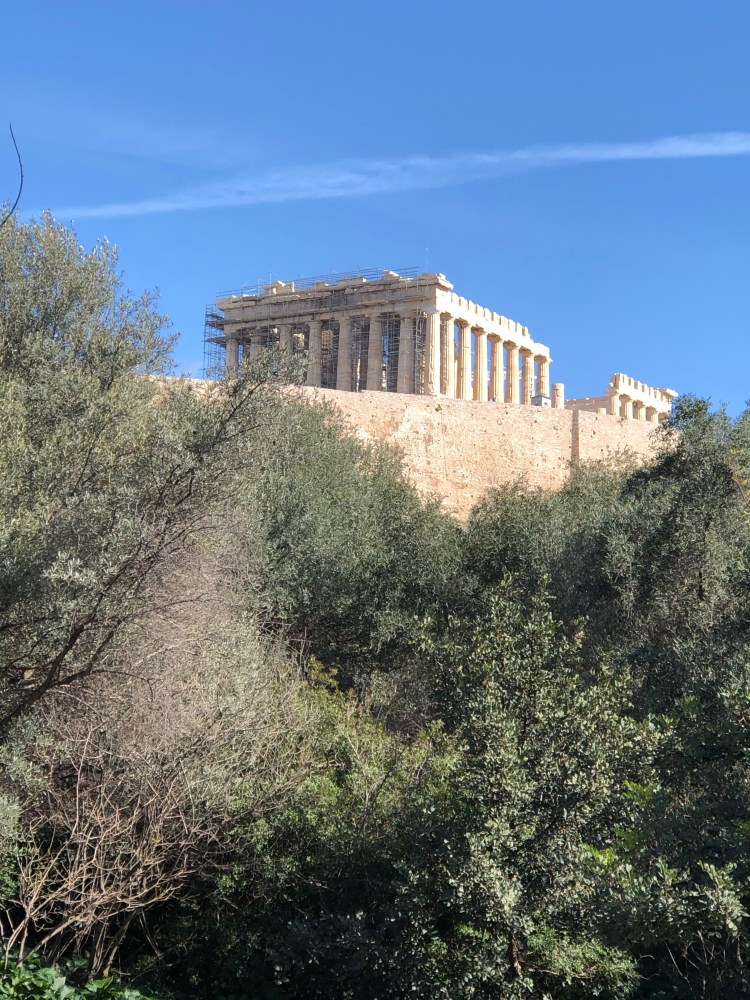
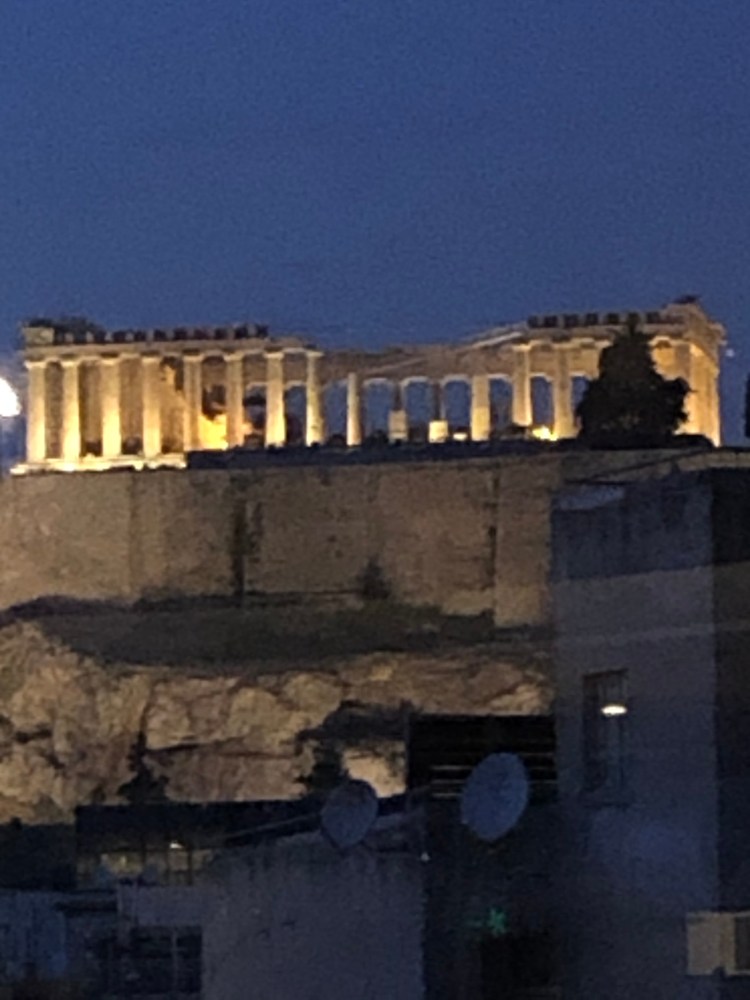
Athens has a height restriction, so none of its buildings interfere with the view of The Acropolis. This and Mt. Lycabettus are the two natural landmarks in the city. And you can see them from everywhere.
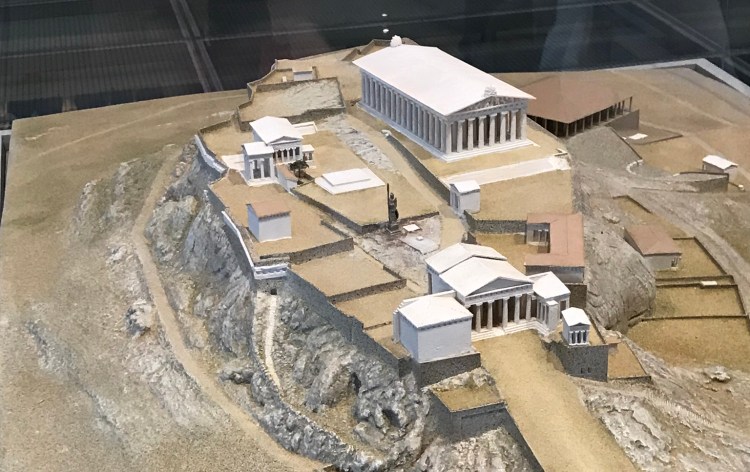
As with most ancient city states The Acropolis was the location of the first settlement in the area, some 4000 years ago or so. Then as the population gradually grew, and Athens gained power and presence in the ancient world, official buildings were located atop the rock and houses were relocated below. Then finally the top became home only to temples honoring the gods.
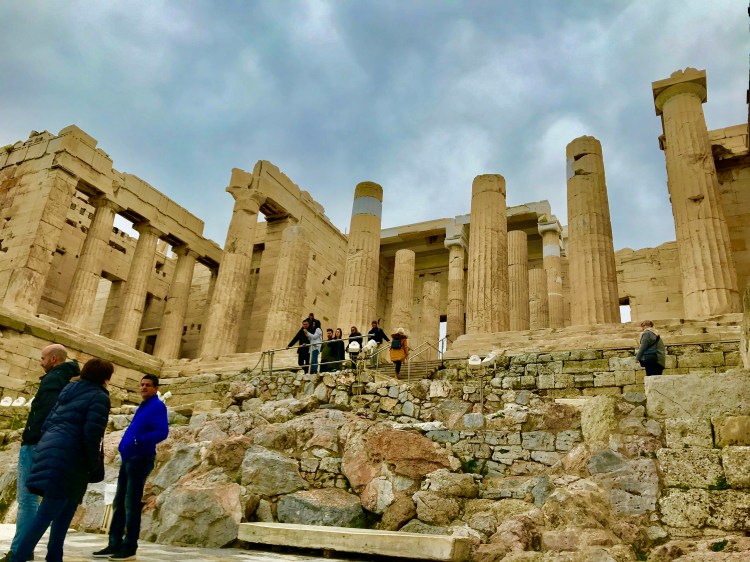
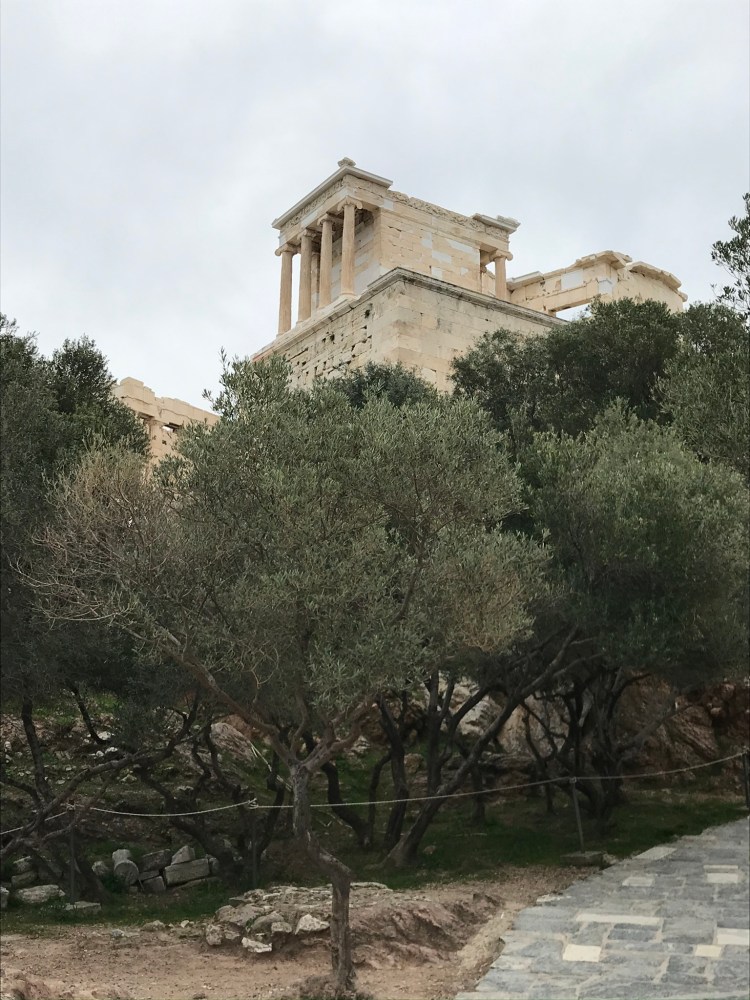
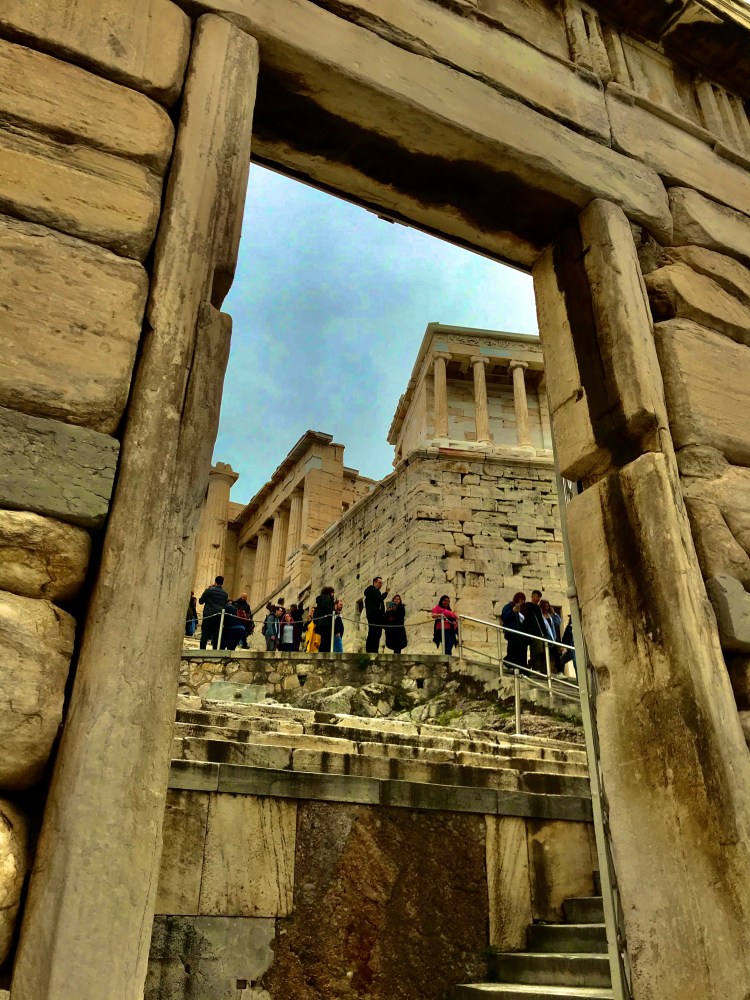
On Friday we met our small group in the Paka neighborhood of Athens and headed for The Acropolis. The approach from the pedestrian thoroughfare downhill takes you up through cedar and oak trees along winding paths to its base. Past the official entrance the trail becomes steeper with more and more steps. Not for meek, in fact one elderly couple had to stay behind. Suddenly from around a corner you emerge facing the Propylaea, with the Temple to Nike Athena straight above you to the right.
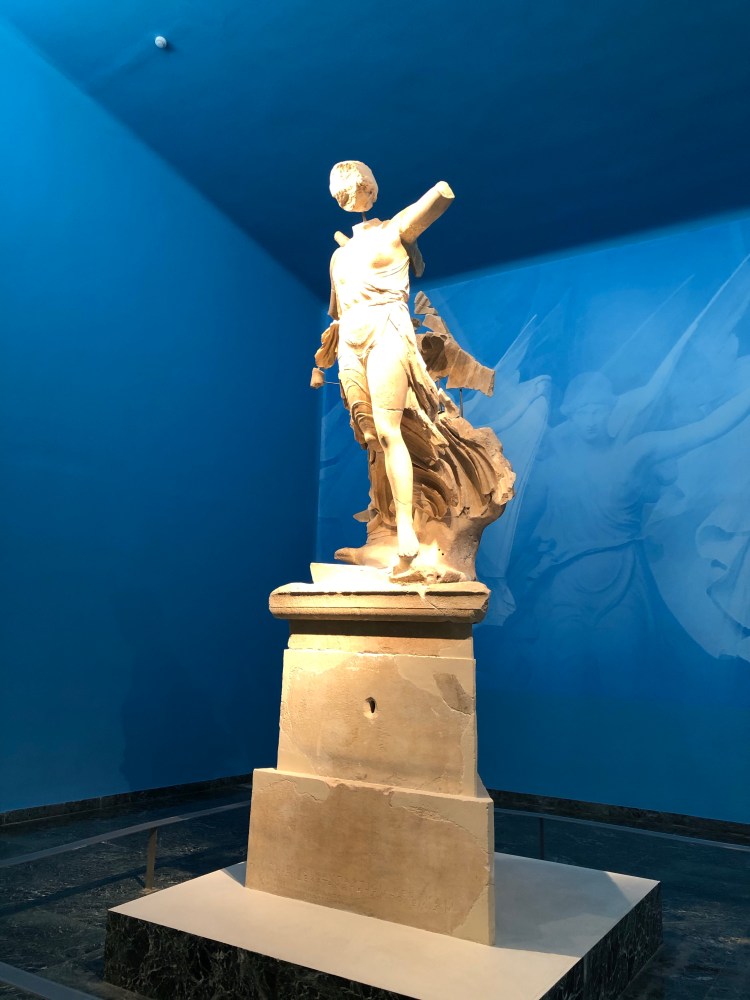
The name Nike Athena reflects the myth that Athena fought a battle with Poseidon for the possession of this high rock and land, and victory belonged to her. Nike is the Greek word for “victory,” so often you will see statues of Athena with wings otherwise called “winged victory.”
(Note: While Nike brand shoes have the Greek mythology of victory as their heritage, competitor Adidas was started in the 1920s by a German fellow named Adolf Dassler. He shortened both his names to create the brand name Adi-das. Further note: in the 1936 Olympics in Munich, when Hitler was about to rampage, German company Adidas provided metal-spiked running shoes to none other than African-American track and field champion Jesse Owens. So I guess they each have their claim to victory!)
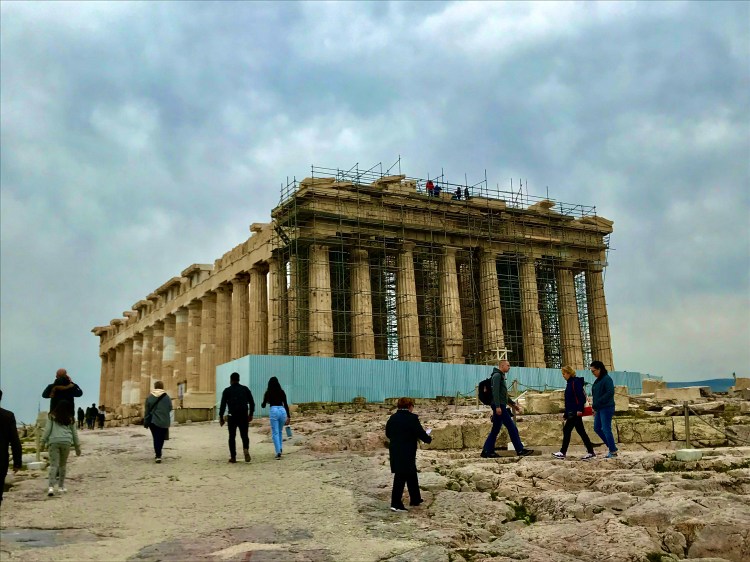
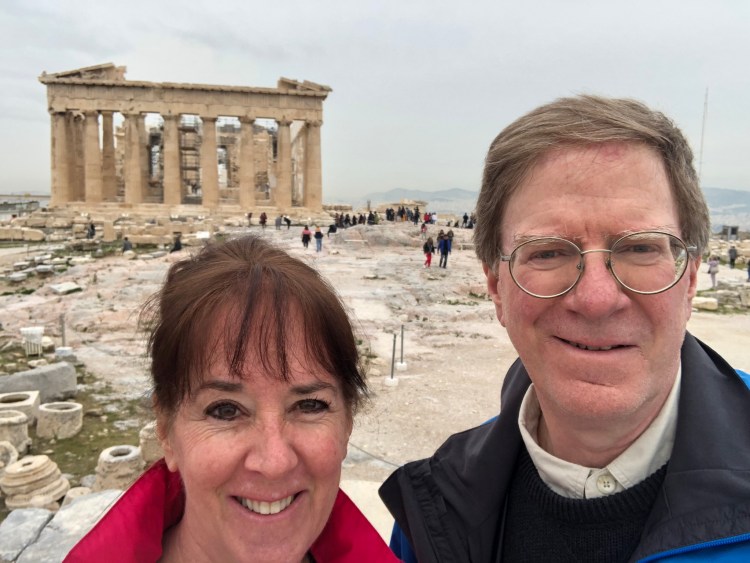
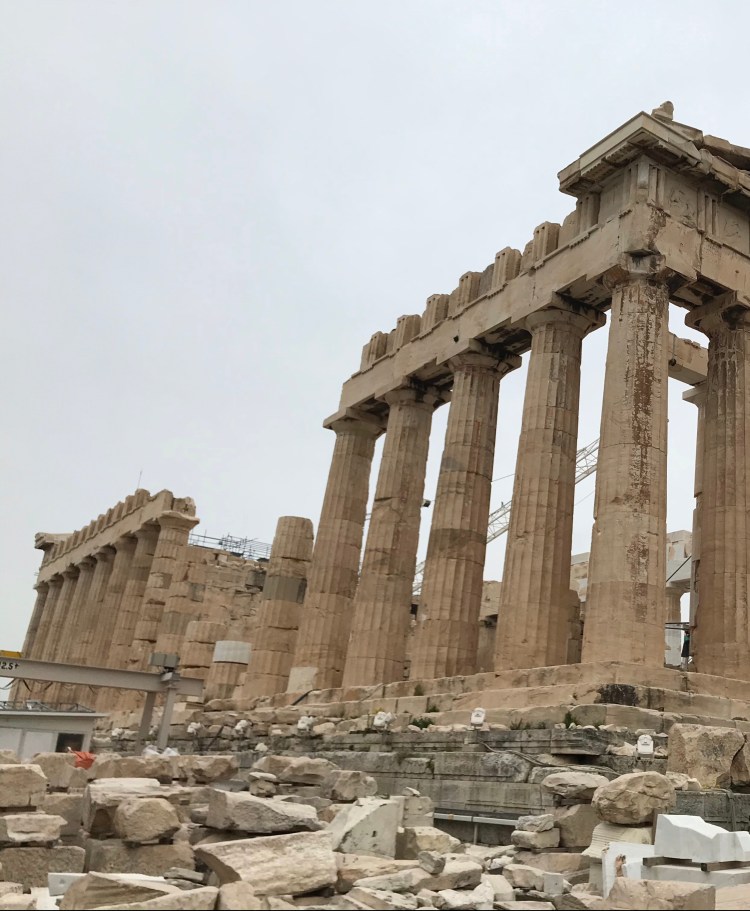
Up through the opening, up more steps still – all white marble – and suddenly the Parthenon is revealed in startling glory. Built between 447 – 438 BC, this huge temple is also dedicated to Athena. Seven columns wide and 17 columns long, it retains the classic ratio of temples built all across ancient Greece. Each column is a bit wider at the base than at the top, and each column leans in slightly toward the temple’s center. These characteristics provided greater support for the exterior façade and roof.
As with many ancient structures, over the eons the Parthenon’s function changed. Until the demise of ancient Greece in the 300-400’s AD it served as a temple, first to Athena and then to Roman gods during the height of the Roman Empire. Then with the fall of Rome and the rise of Byzantium and Christianity from the east, under which Greece was then ruled, it became a place of Christian worship. Still later under Ottoman Empire influence it became a mosque. And now it is where tourists worship the past. In the late 1600s the Ottomans in Athens were besieged by the Venetians. The Ottomans stored gunpowder and munitions in the Parthenon, until the Venetians lobbed a bomb directly into the structure. It blew, and the damage to the roof and the south side that we see today still remains.
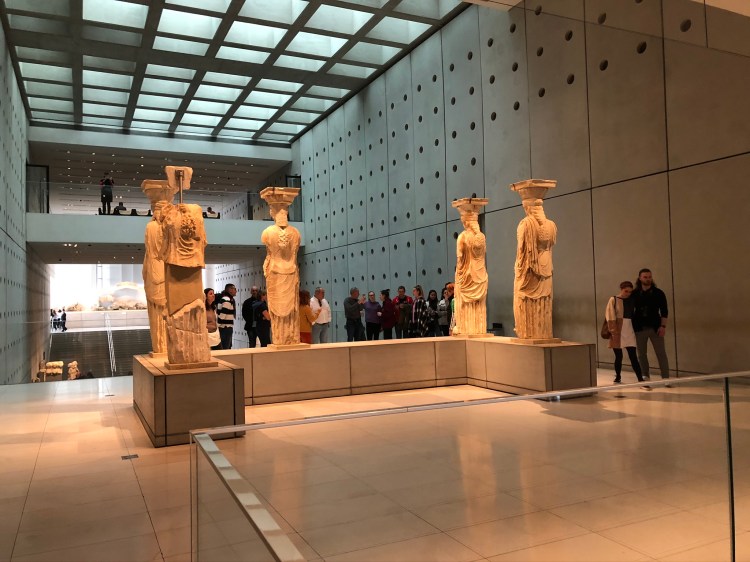
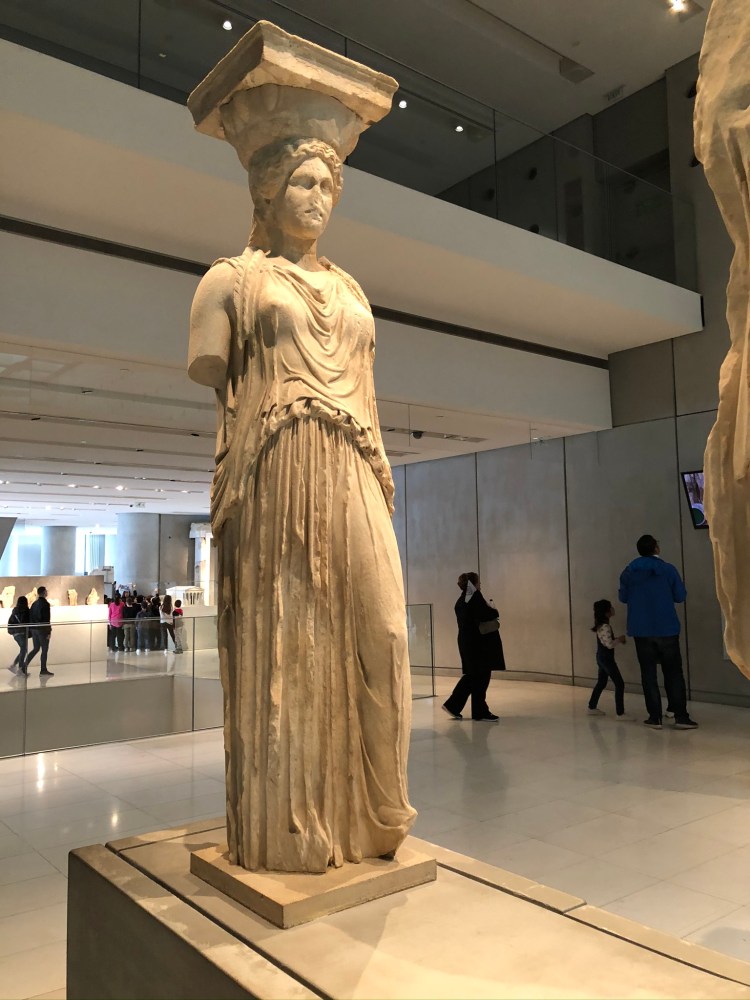
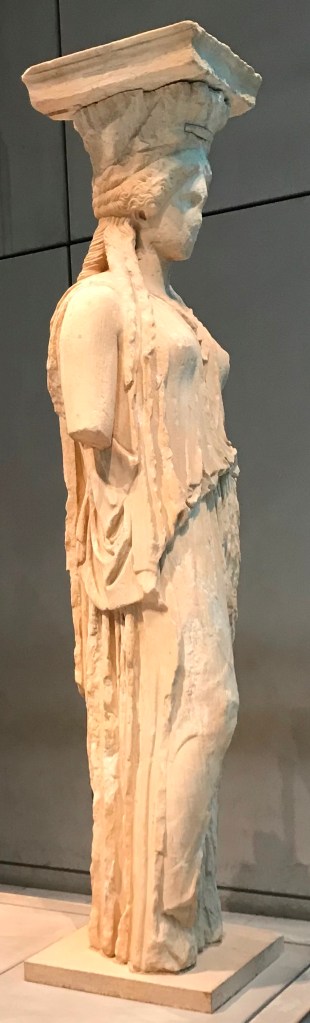
To the west of the Parthenon is the Erechtheum, dedicated to (who else?) Athena but also to Poseidon. It is famous for its “Porch of the Maidens”, with six draped female figures as supporting columns. We saw some of the original maiden columns in the Acropolis Museum later in the day.
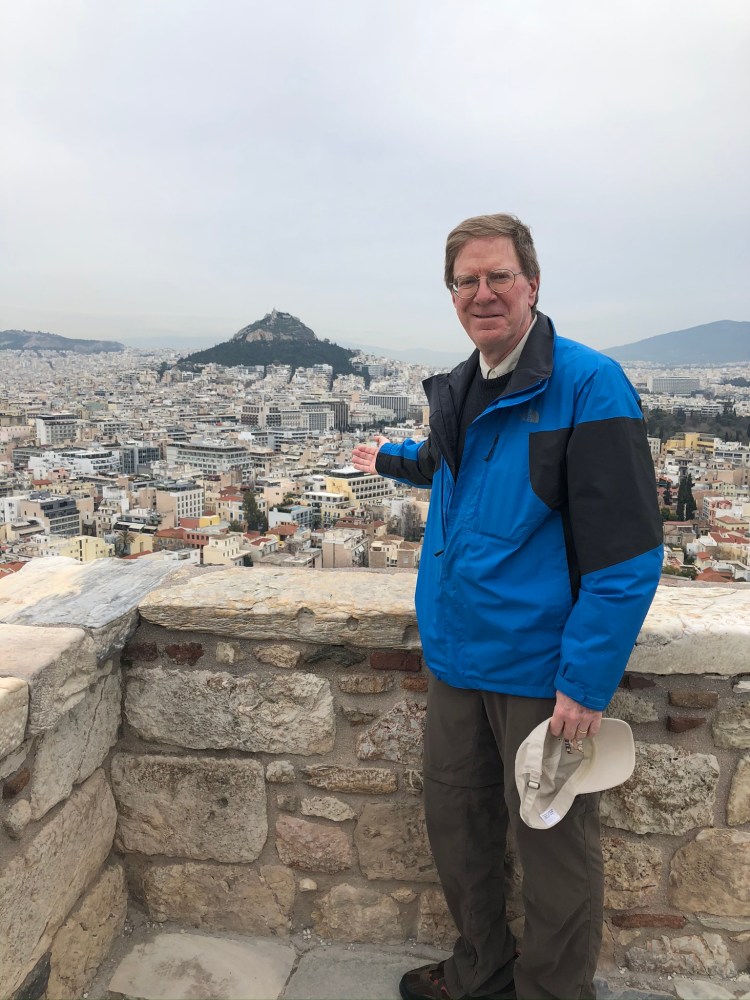
On the far east end of The Acropolis is the overlook toward Mt. Lycabettus. In 1968 when I was here in Greece with my high school group, I took an afternoon to hike to the top of the mount. There’s a chapel to St. George up there. Along the way I stumbled upon a Greek military installation containing field artillery aimed at the nearby airport. Greece had just gone through a military coup a year earlier; the military that took over was fearful of foreign powers flying in and taking over the country. I was stopped by the army guy, who was pretty ticked off that I had discovered their secret site. Whoops!
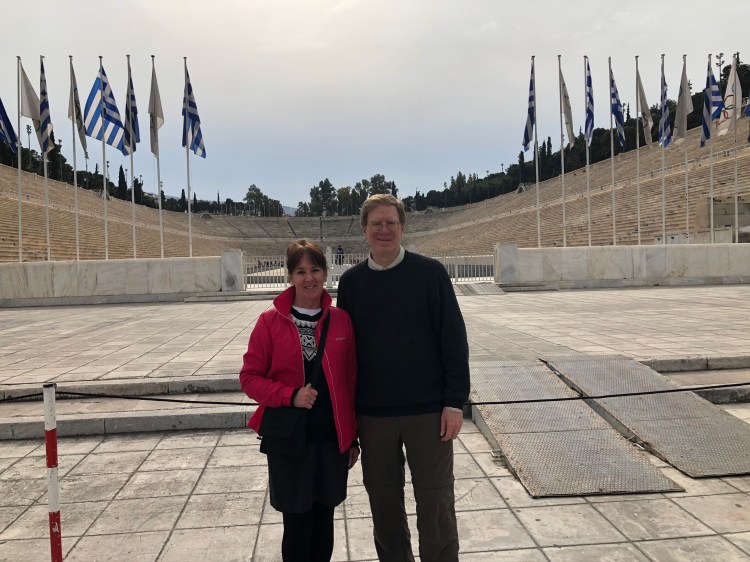
Which takes us to the rest of the day. After leaving the hilltop, a short bus ride through the city took us past the modern Olympic stadium built in 1896 for the return of the games, the Parliament, a temple to Zeus, and finally to the Acropolis Museum.
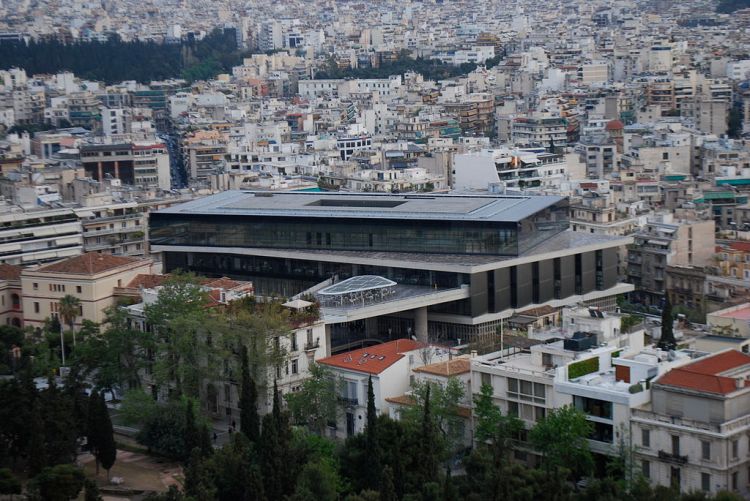
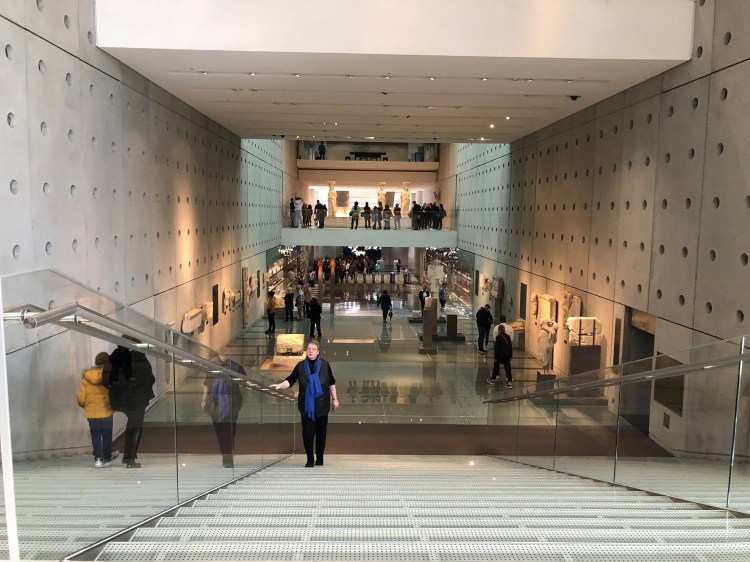
The Museum is a very special place. Situated just below the Acropolis, it opened in 2009. The top level of the museum, as you can see from the photo, is a rectangle that is set awkwardly above the main building. This top rectangle is exactly the same size and height, and is oriented in precisely the same direction, as the Parthenon which you can see out its huge windows looming right above it. Then inside this top level are positioned the friezes taken from the Parthenon ruins, in exactly the position they occupied on the original building. The friezes tell mythological stories in panels – sort of like a comic strip – and interestingly include pictures of Athenians alongside gods in some of the panels.
Unfortunately, many of the original friezes are neither on The Acropolis nor in the Museum. In the 1820s Lord Elgin was the British representative to the Ottoman Empire in Greece. The Ottomans cared not at all for mythological Greek art. So they allowed Elgin to remove friezes and take them to England. The UK government later sold them to the British Museum. And there they remain to this day. Since they are the property of the British Museum, and not the UK government, the Greek government has had a difficult time getting them back. The matter is tied up in international courts. With the building of the Acropolis Museum, the so-called “Elgin Marbles” really ought to come home now.
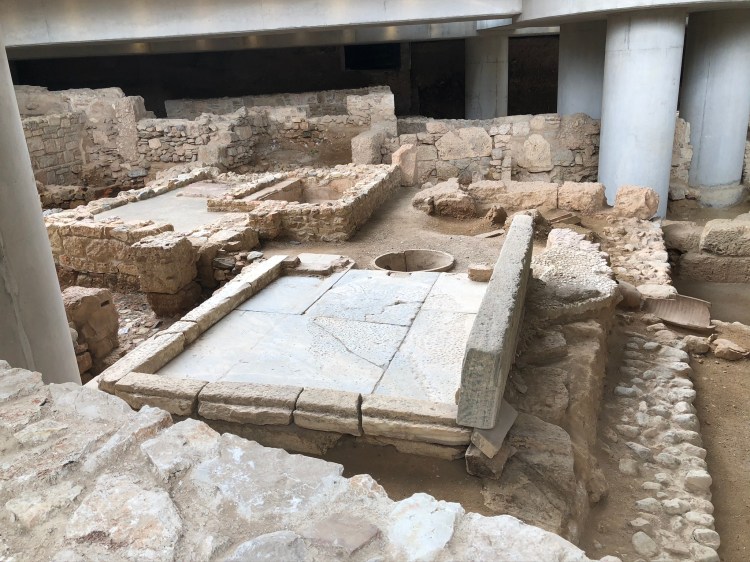
Lower floors of the museum contain statues and other finds from excavations on the acropolis. Then underneath the entire museum is an archaeological excavation of early Athens settlements at different times in its history. This exhibit just opened for the first time in 2019. Layer after layer the dig goes down, exposing settlements in the early AD centuries to those in BC centuries.
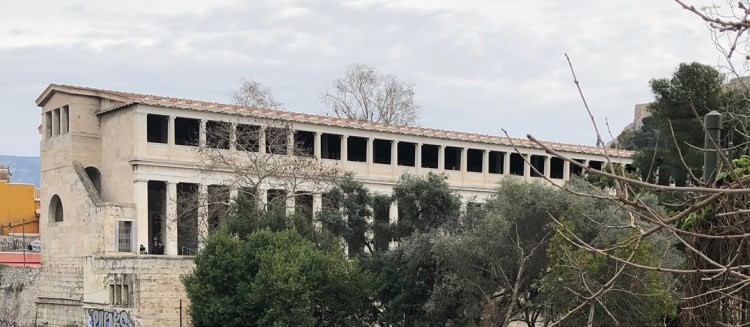
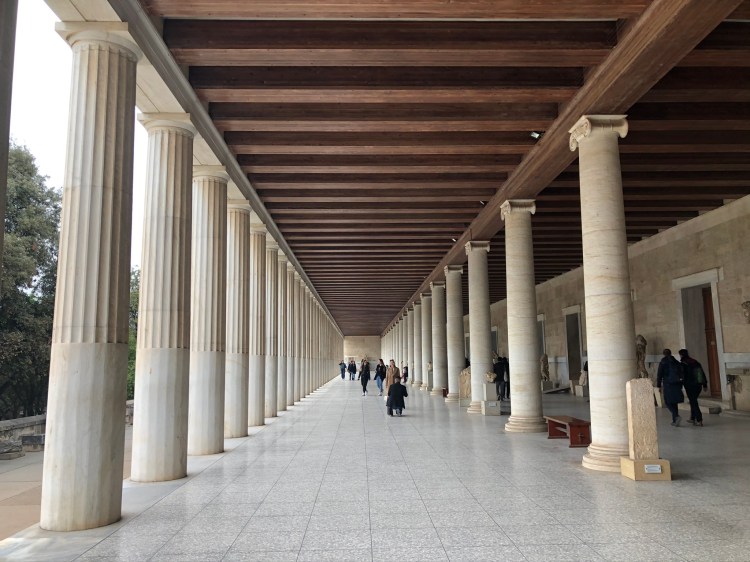
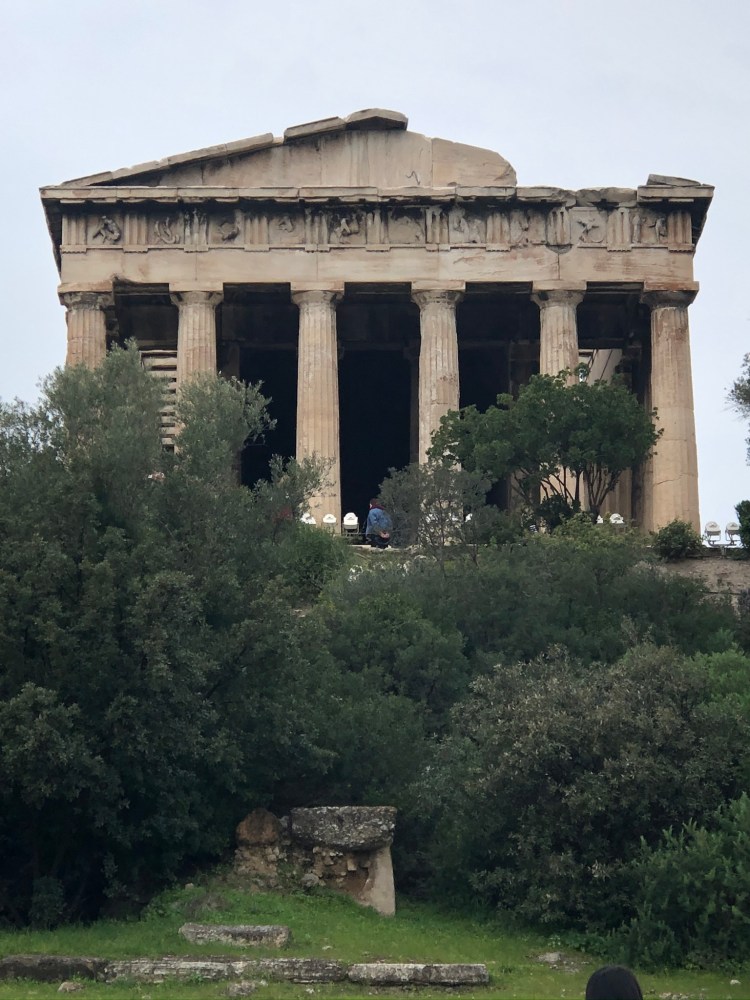
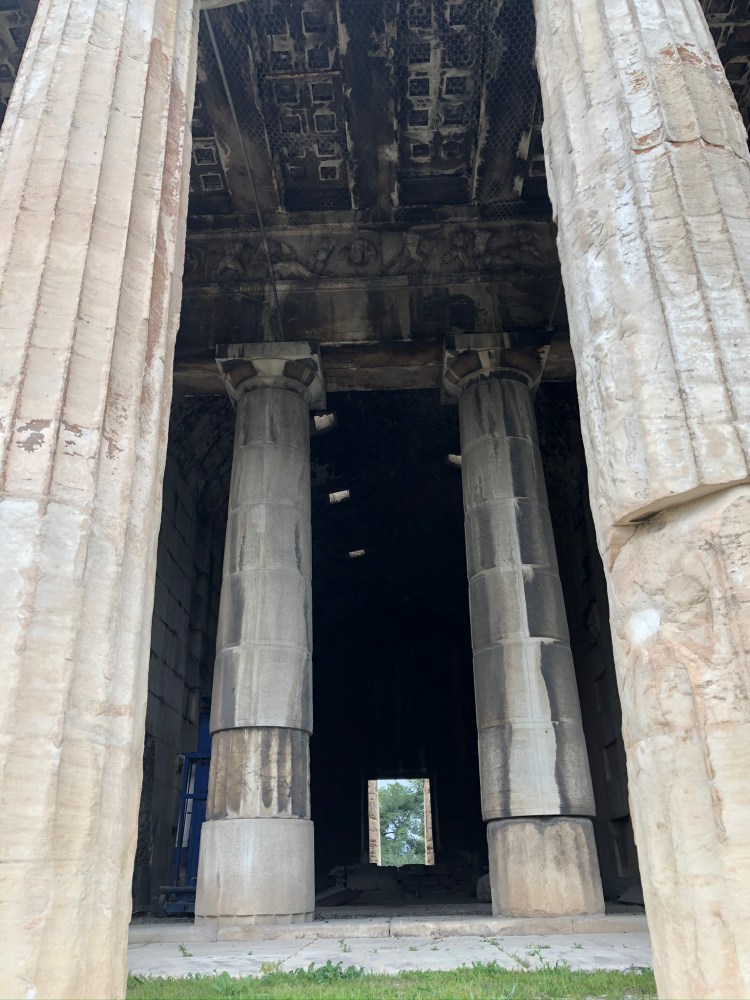
By the time we finished the museum it was early afternoon. Nearby we lunched at a restaurant that has fantastic gyros. Greek food is filling! But we kept going, and walked on the pedestrian way around the south and west sides of the Acropolis, down the hill to the ancient Agora. This was the center of politics and markets. A Stoa along the west side housed shops. A theatre provided entertainment for thousands, and you can wander around the largely intact Temple of Hephaestus, who was the patron god of metal working, craftsmanship, and fire. But the primary interest of the agora is that this is where representatives from Athenian society gathered democratically to make laws and vote. This was the seat of democracy.
After a long day, having seen much and with much to think about and talk about, we wandered back up the pedestrian way underneath the Acropolis and then back down the hill on the other side to our peaceful hotel room.
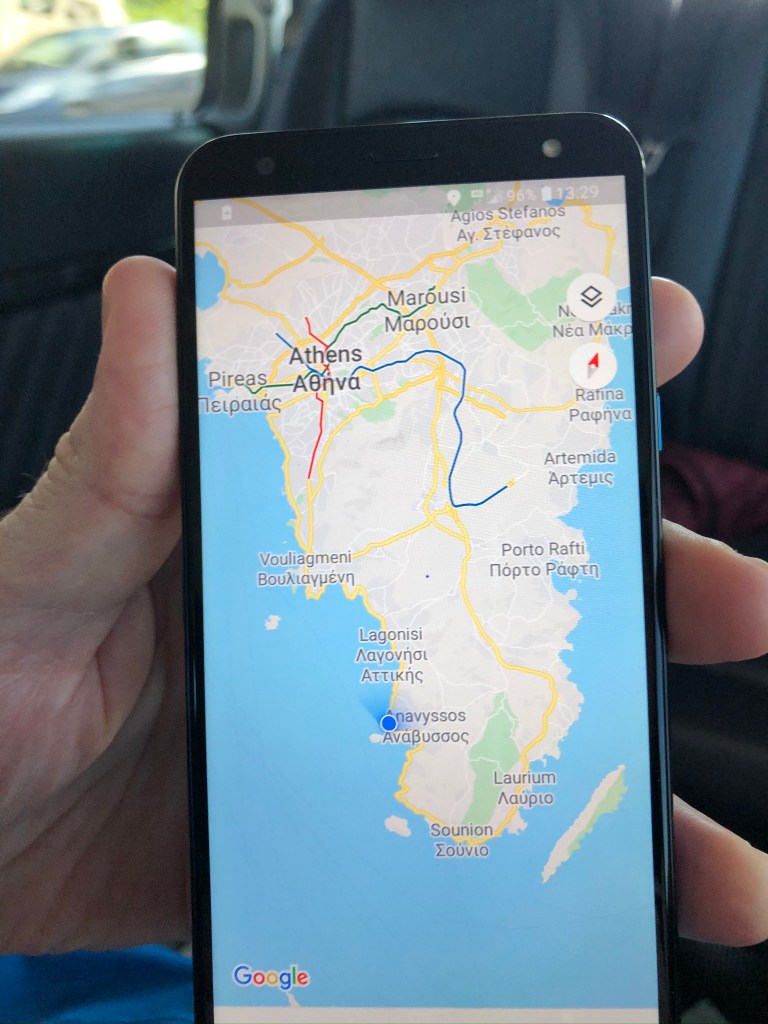
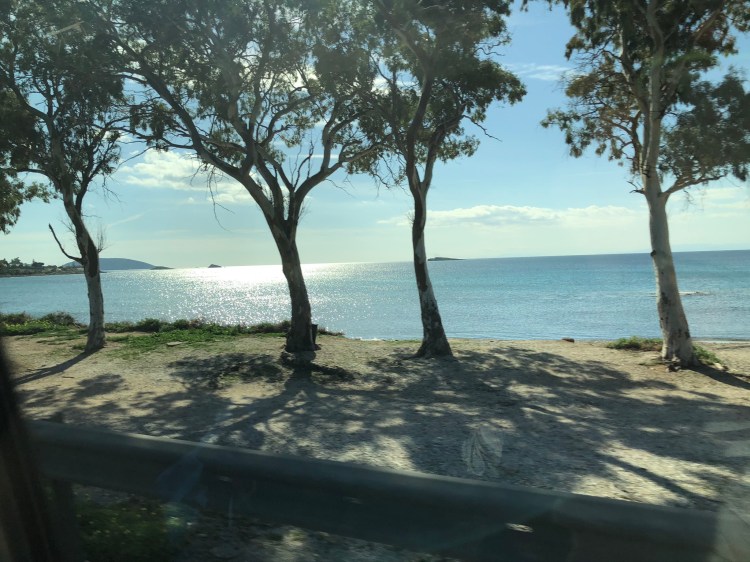
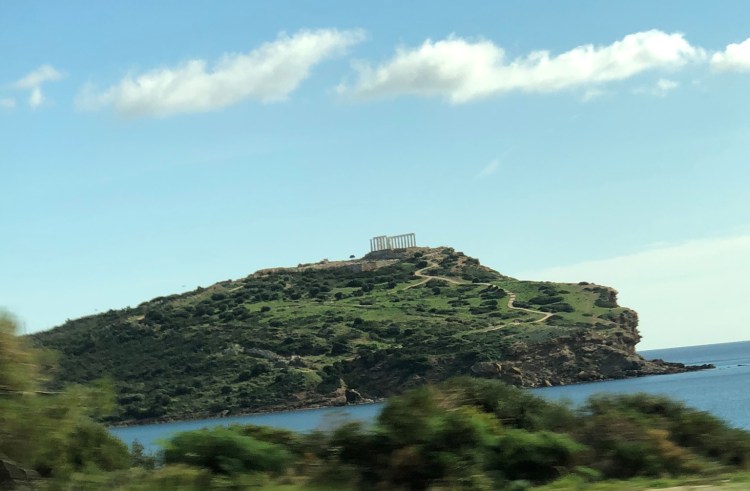
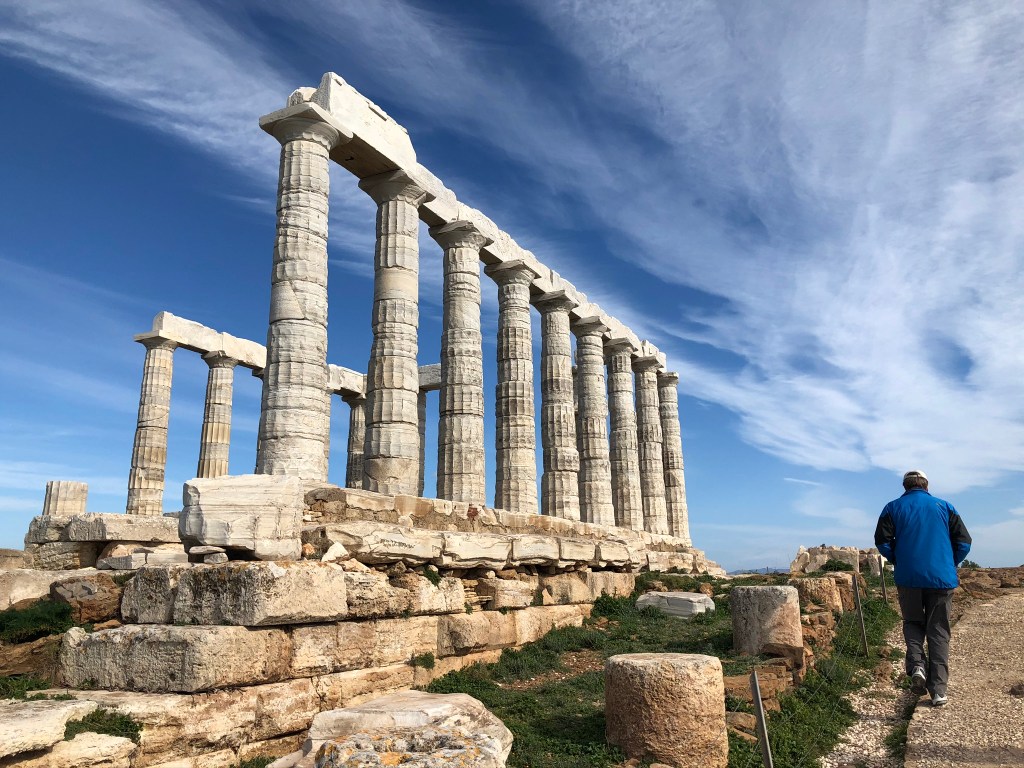
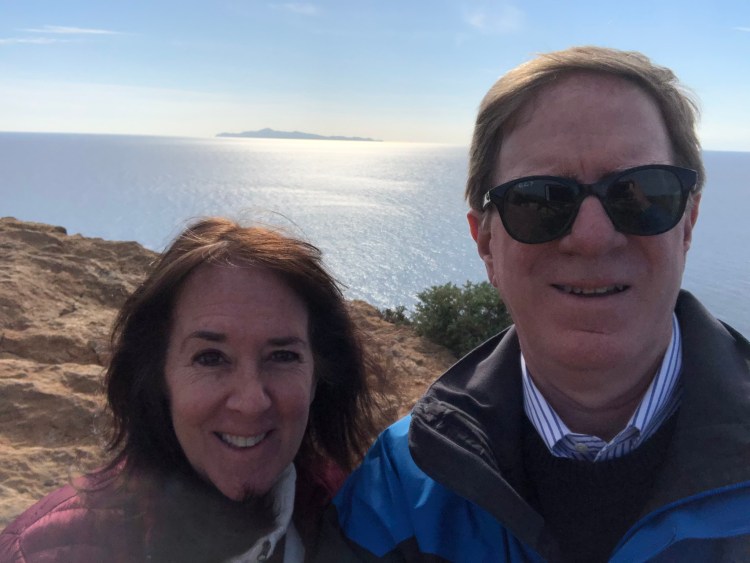
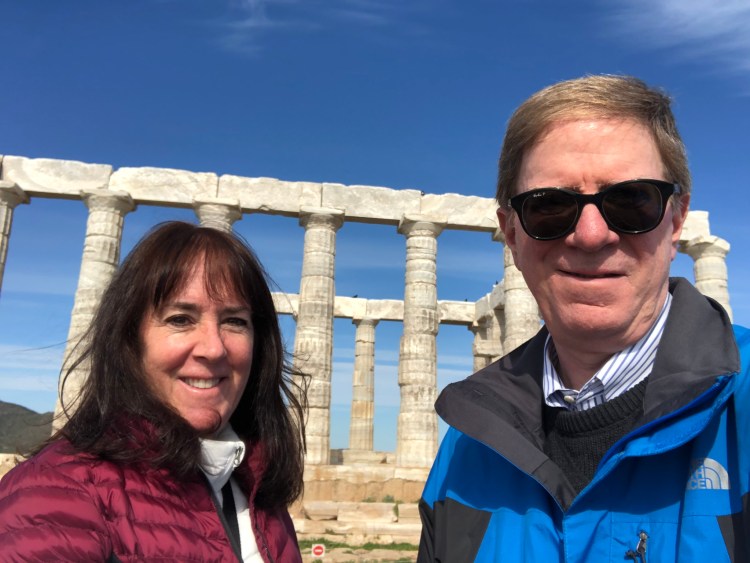
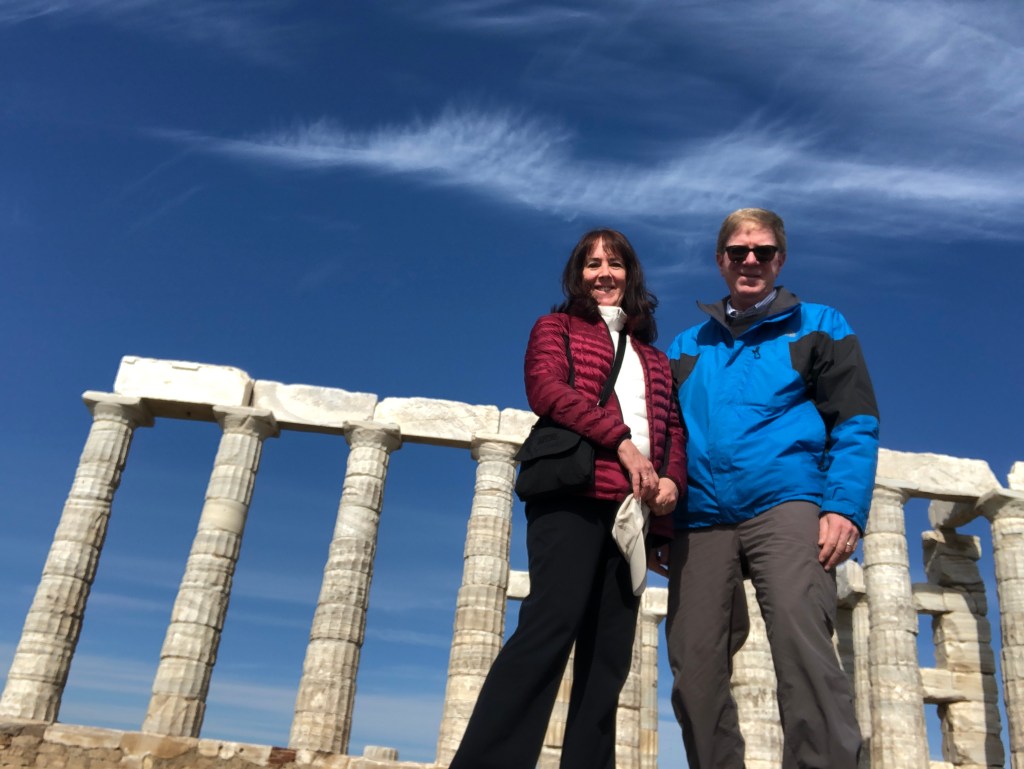
Our fourth day of site-seeing in Greece was supposed to be a free day, but we were on a roll. Page arranged for George, our driver to and from the airport, to take us south to see the Temple of Poseidon that he remembered fondly 52 years ago. This drive through wealthy beach towns and homes was a lovely ride along a rocky coast. Also, George made a couple turnoffs to show us places we would never have seen!
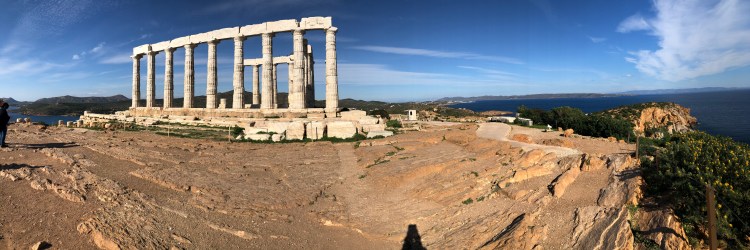
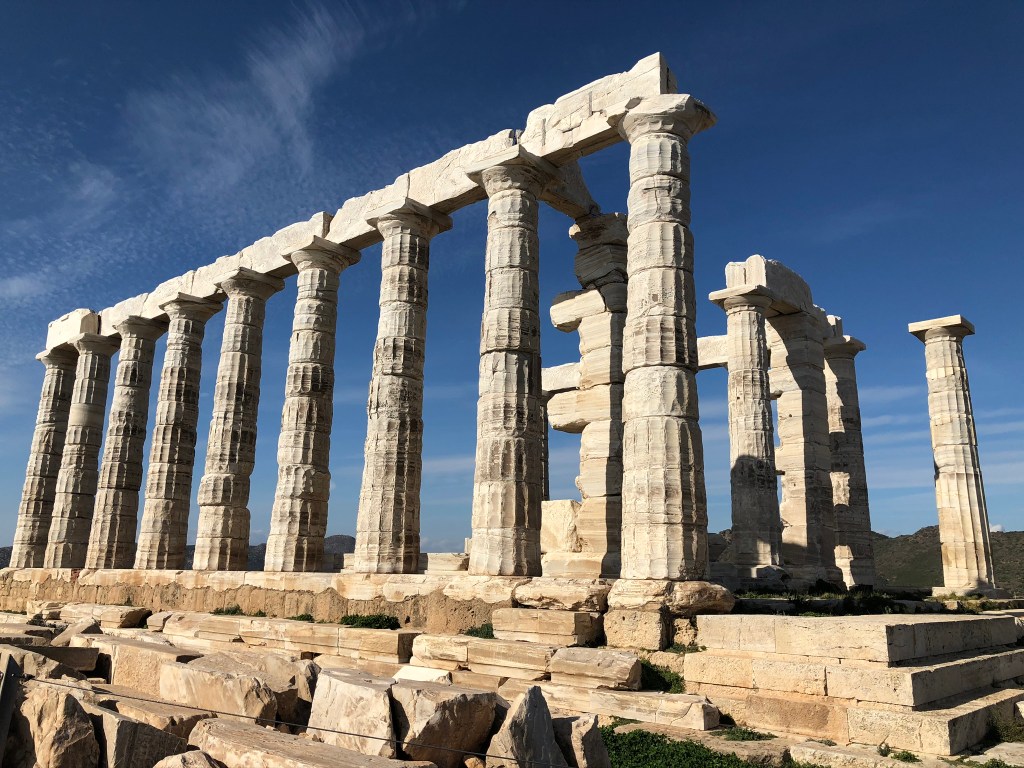
First sight off in the distance on top of the hill…..!
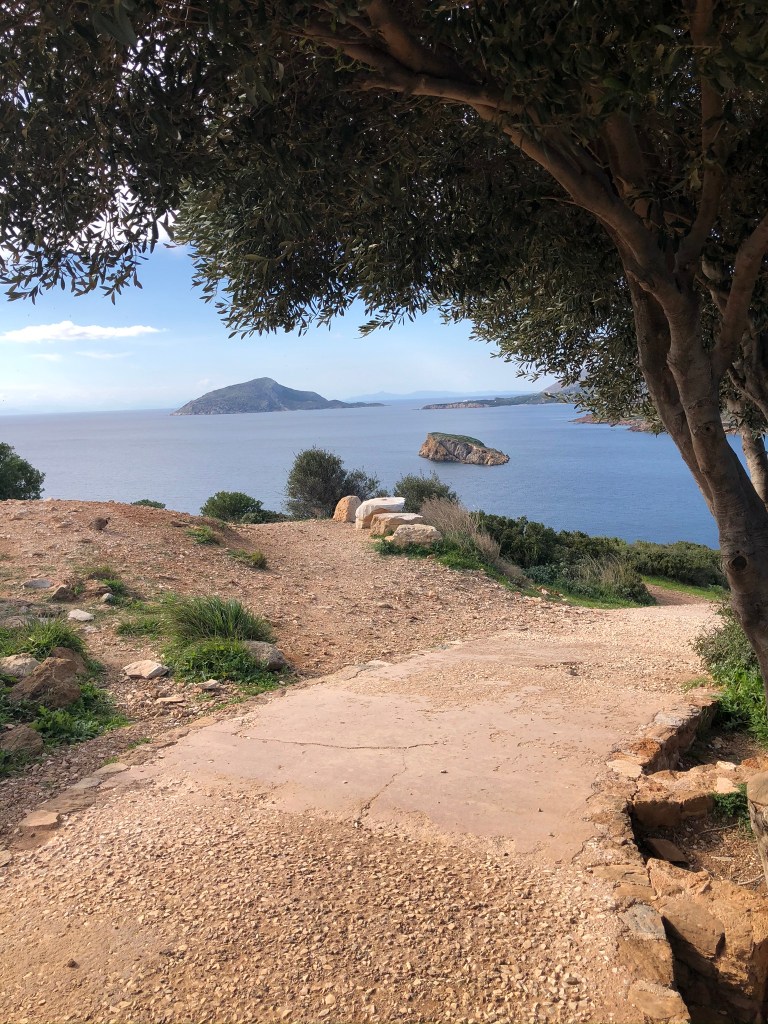
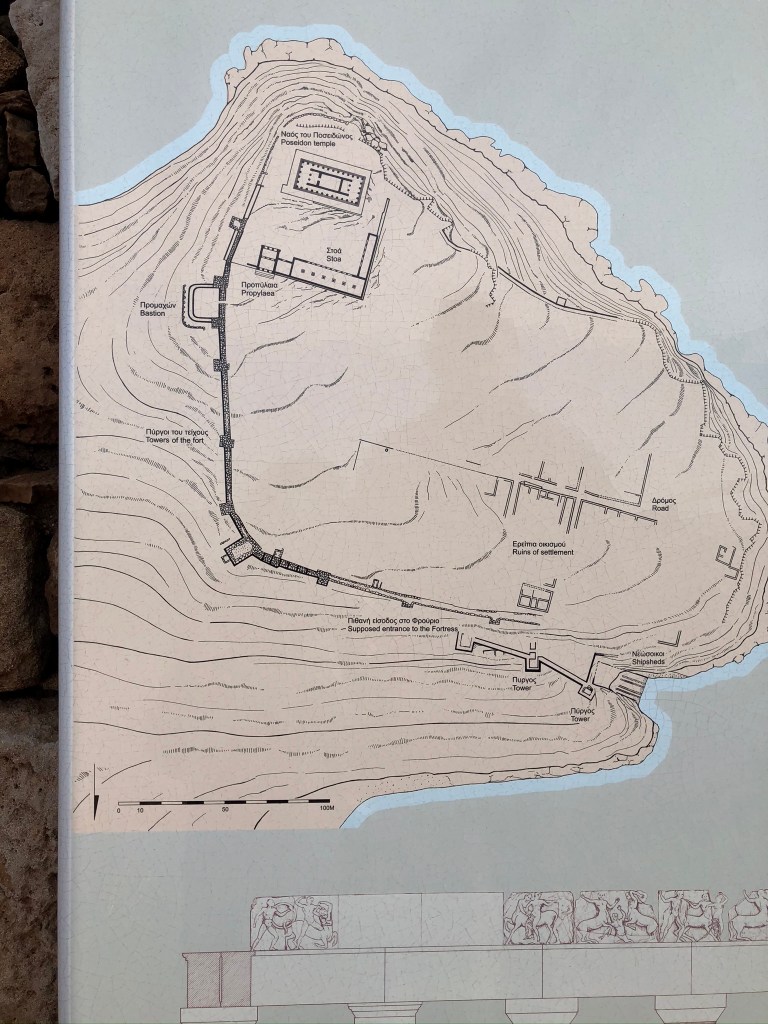
We spent about an hour, almost alone, wandering the trails and studying the maps.
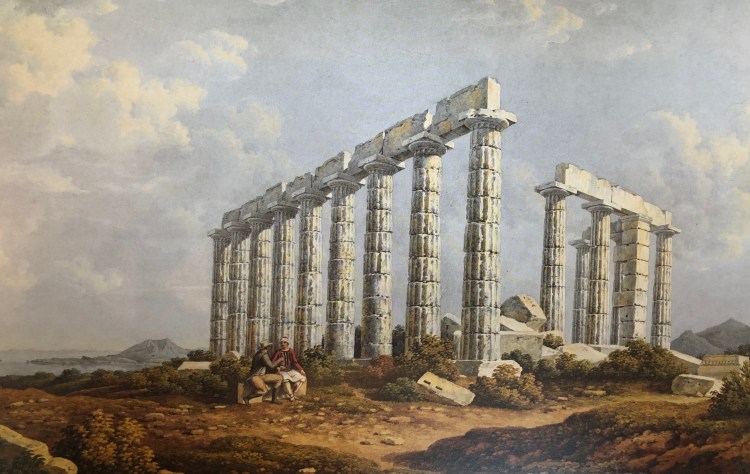
Poseidon was the God of the Sea. High on a cliff peninsula on Cape Sounion, the fortress and sanctuaries were built during 444–440 B.C. Homer was the first to refer to them in his Odyssey as “the sacred cape of the Athenians”. The investigation of the Poseidon Temple started in 1884 by Germans and now current work is conducted by the Greek Archaeological Service since the 1950s. Before they departed on long sea voyages, ancient Greek sailors would come to the temple at sunset and pray to Poseidon for a safe journey. They knew they were nearly home when they saw the first glimpse of white. It was awe-inspiring to be in this place and imagine those days.
Check this out! My photo compared to a painting from a century ago!
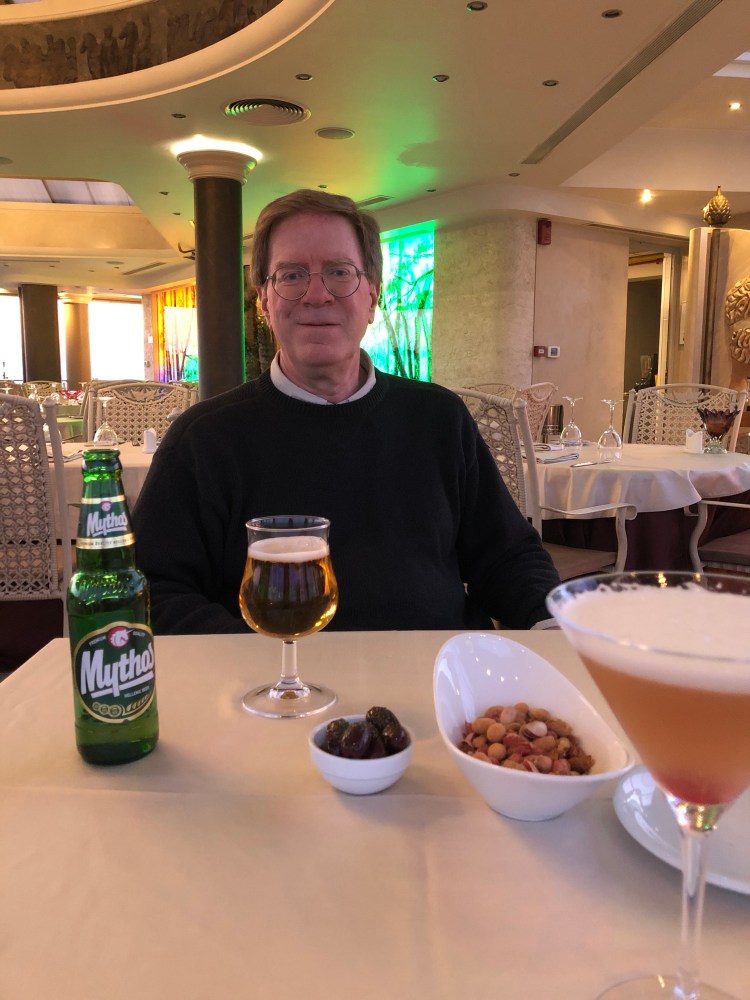
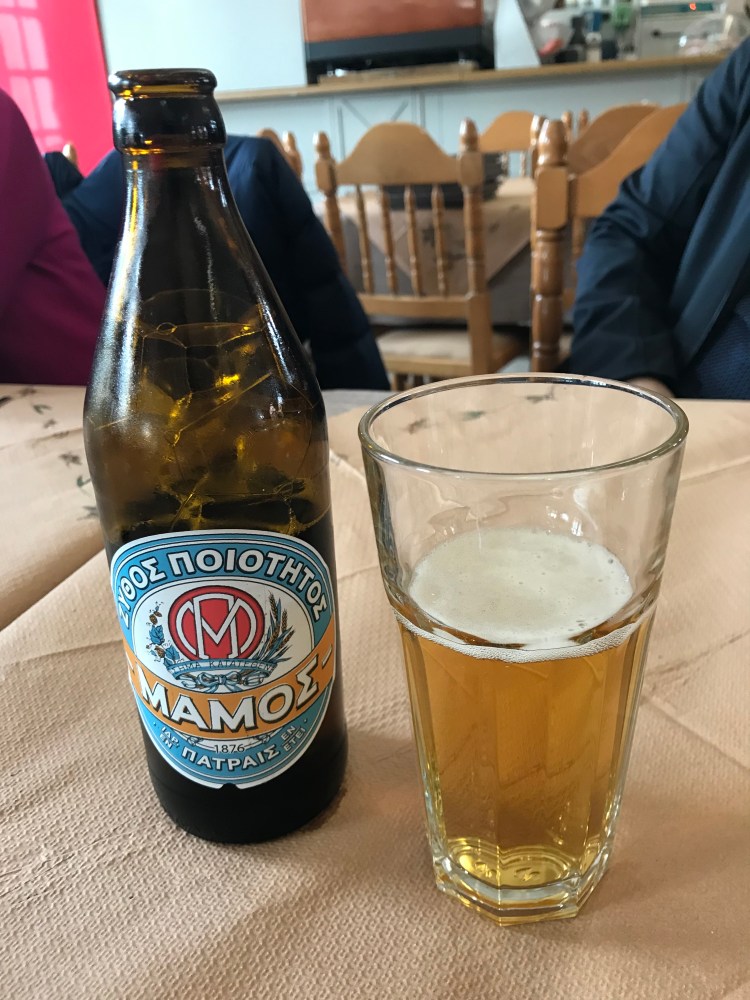
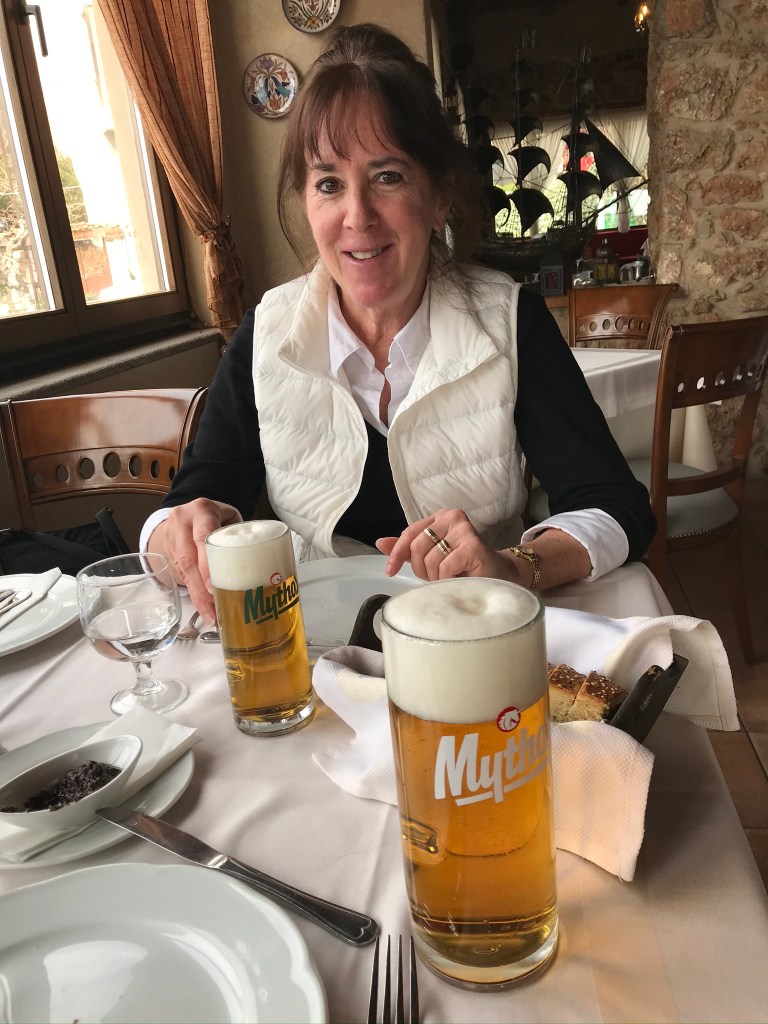
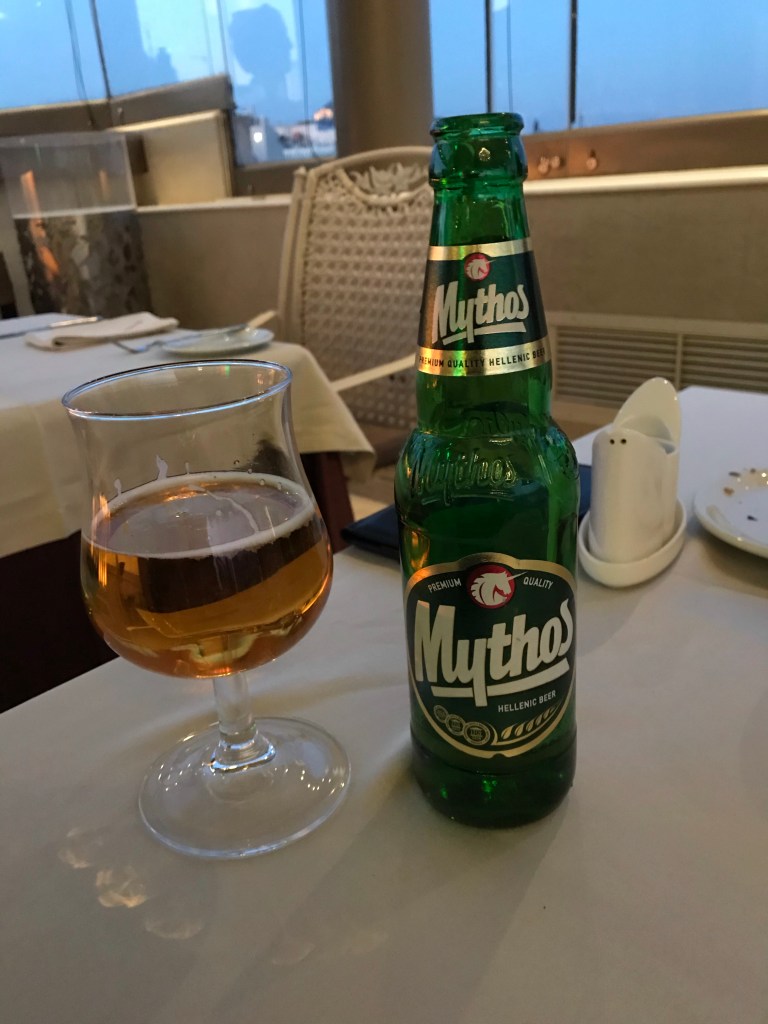
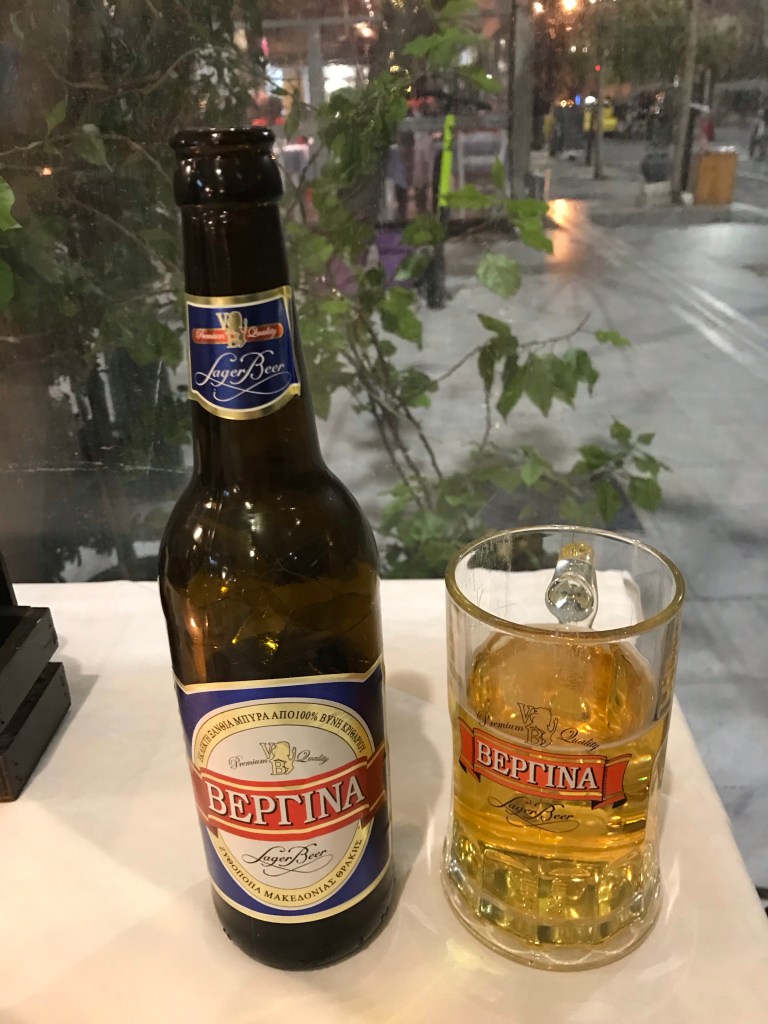
This one’s for our friends John and Ken (who don’t know each other). John collects beer mugs and glasses from around the world. Following an earlier post that pictured one of the three local Greek brews Mythos, John commented immediately that he has a Mythos glass in his collection (probably now stored in some box since they recently moved).
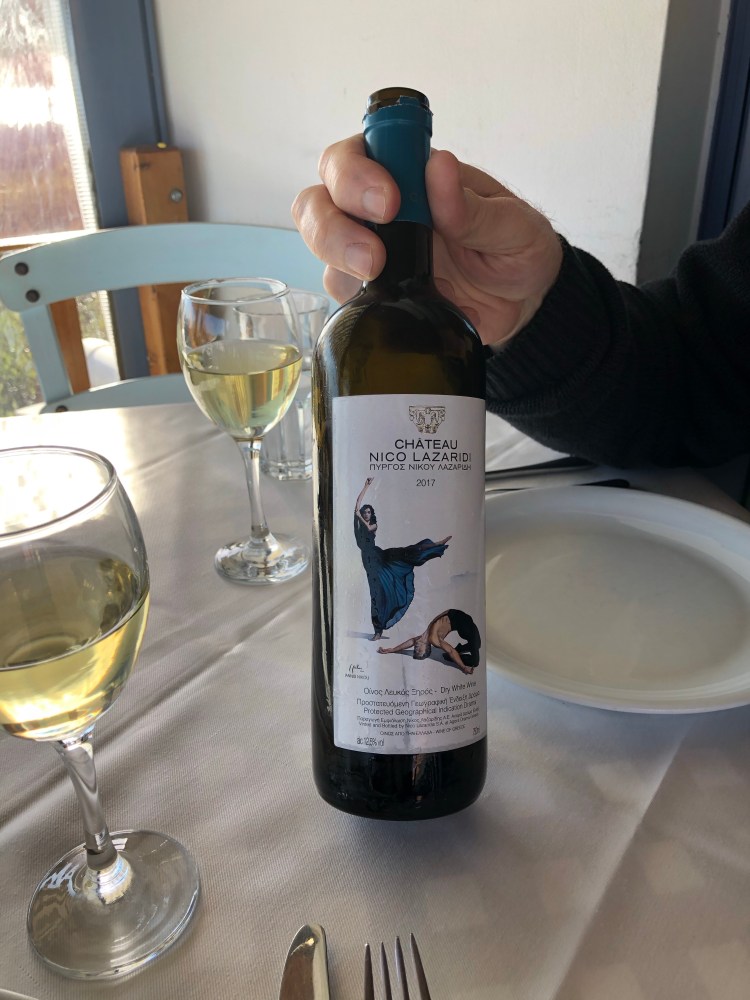
Ken collects wines. One time when were sitting in an outdoor cafe in Santiago, Chile, drinking a nice Carmenere, we thought Ken would be interested. So we texted him a picture. A few seconds later the reply came in, that we could get that at Total Wine for about 8 dollars. Oh.
In any case, we here now challenge our friends with these two new additions to our own “having-imbibed” collection.
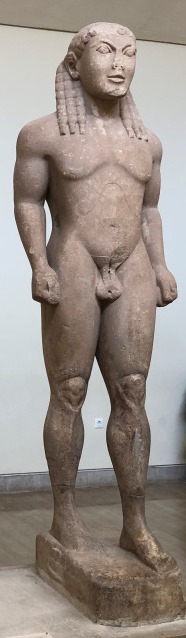
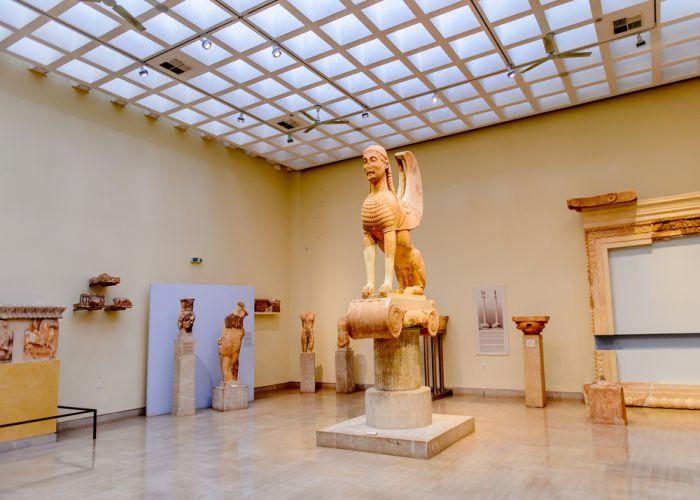
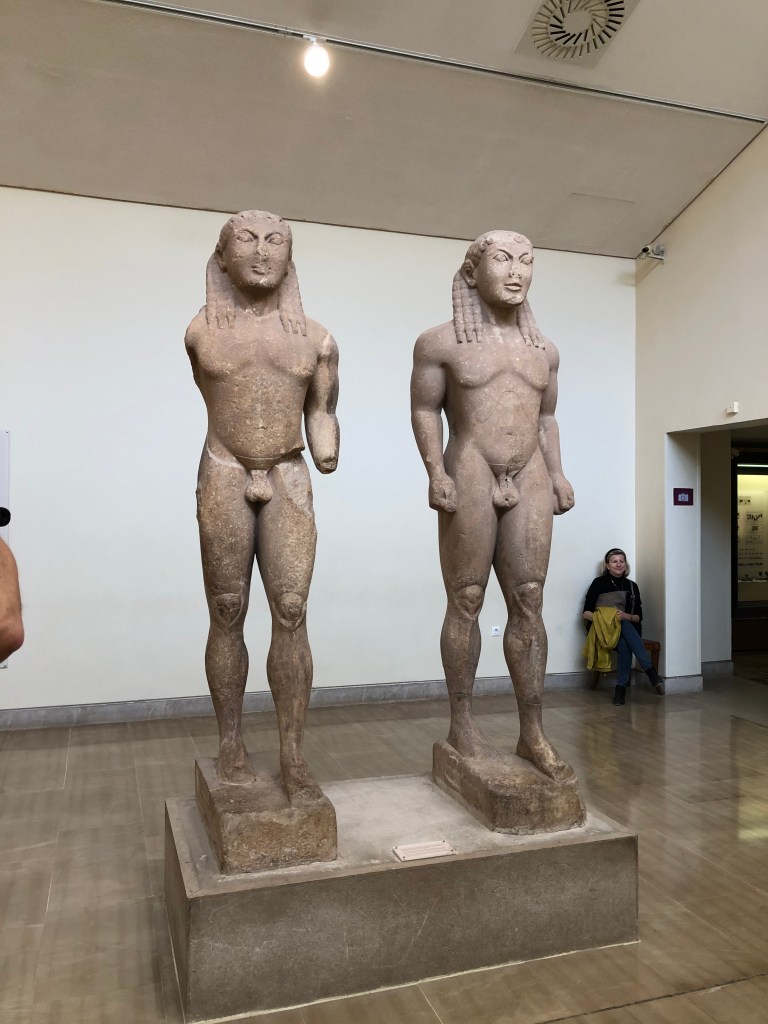
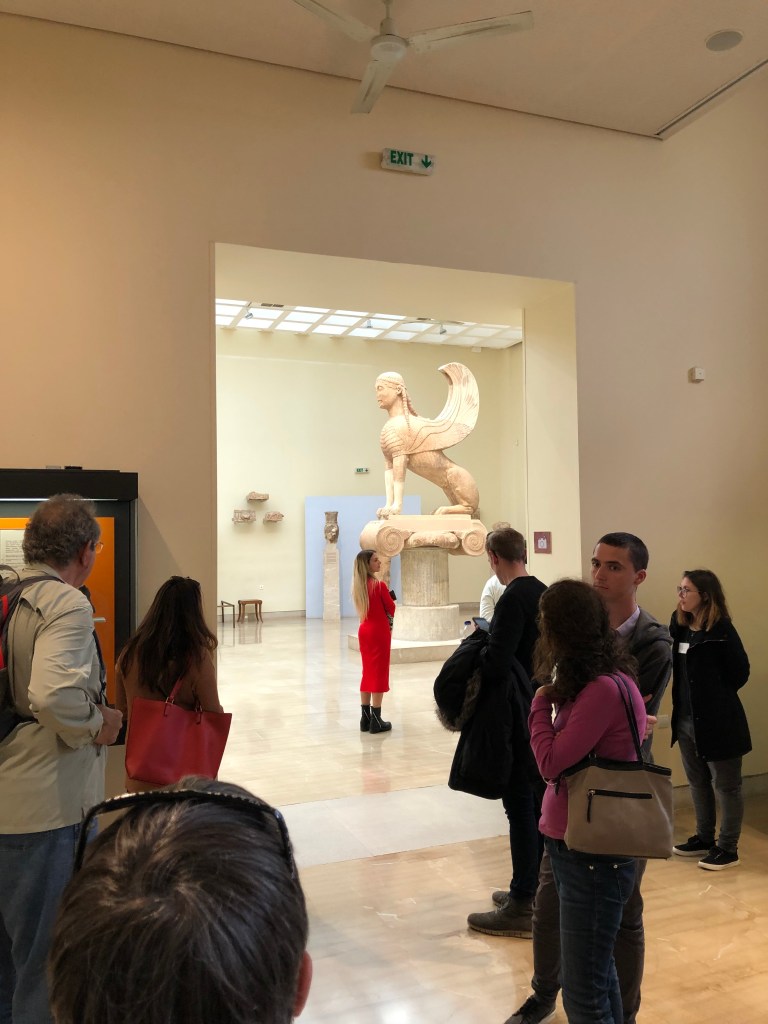
Over a thousand years passed between the ancient Mycenaeans and the Greeks who competed at Olympia or went to the Oracle of Delphi to have the truth divined. In that same span of time Greek art moved from the archaic to the classical. Archaic sculptures were more stylized figures. They usually exhibited straight hair and unnatural physical positions. A token smile on many archaic sculptures was the only real nod to human emotion; the rest was just representation. Notice these characteristics in the Sphinx and the Kouros statues from Delphi.
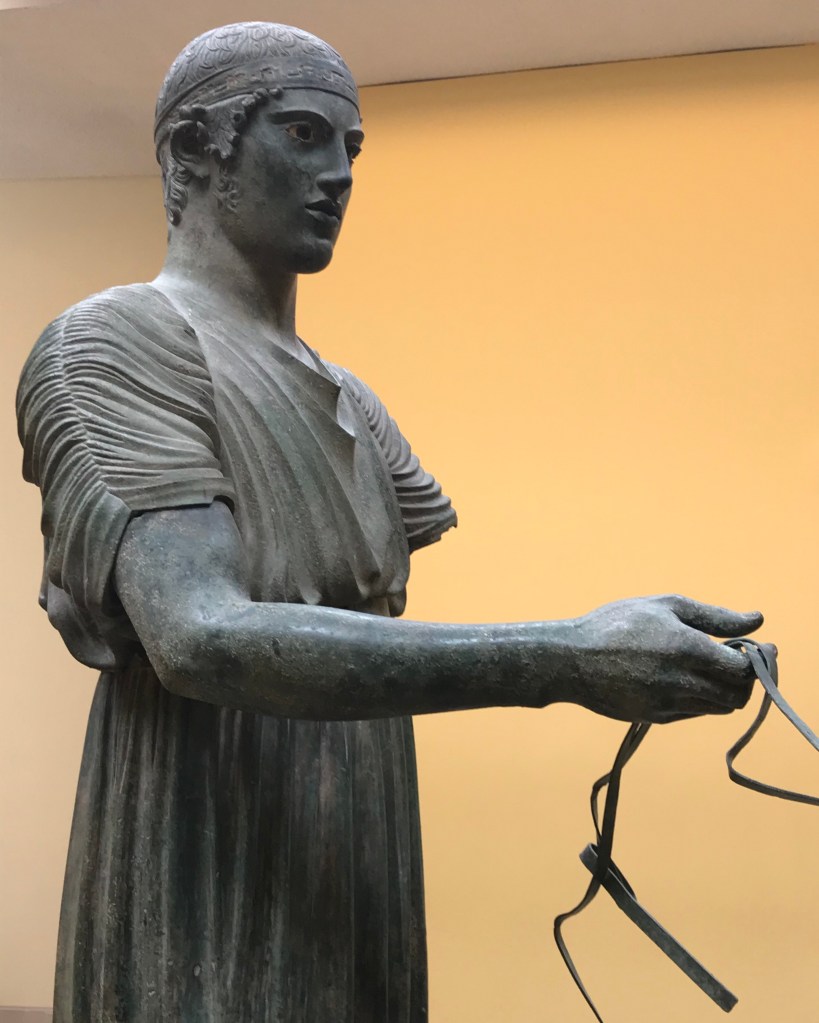
Classical work started appearing in the 5th century BC, about the time democracy was established in Athens. This was also the age of Socrates, Plato, and Aristotle. In Greek, “classical” means “excellence.” The classical period was when art became more involving. Sculpture more accurately described humans, containing much greater detail and natural poses and motions. They also taught how to behave in certain situations, by displaying emotions such as anger, fear, and uncertainty.
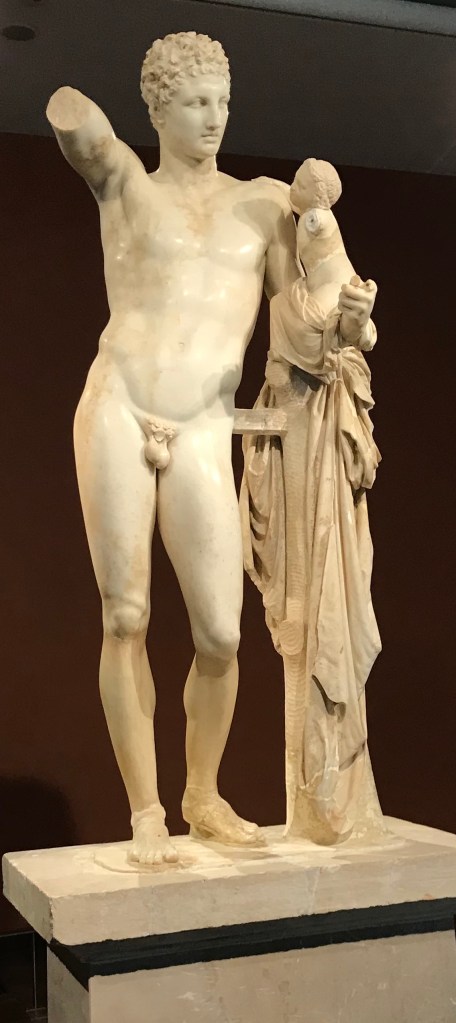
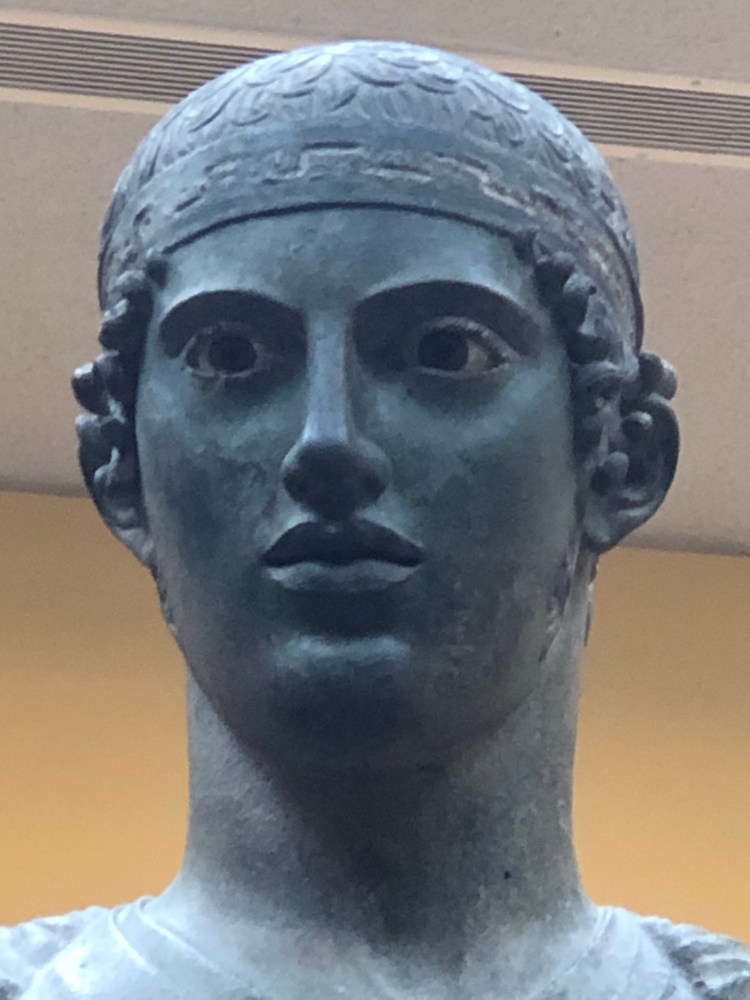
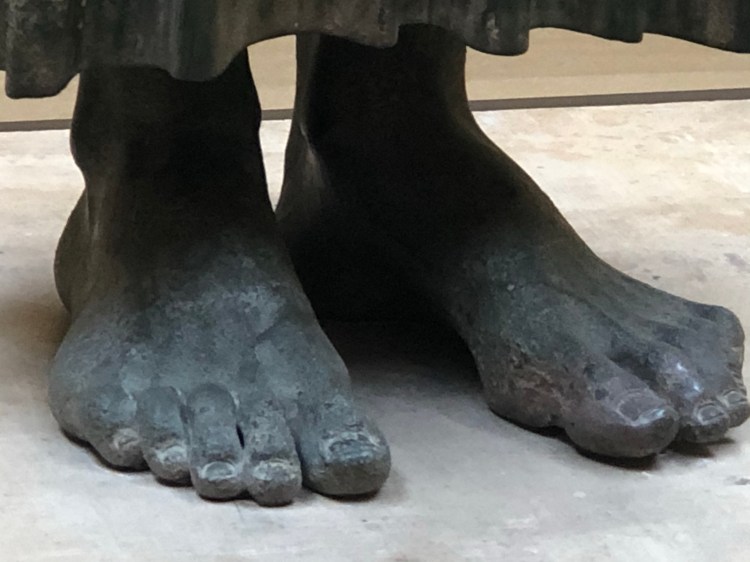
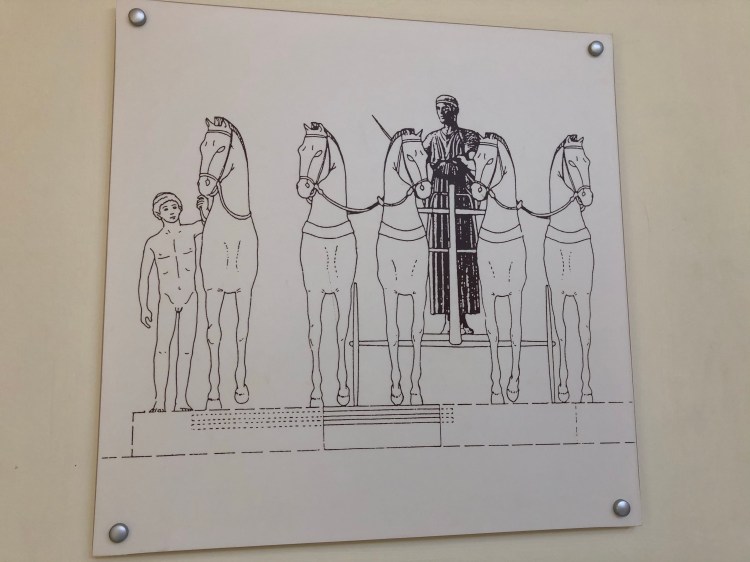
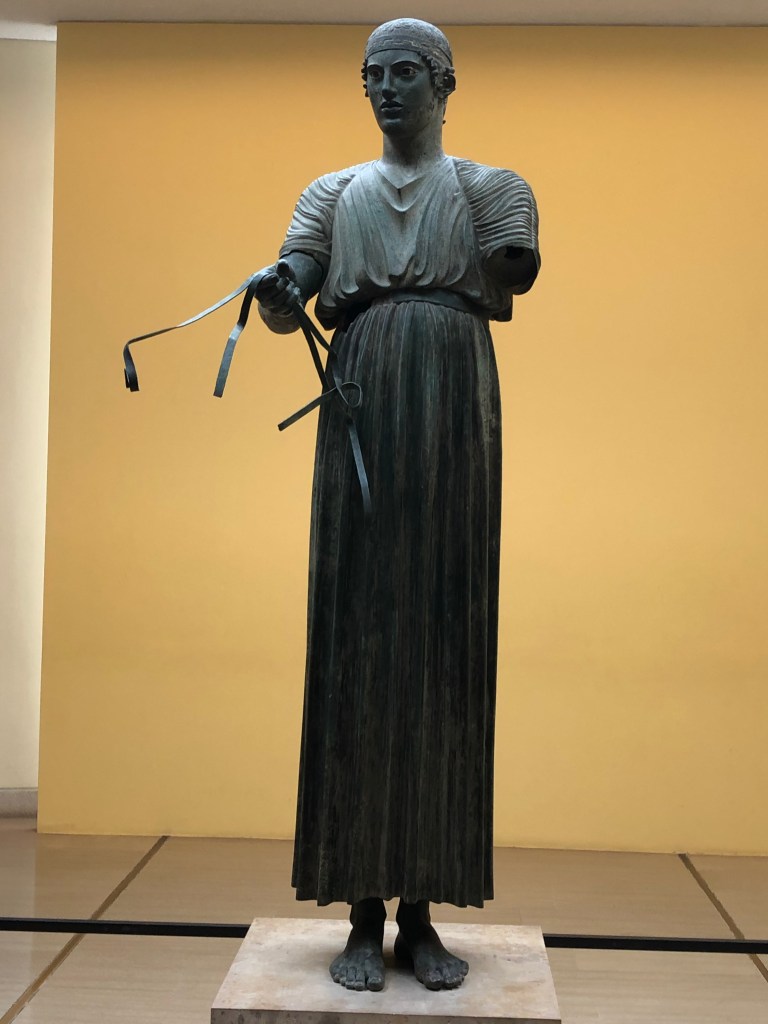
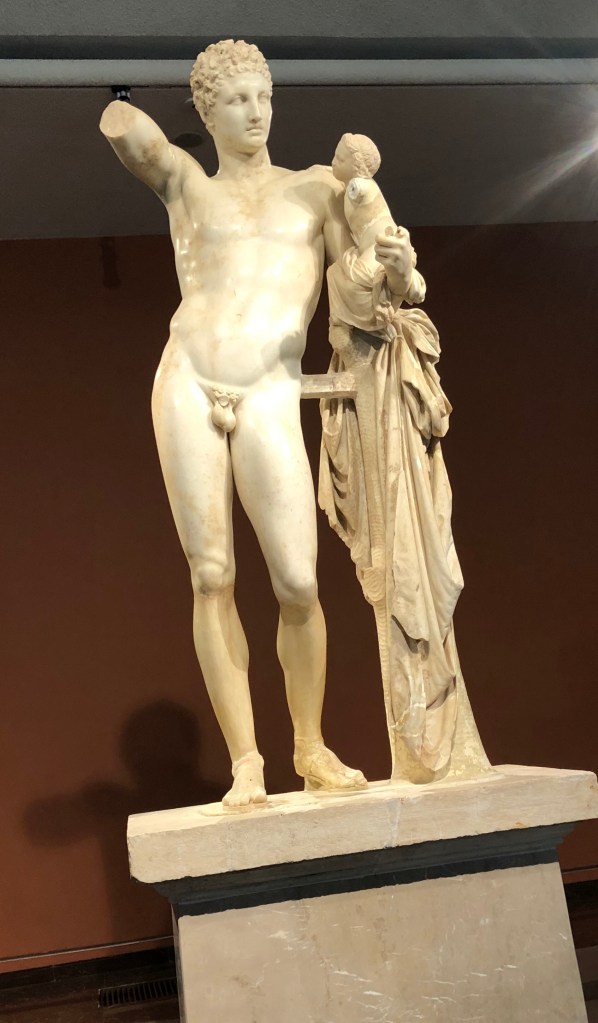
The Bronze Charioteer from a later time in Delphi, the Caryatids from the Erechtheion on Athen’s Acropolis, and the famous Hermes of Praxiteles all exude characteristics of classical sculpture. Notice the detail, the curled and braided hair, natural body positions, the natural draping of the fabrics, and the human emotions that are evident in their faces.
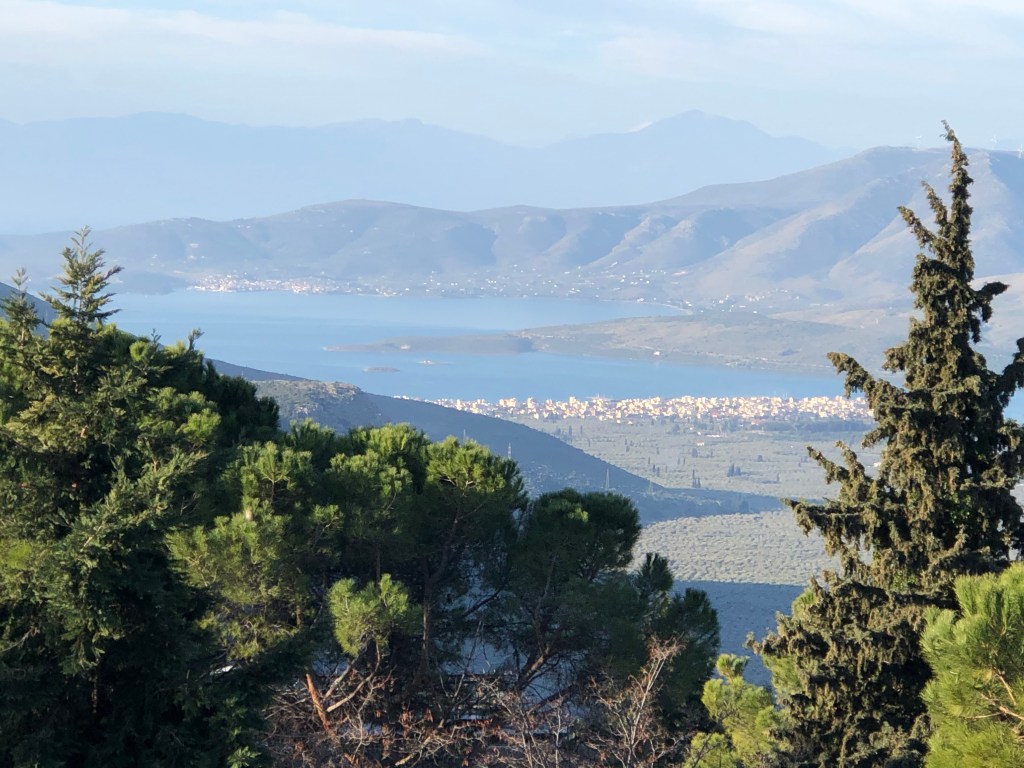
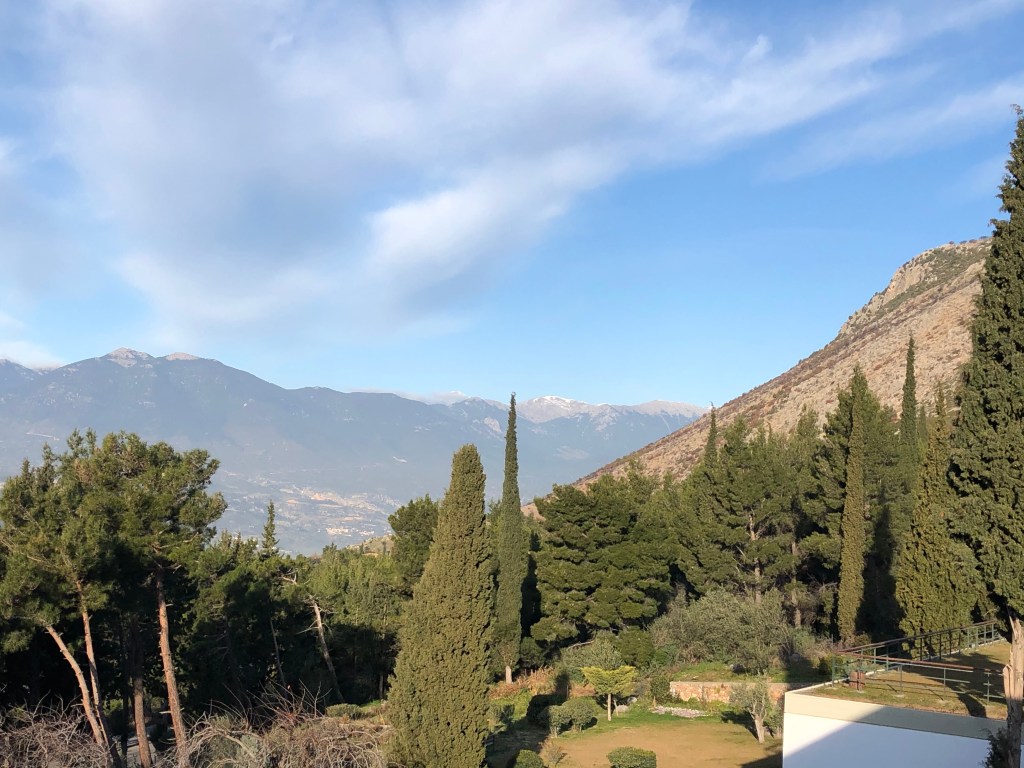
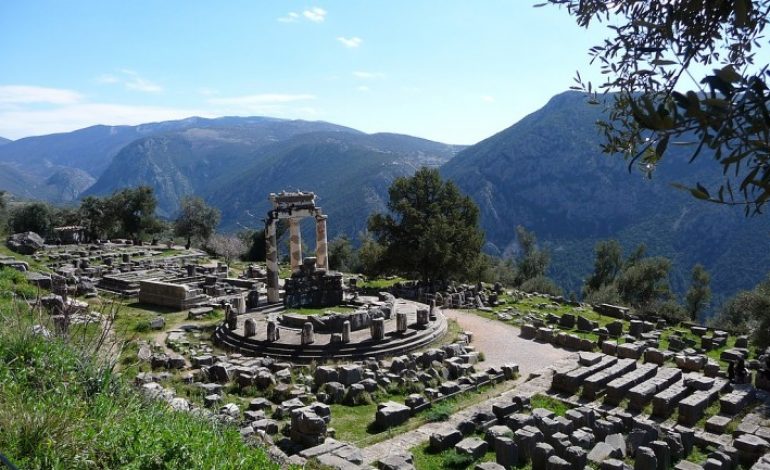
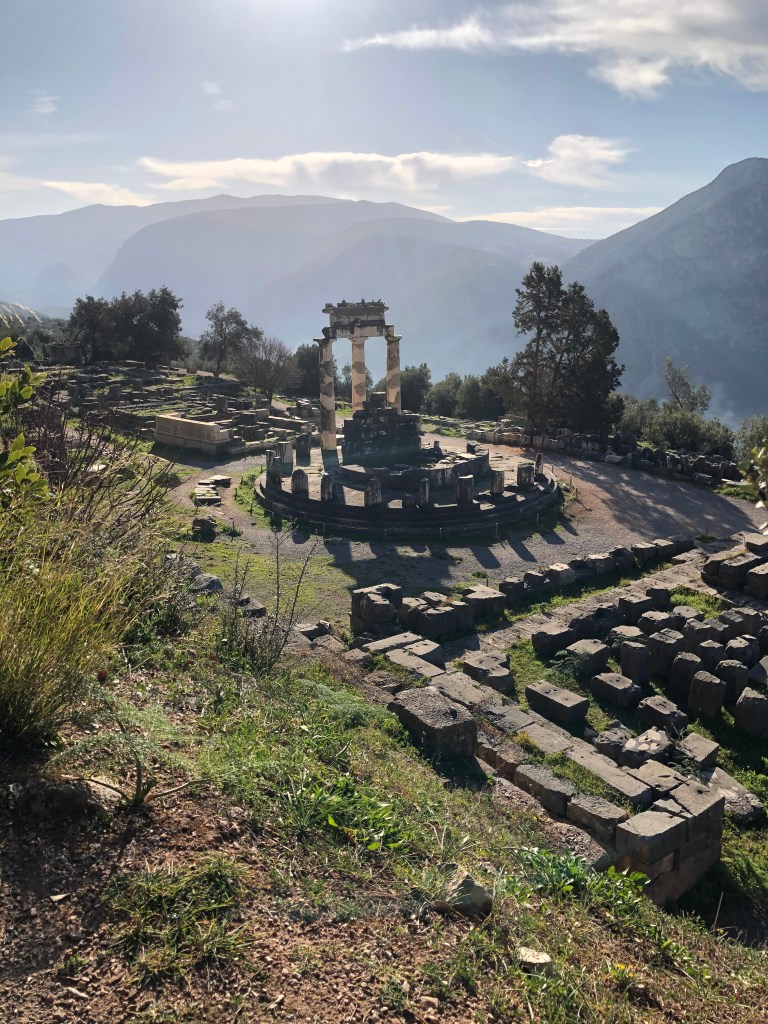
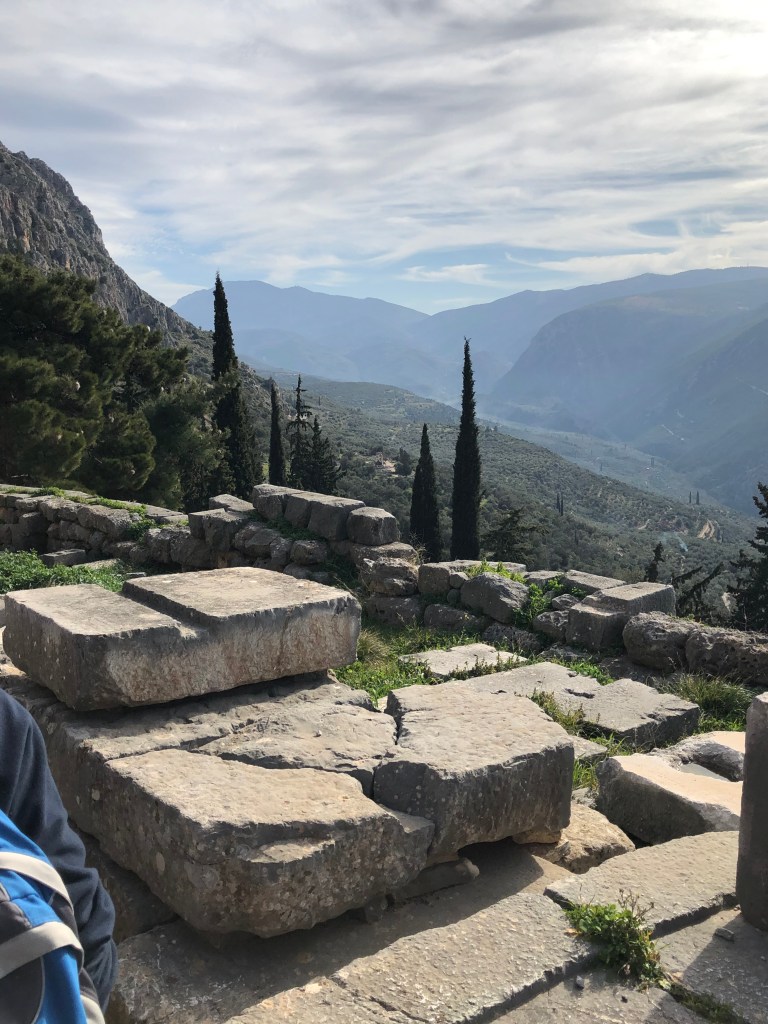
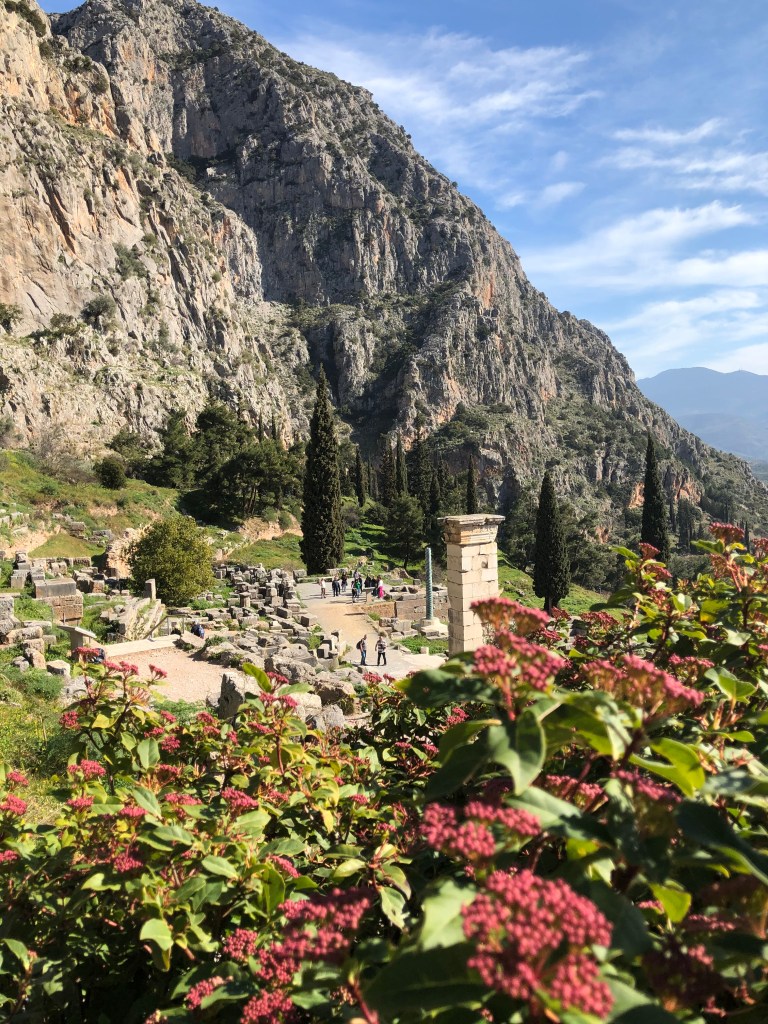
With awe-inspiring and spectacular views high on the southern slopes of Mt. Parnassus, this is home to the prophetess known as the oracle (a.k.a. the Pythia or sibyl), the mouthpiece of Apollo on earth. So glad we spent the night here before our visit to the ruins. The night sky followed by misty morning mountain views was all I needed to get into a mood for ancient Greek mythology.
A short drive after a fabulous breakfast and we were ready to tackle our third day of “school”!
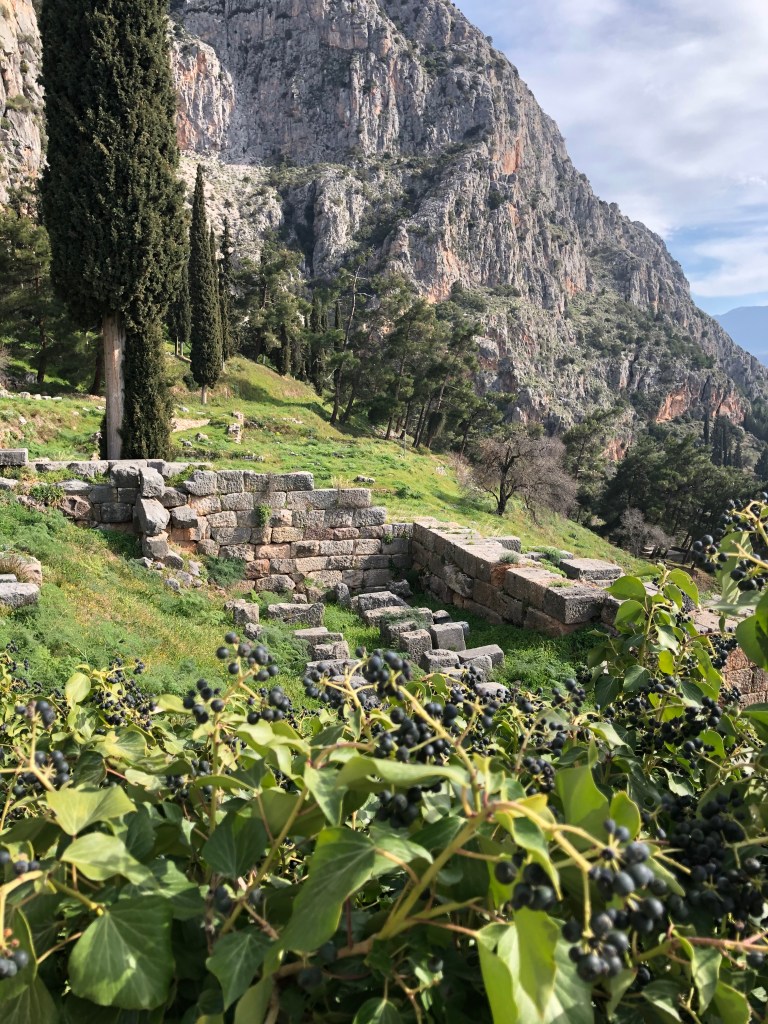
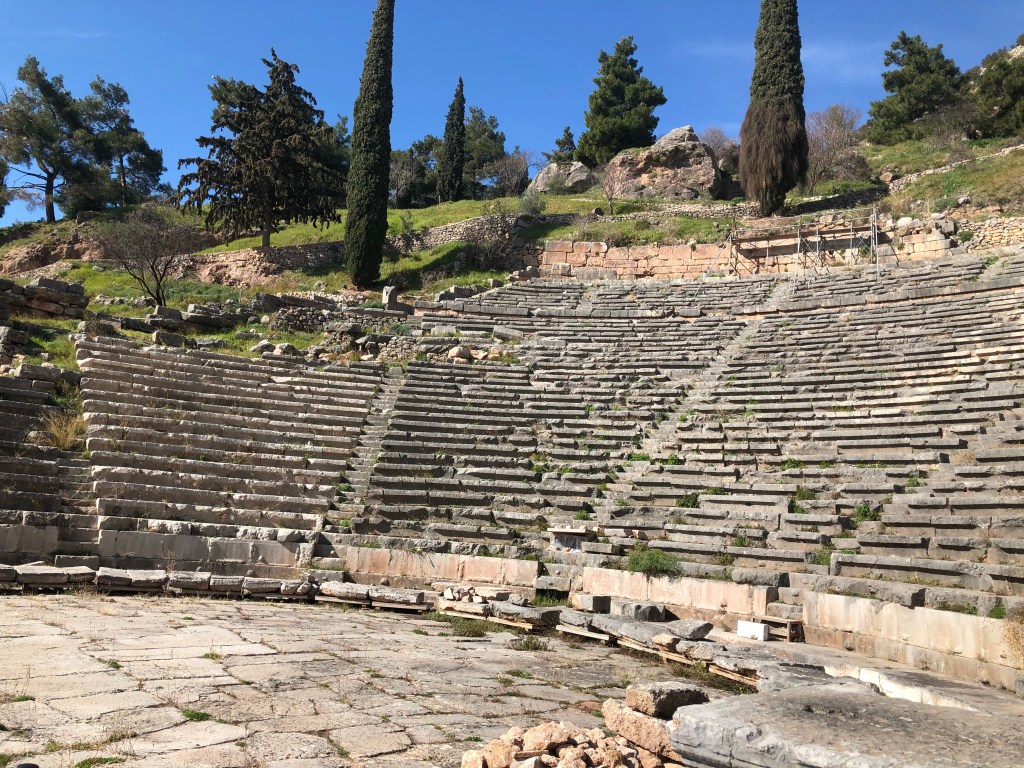
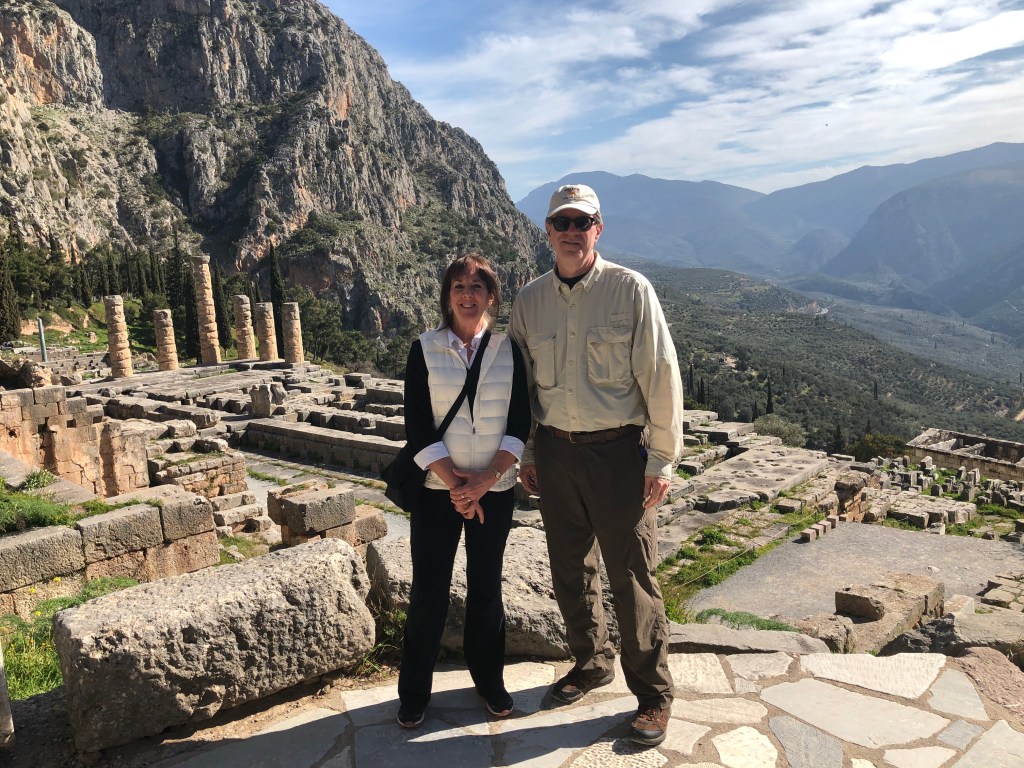
Archaeologists showed up here in 1892 and cleaned up this area. Legend has it that Delphi was the center of the world determined by Zeus. It was here that a priestess (the sibyl) worshiped Gaia, the mother of the gods. A serpent called the Pythia, or Python, guarded the ravine. Apollo showed up one day in the guise of a dolphin (hence Delphi) and killed the Pythian snake. The sibyl became known as the oracle who served Apollo. Eventually the Pythian Games (which rivaled the Olympics) took place here. Even when Greece was conquered by the Macedonians (Alexander the Great) and later the Romans, the sanctuary was preserved. For over 1,000 years Apollo spoke to the mortals through his prophetess, until A.D. 394 when Christians shut down the pagan site.
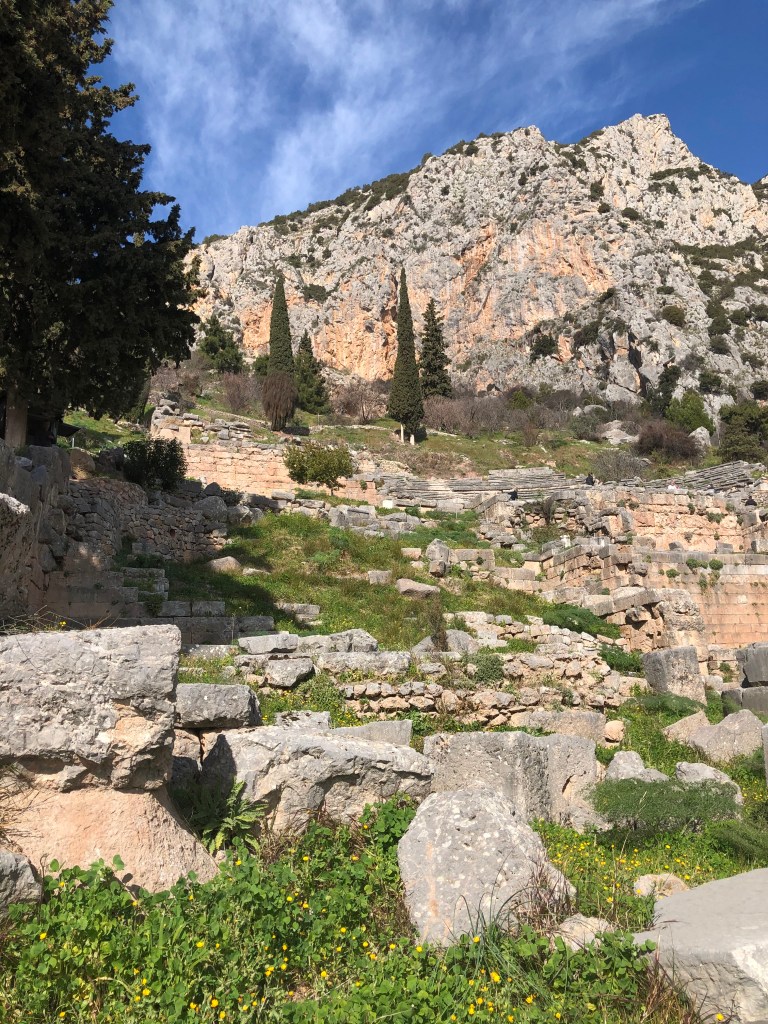
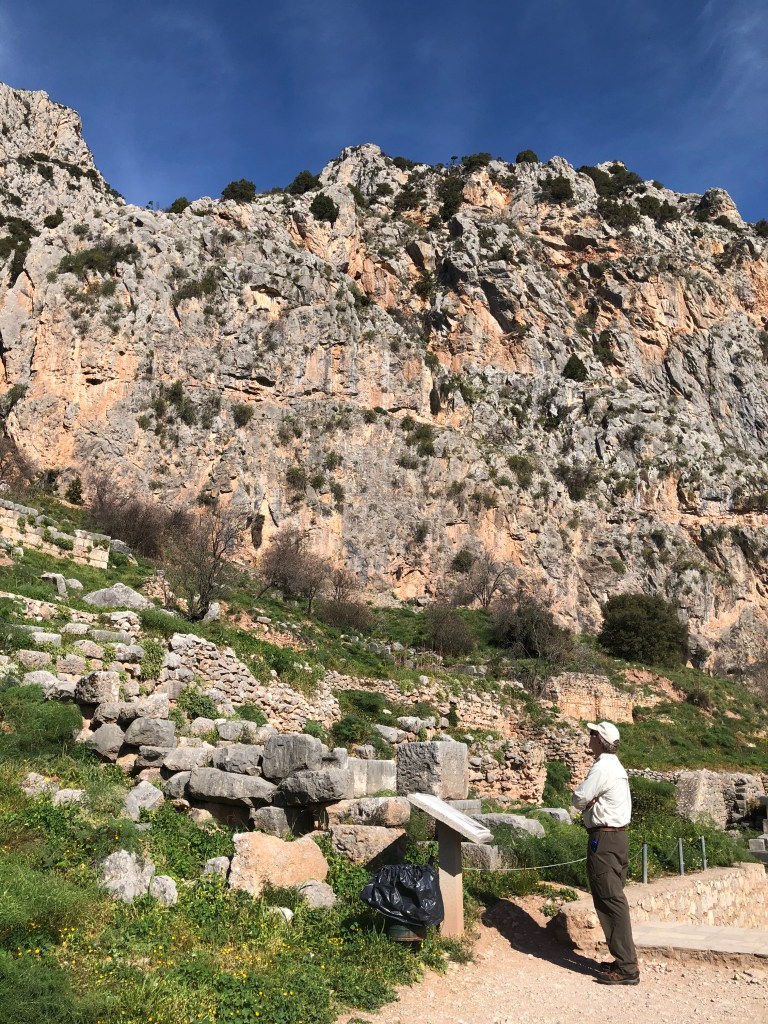
Our morning was spent listening to Stathis tell his stories and slowly climbing the steep rock face on switchback trails up to the Temple of Apollo and the theater.
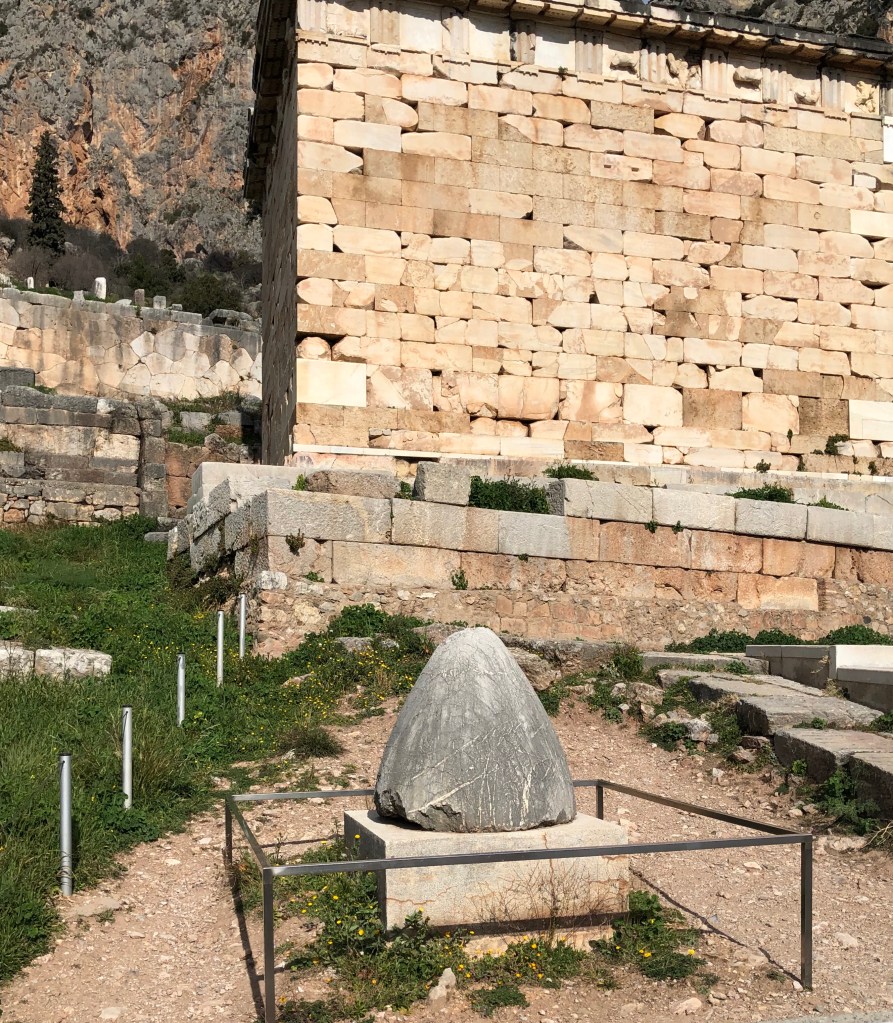
One strange stone cone-shaped monument is called an omphalos or navel! This was the center of the world, remember? So a navel represents that. Legend has it that Apollo’s mother Gaia sent two eagles flying off to go around the world, and after flying a long distance they met at this spot.
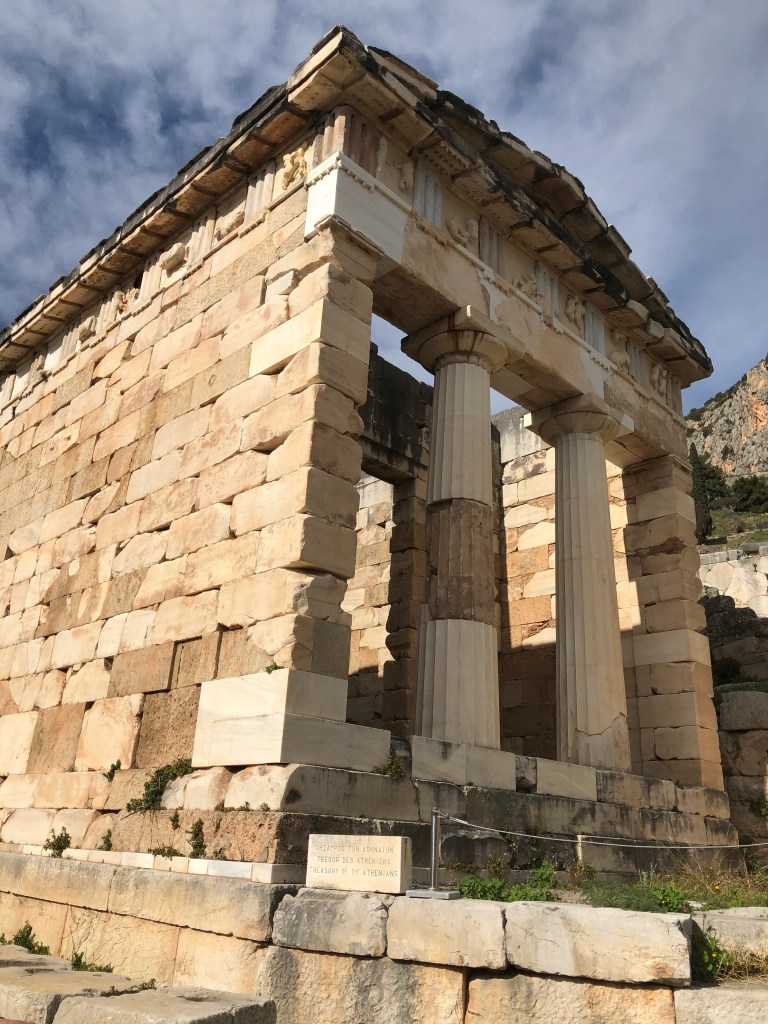
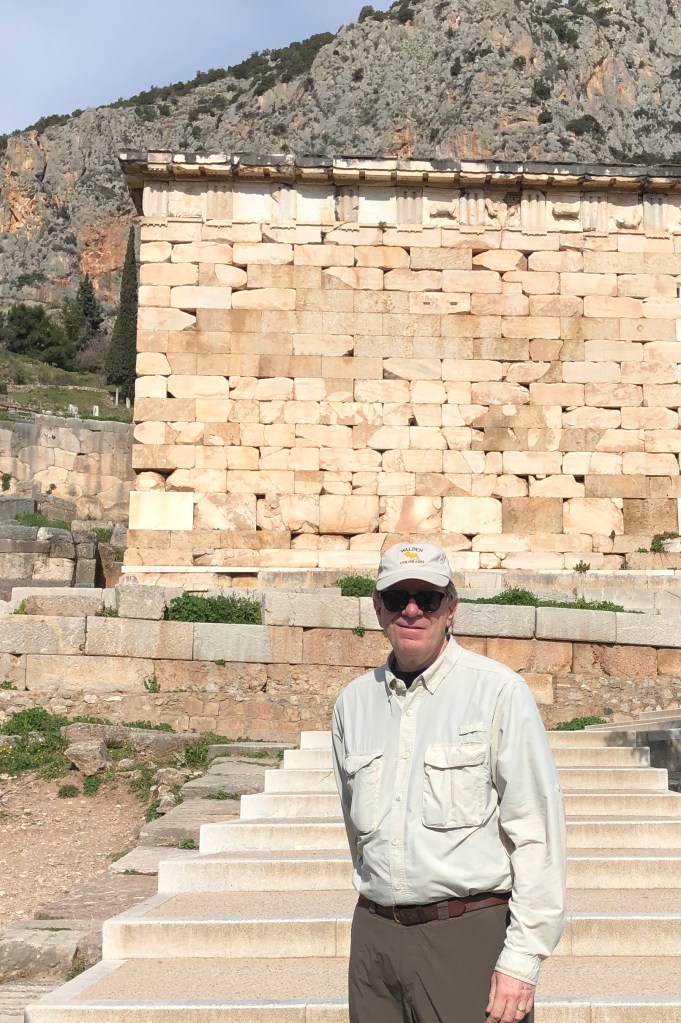
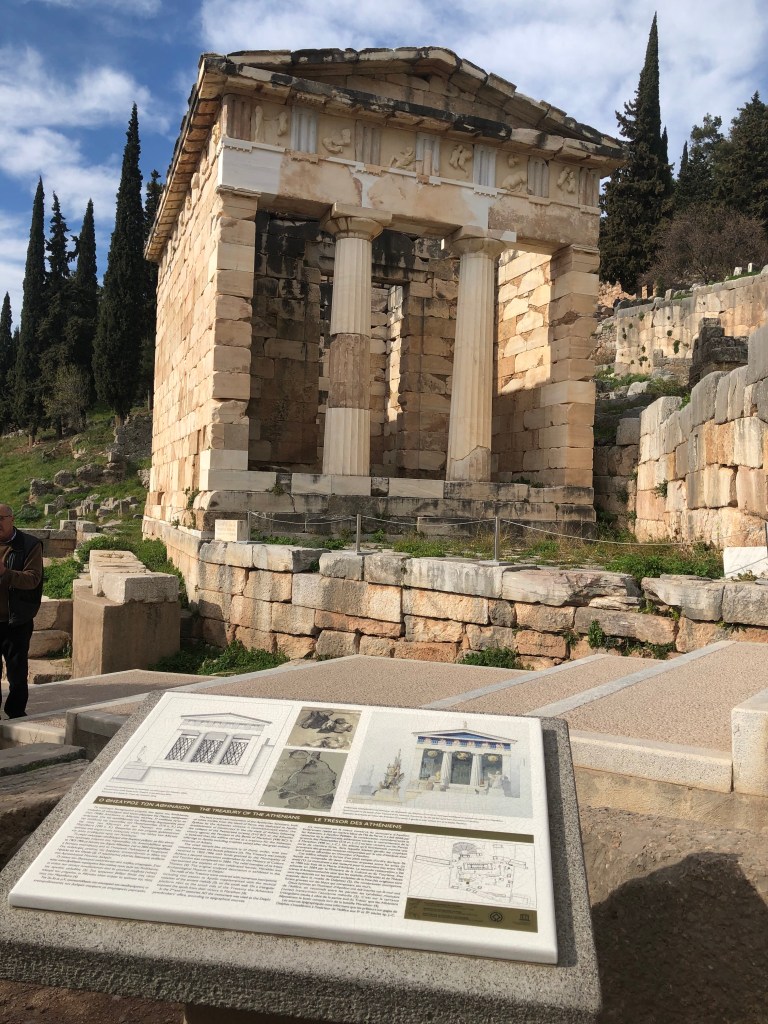
The Treasury, built of white marble, commemorated either the establishment of Democracy in Athens or the victory against the Persians at the Battle of Marathon in 490 B.C. “We just don’t know.”
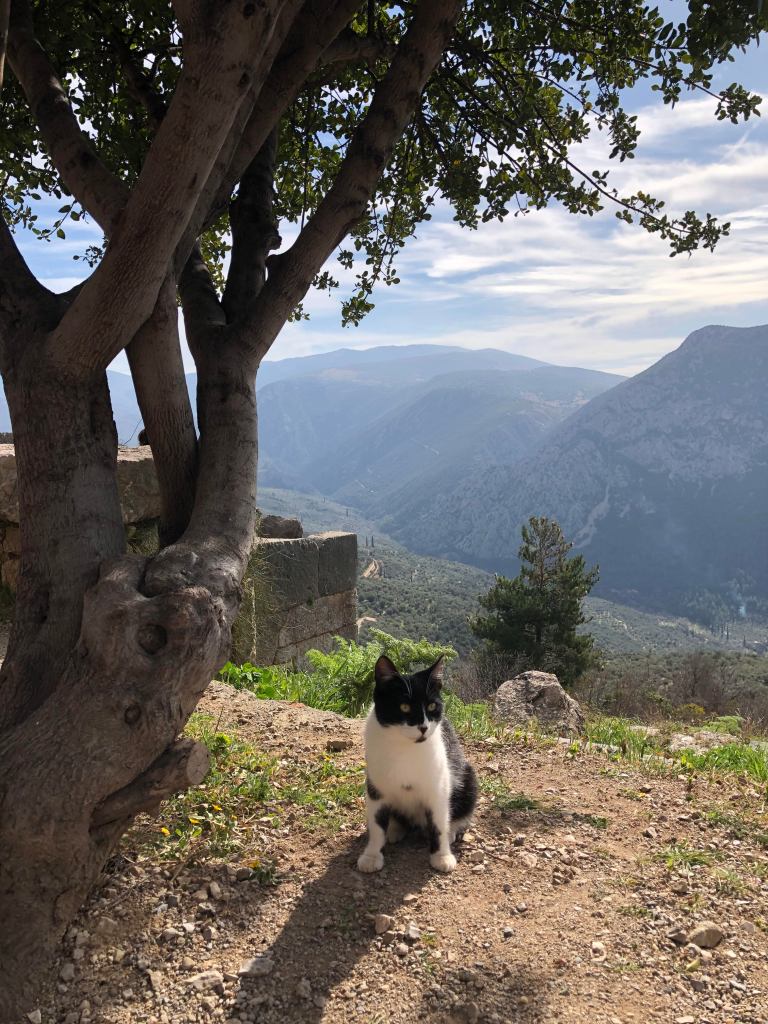
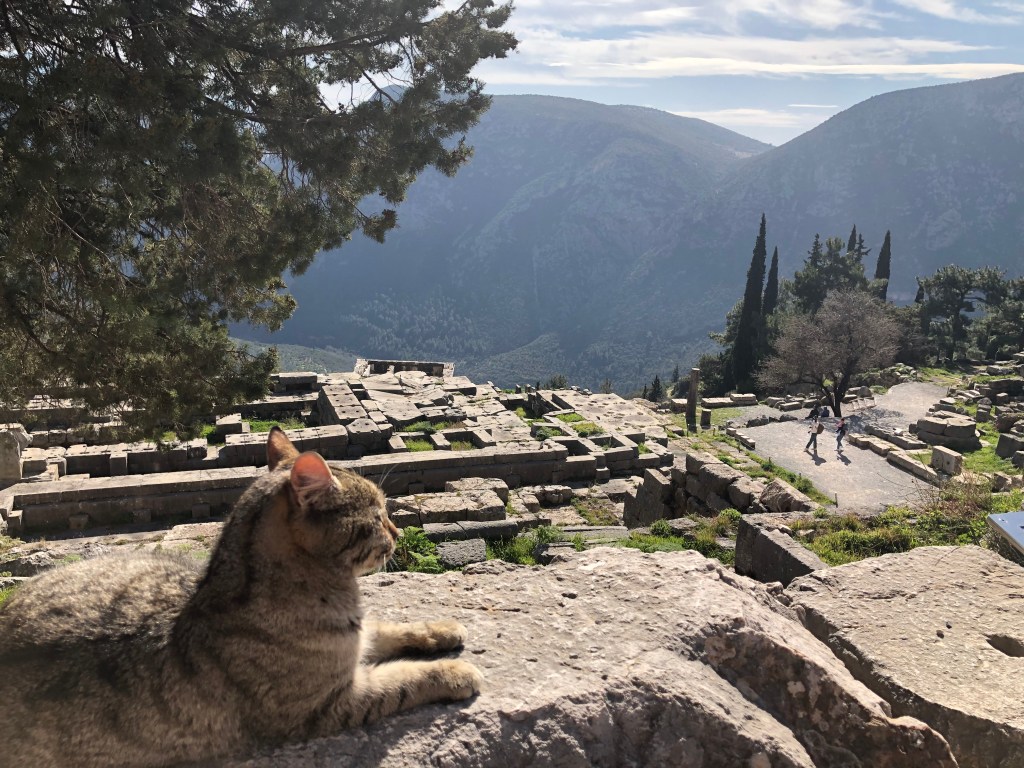
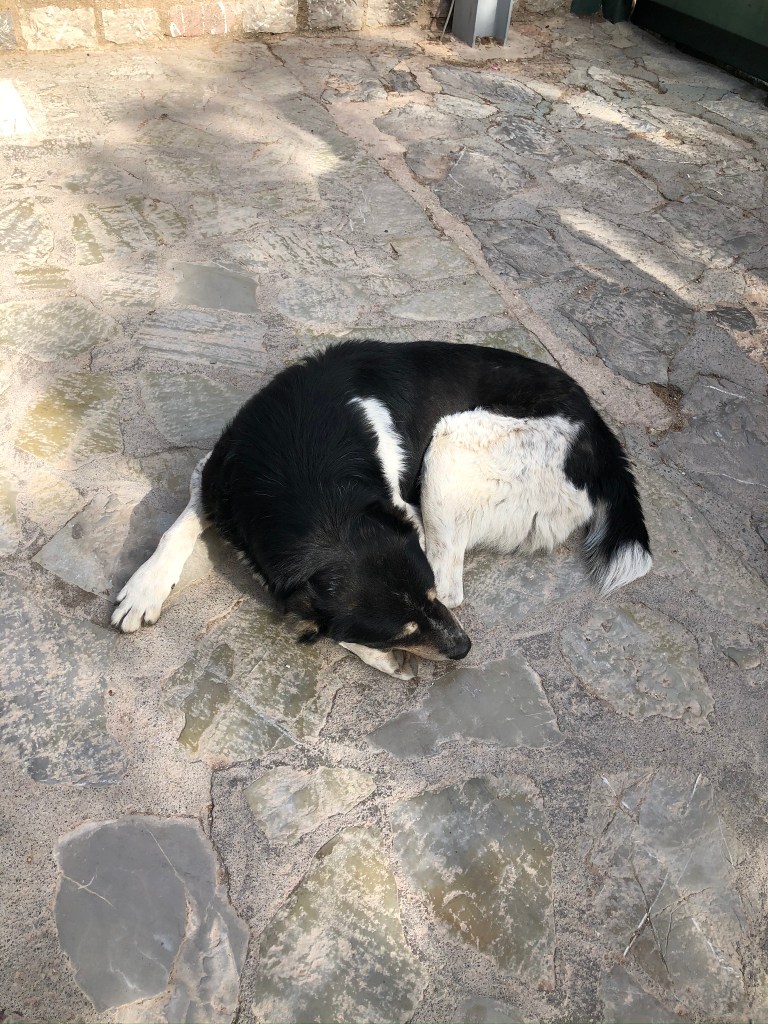
Cats and dogs are everywhere!
The Archaeological Museum here was well done. Housed here are the Twin Kouros Statues, the Sphinx of Naxos, and the Bronze Charioteer.
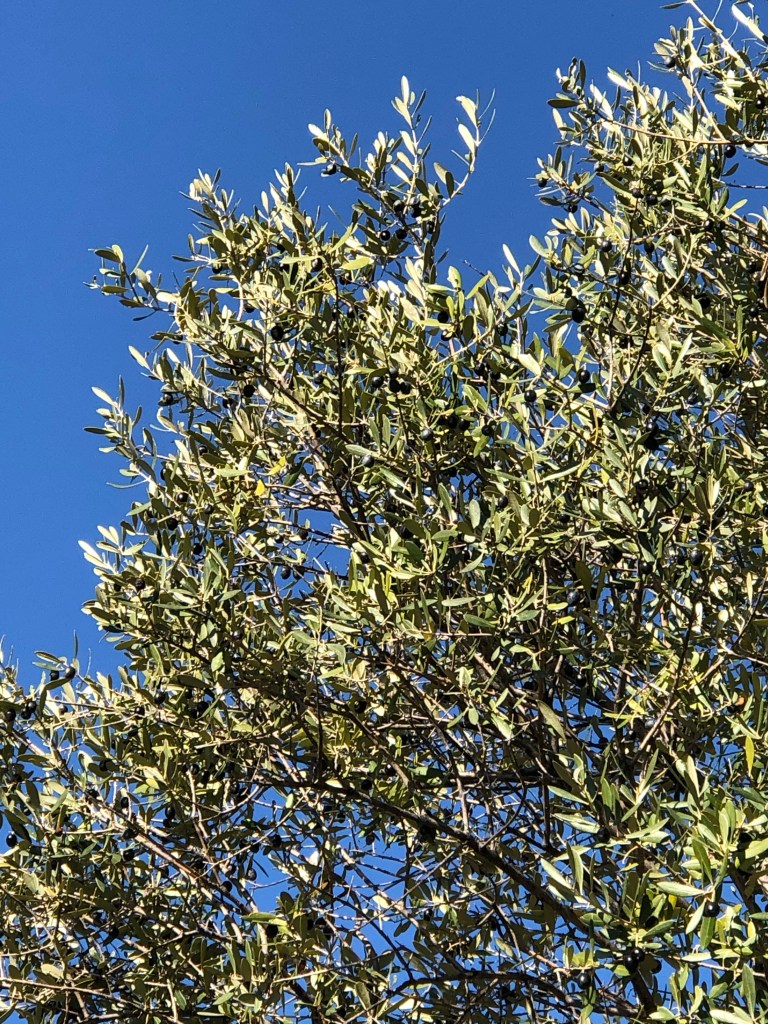
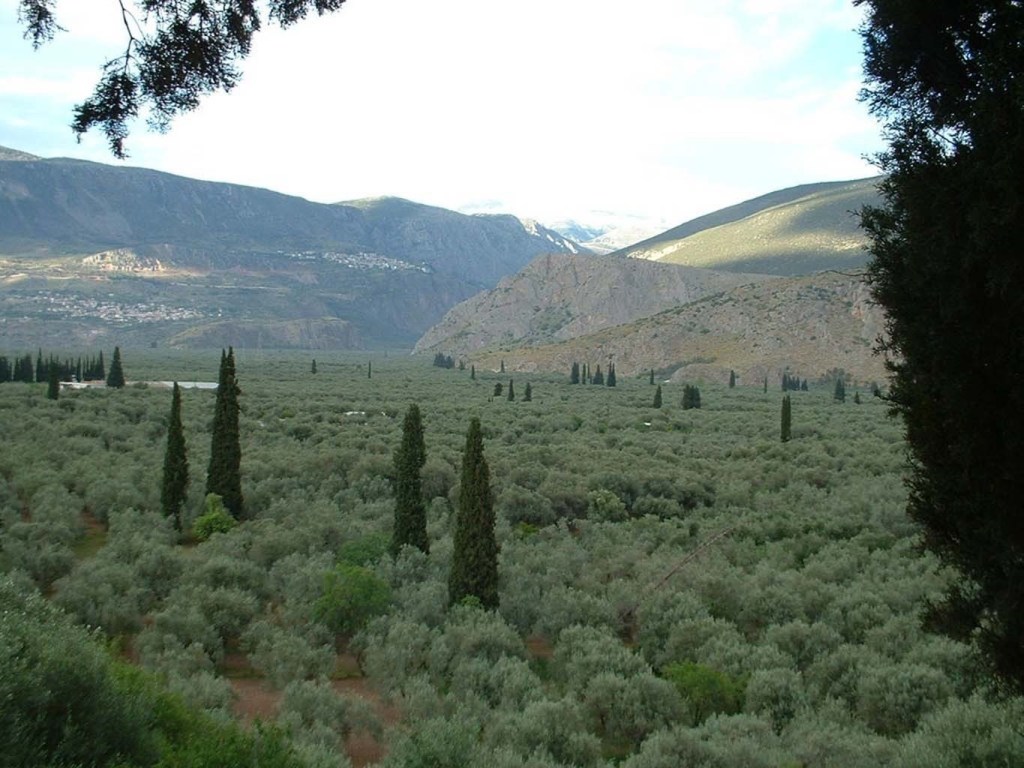
There are over a million olive trees on the slopes here. 70% of them are more than 150 years old. This olive grove is the largest continuous grove in the country and belongs to the famous Delphic Landscape.
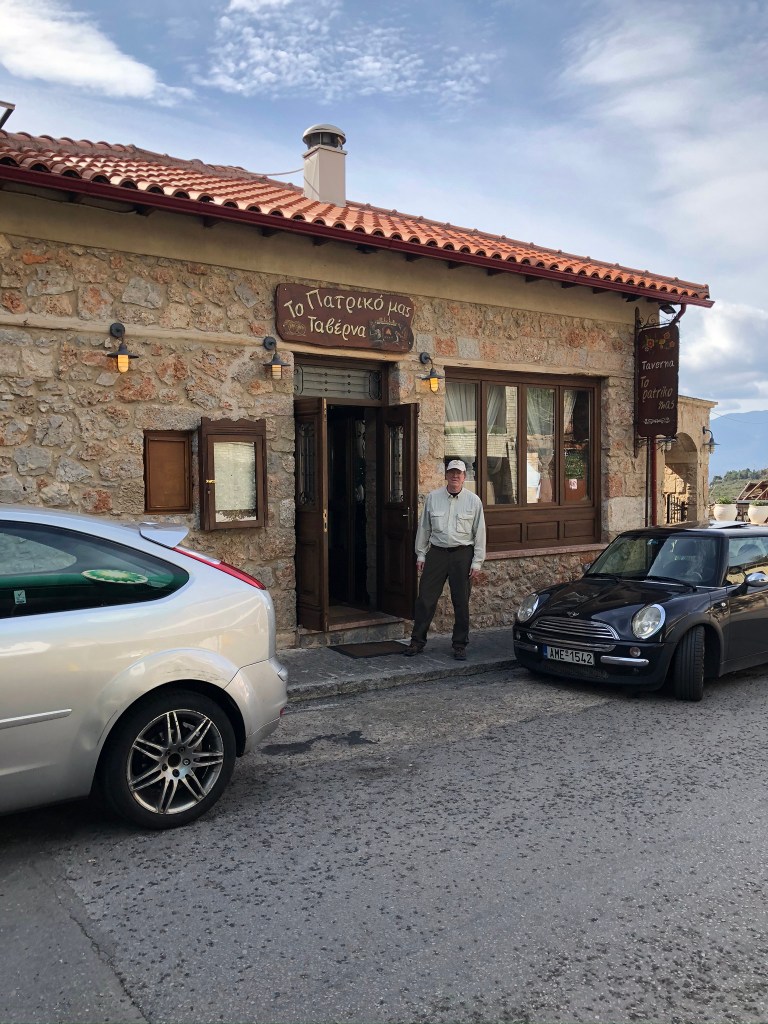
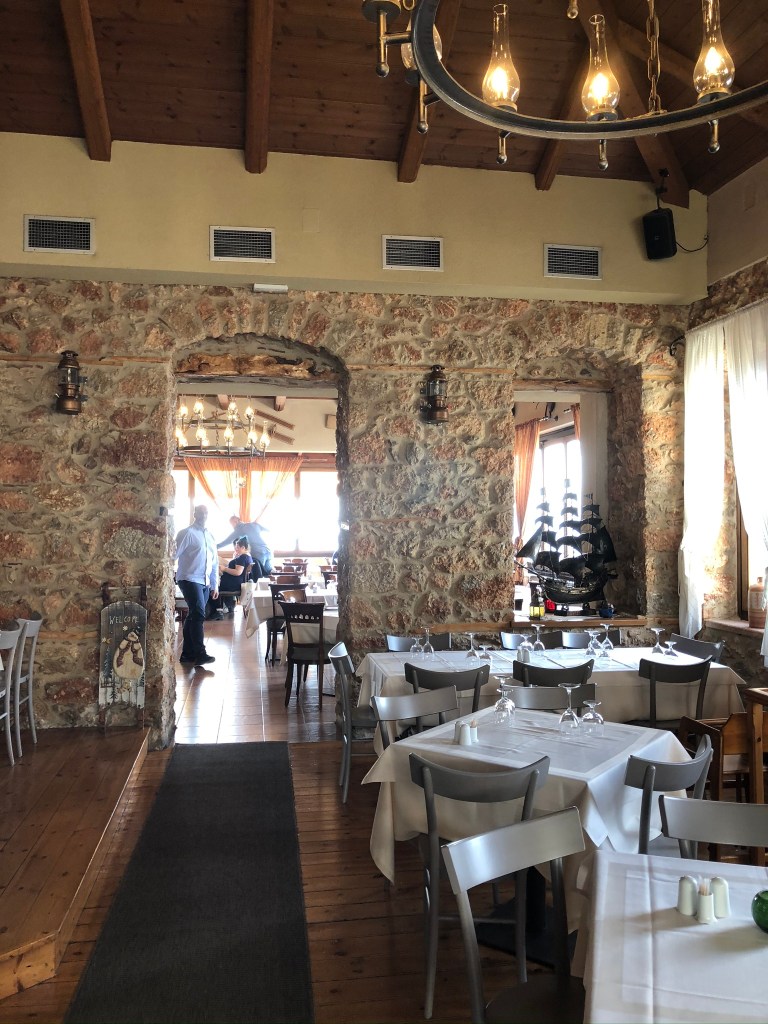
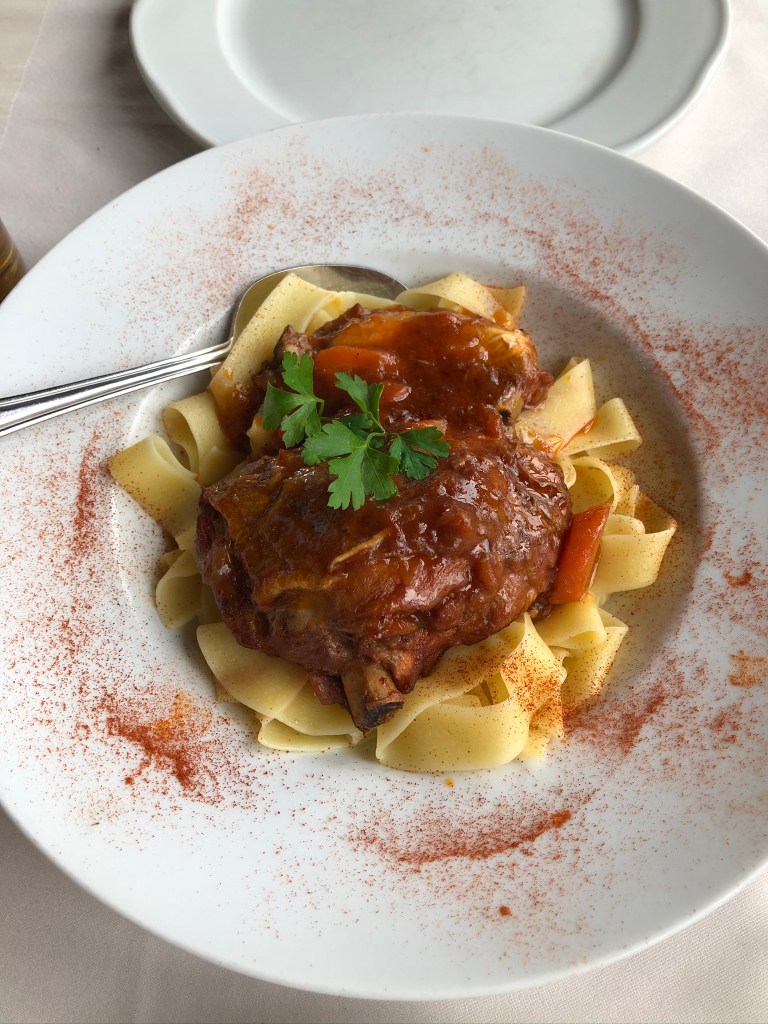
The tiny town of Delphi with its two roads running parallel, hanging on cliffs and connected by steep staircases, was the perfect spot for a lunch of salad (Greek with tomatoes and feta cheese) and traditional roasted rooster cooked in red wine called kokoras kokkinisto (not chicken, but who could really tell?)
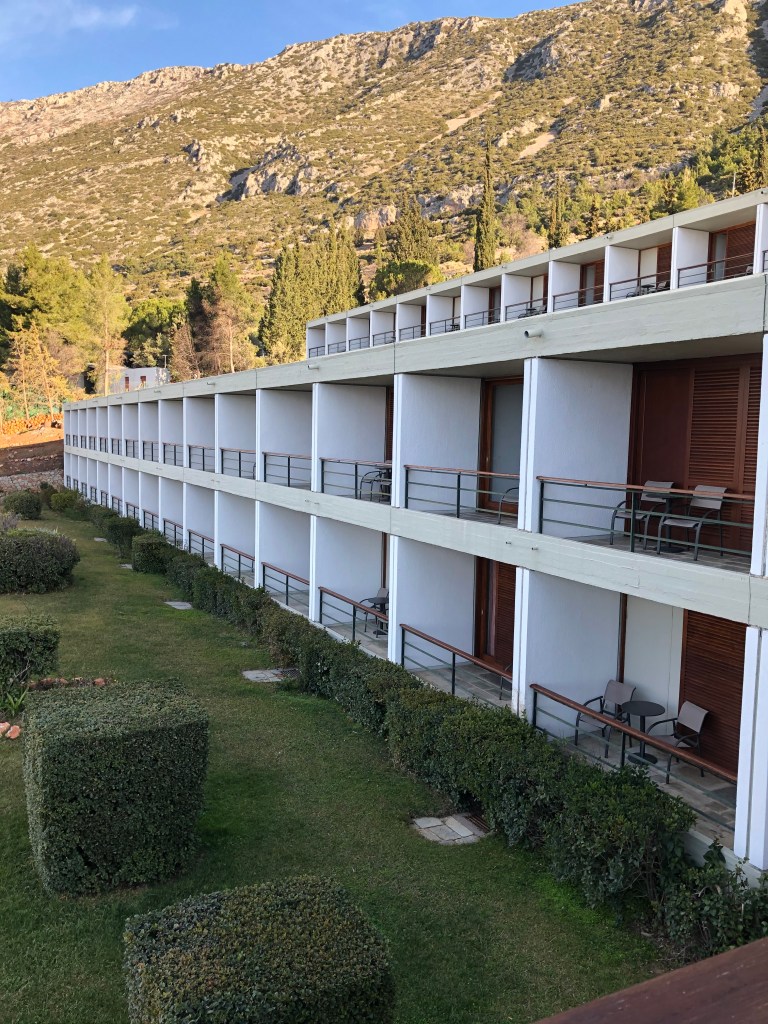
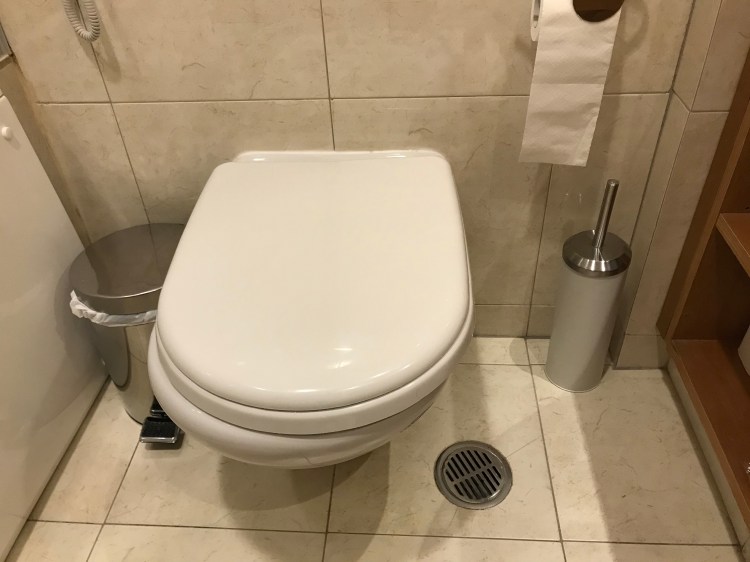
Wherever we went in Greece, our hotel had a drain on the floor. OK, maybe that’s not so unusual. When you leave the shower curtain on the outside of the tub and the water runs out onto the floor, it has someplace to go.
But this was different. When you unplug the drain in the tub after your evening bath, bath water frequently comes up out of the floor drain and washes across the floor! Apparently the bath tub and sink are both plumbed into the floor drain pipes, so if there’s too much water to get rid of at once it just flows out across the floor. Disgusting!
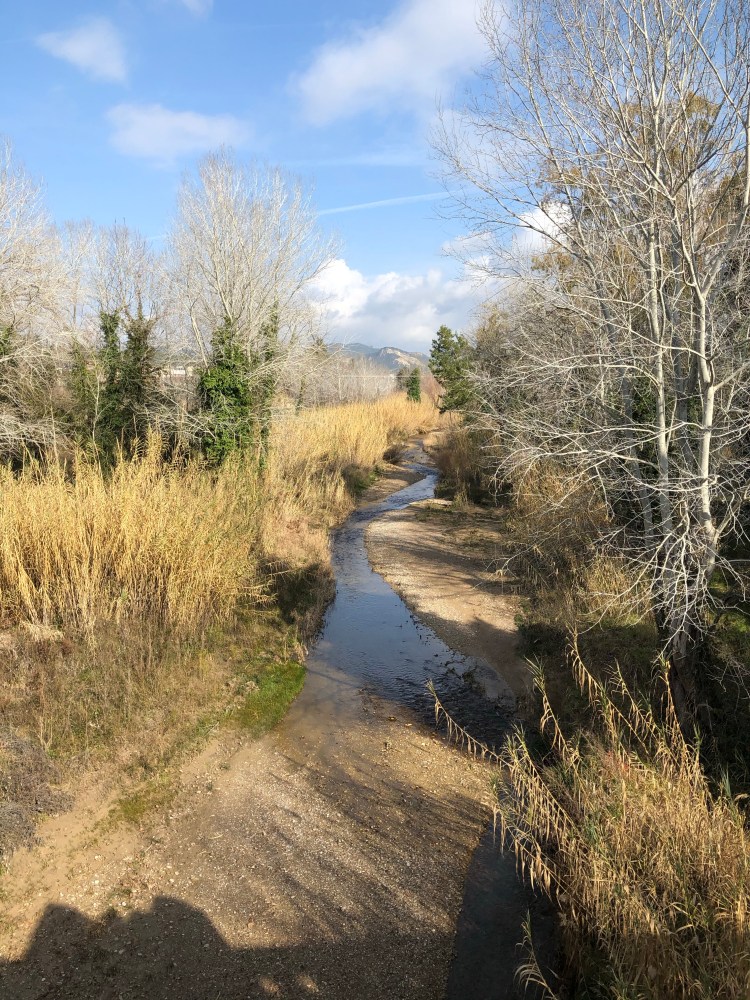
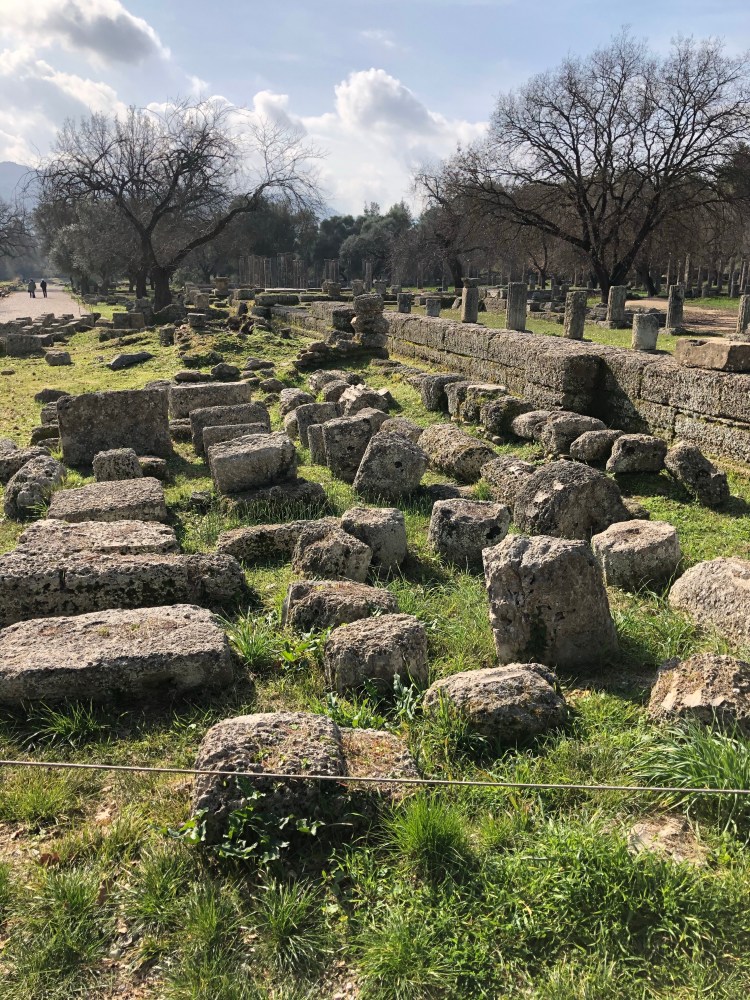
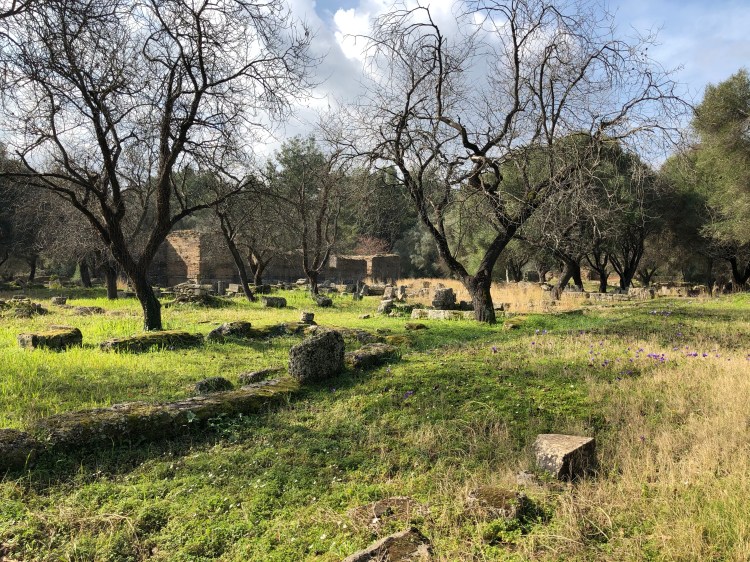
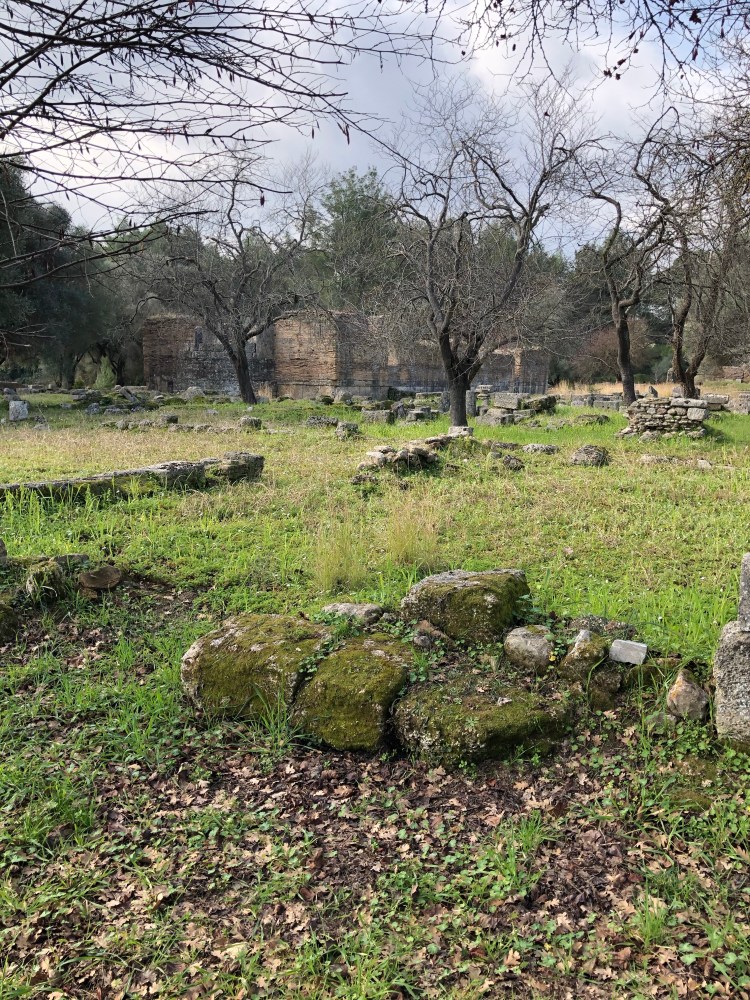
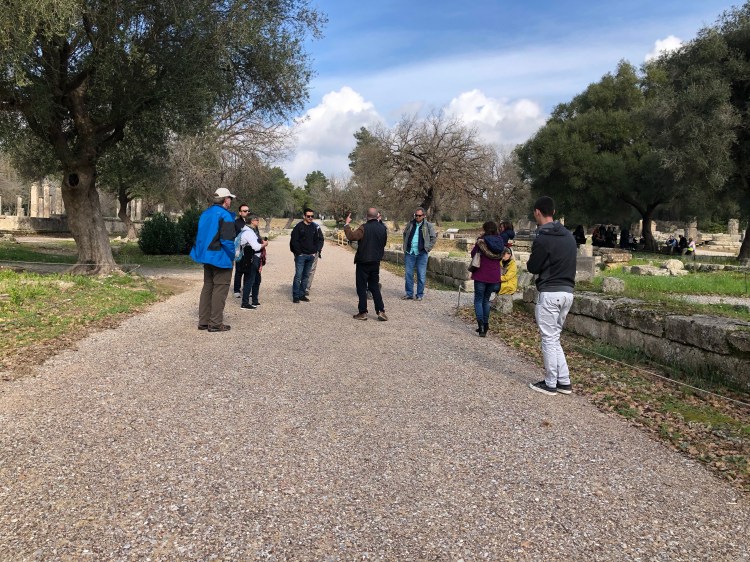
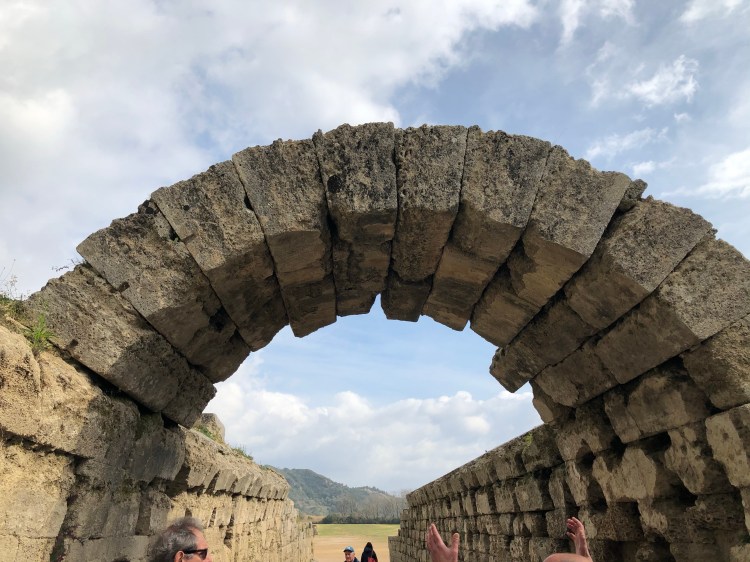
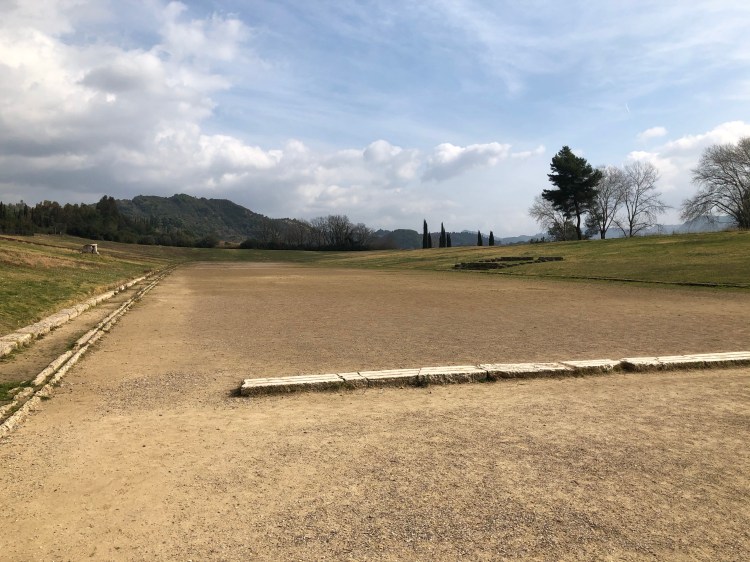
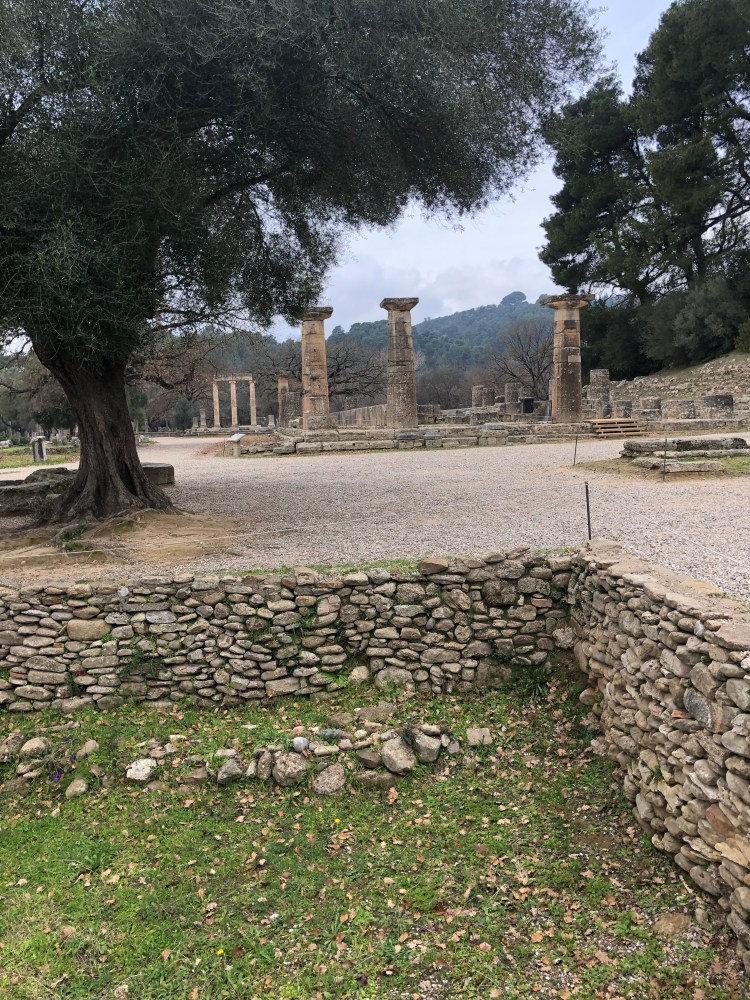
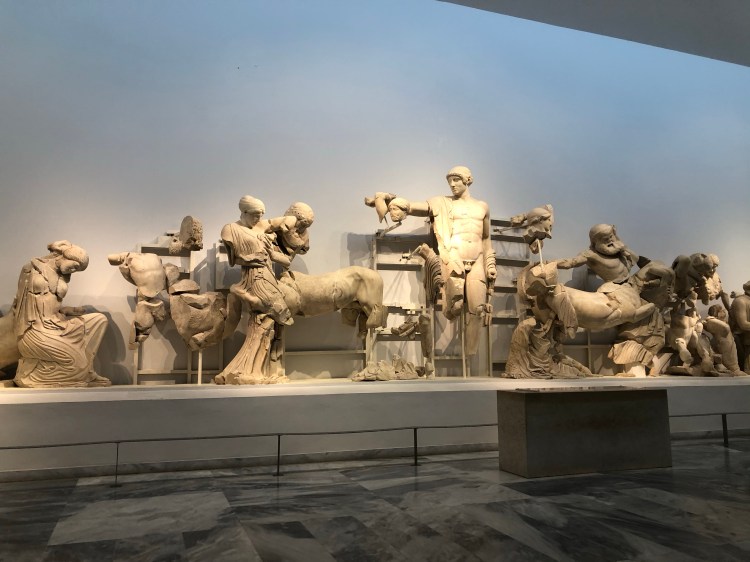
There came to be a place in Greece where young men trained mentally and physically and a competition ensued. This was the site of the original Olympic Games located in the valley of the Alphios River in western Peloponnese. This river is all but dried up as you can see from my picture.
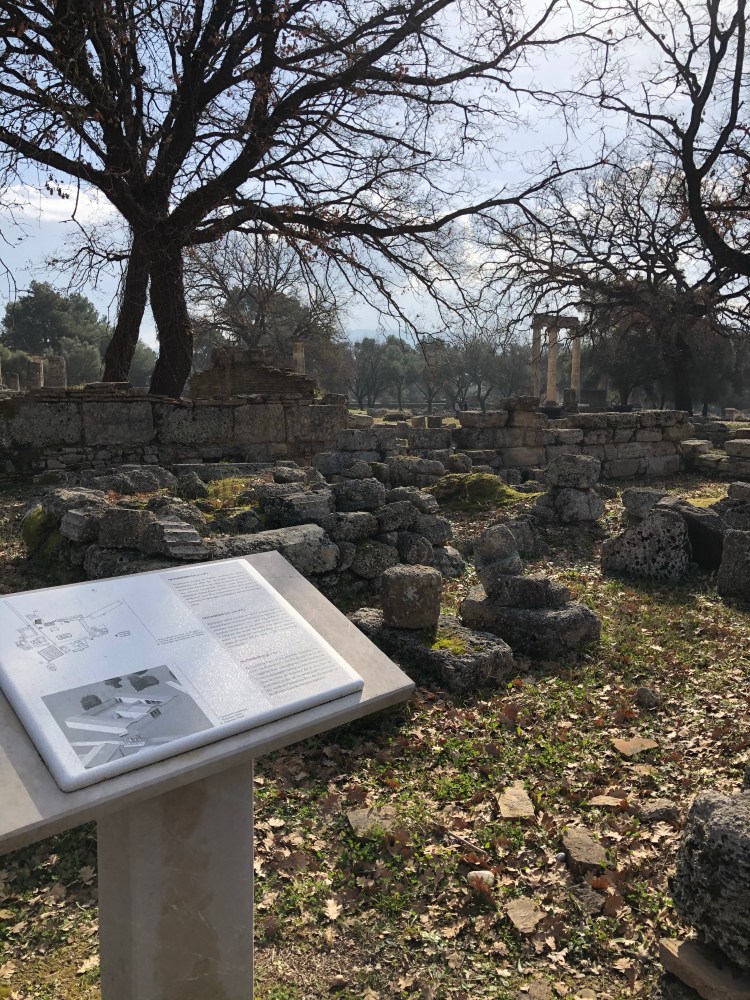
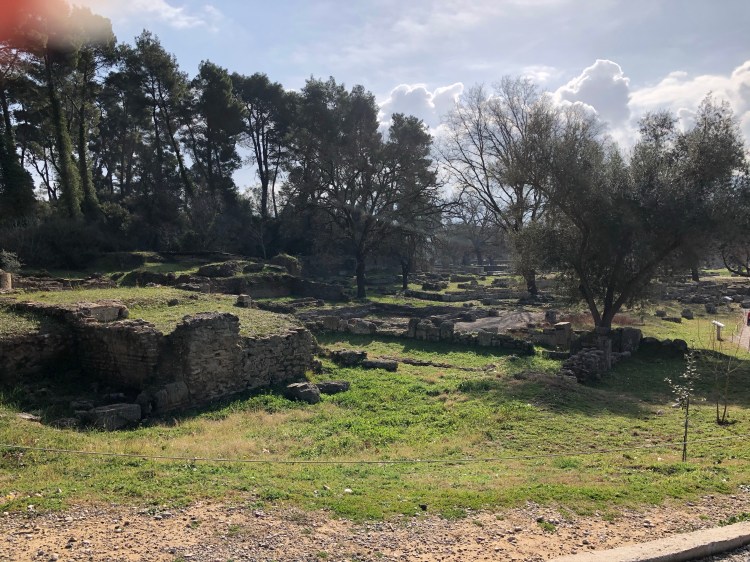
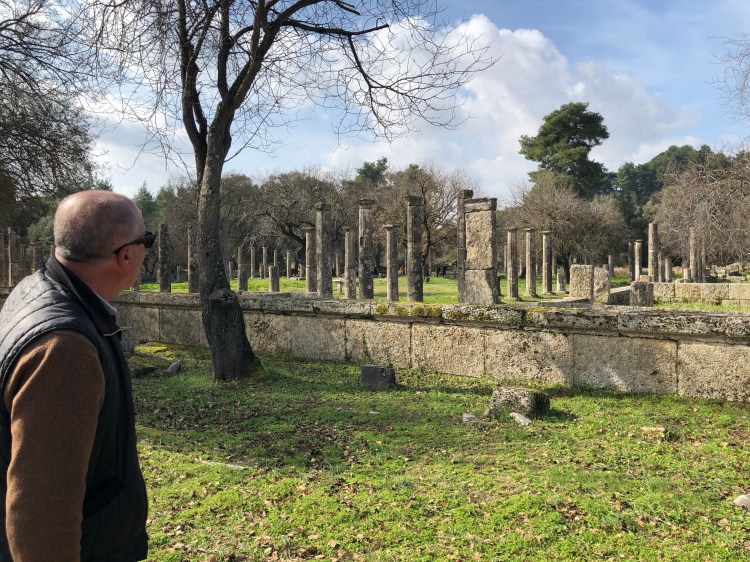
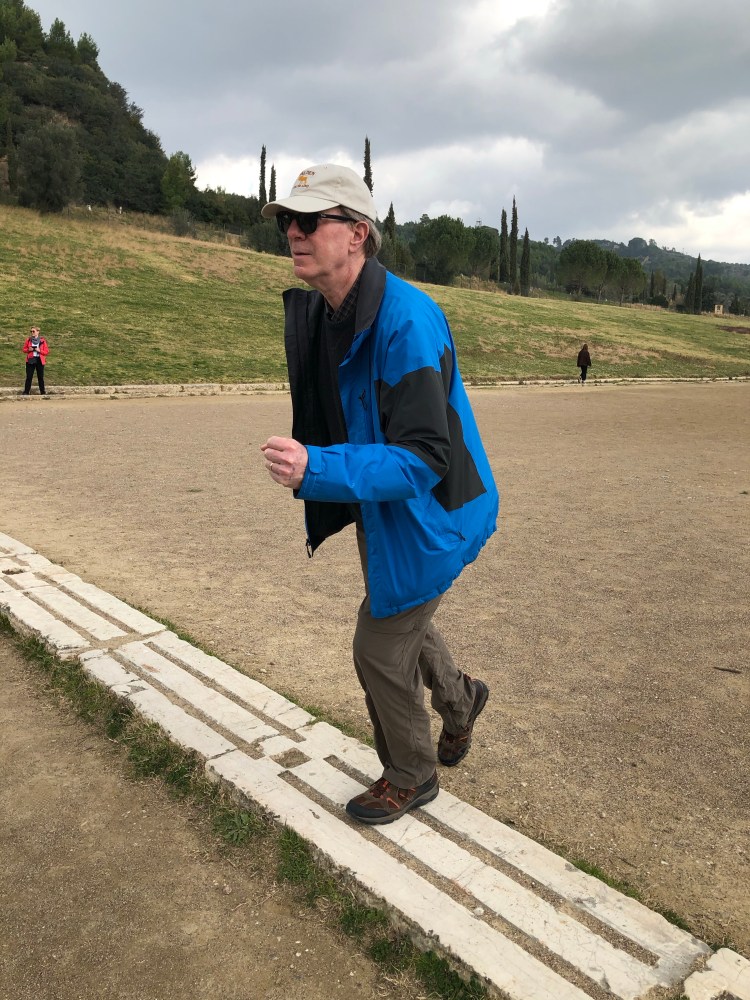
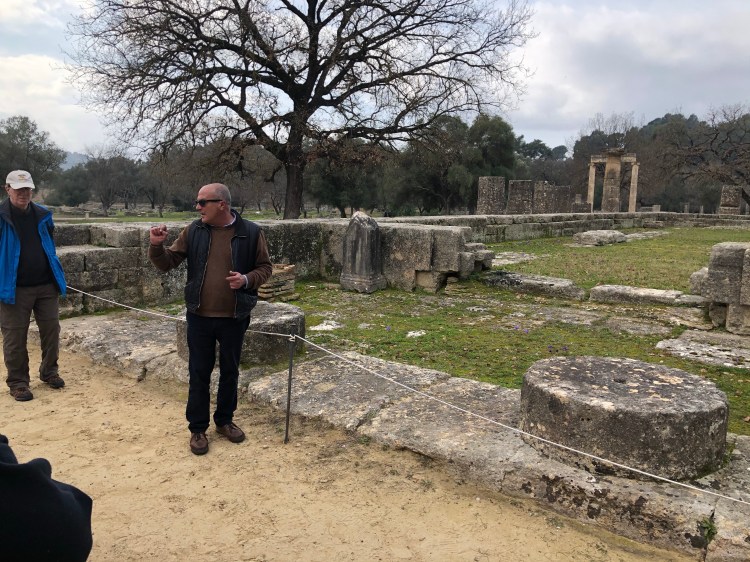
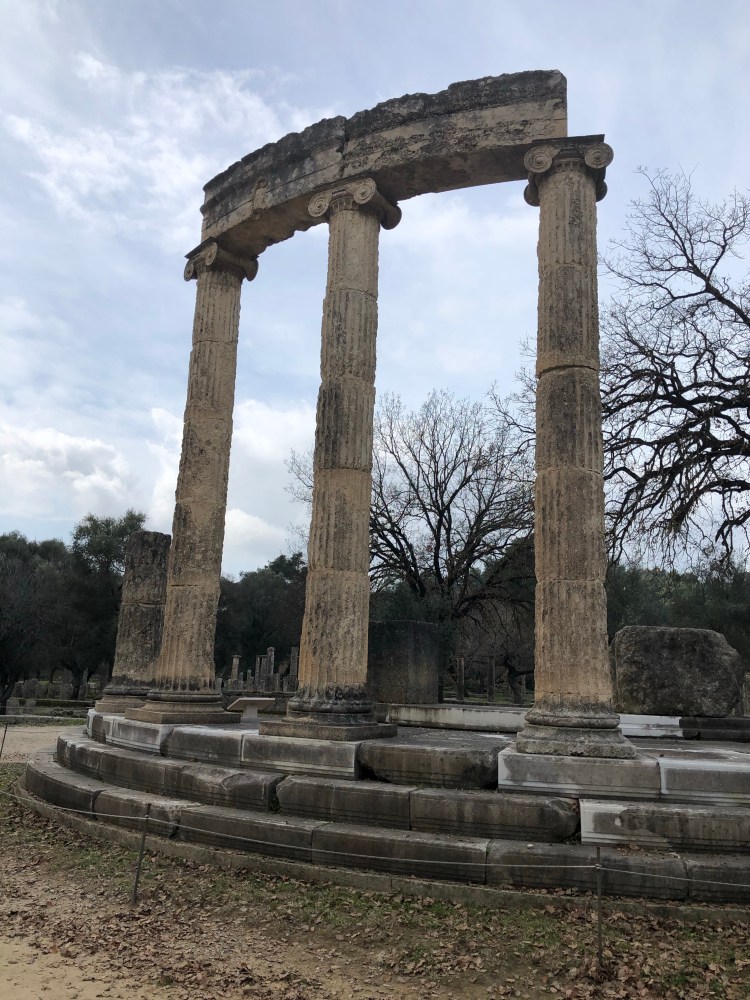
We walked along the Sacred Way to the archaeological site and tried to imagine as our tour guide, Stefis, painted a picture in our imaginations of this pilgrimage site that was only visited every four years and drew 45,000 people for over 1,000 years (776 B.C. – A.D. 393).
It all ended due to an ultra-Christian emperor as part of a purge of pagan festivals. It wasn’t until 1896 that the modern Olympic Games were revived and athletes from around the world were invited to participate. We saw that stadium in Athens later in the week. But back to this peaceful ancient campus, the part I tried to imagine was the hot month of August, hundreds of young (19 – 21 year old) NAKED men covered in olive oil and dust, plus the cheering crowds of spectators! Imagine the sunburn!
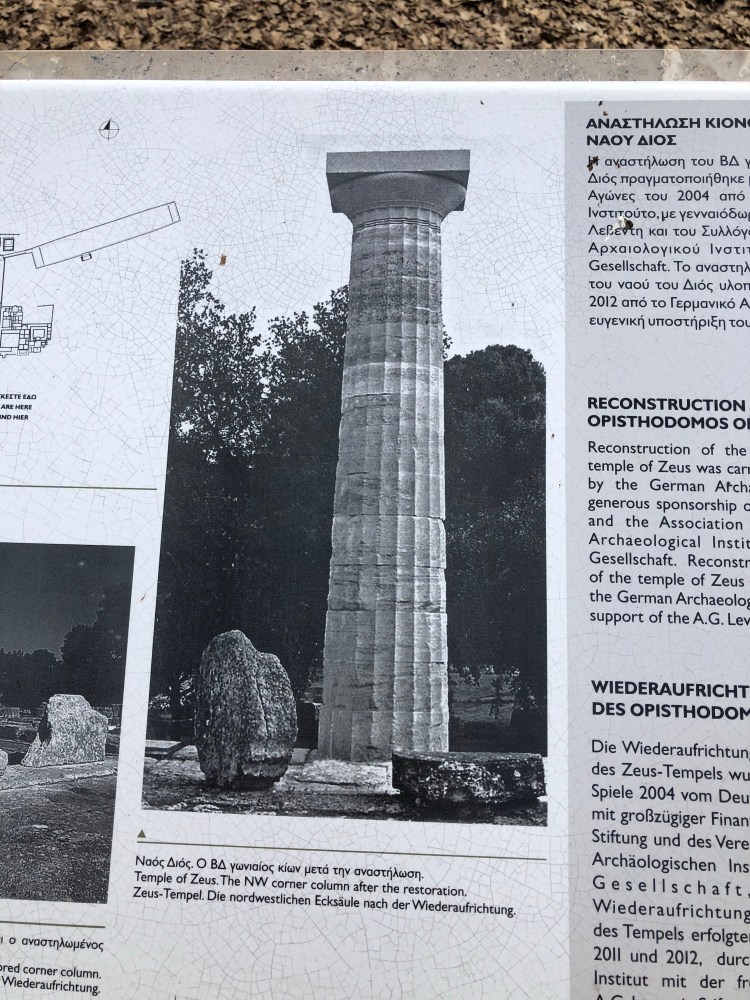
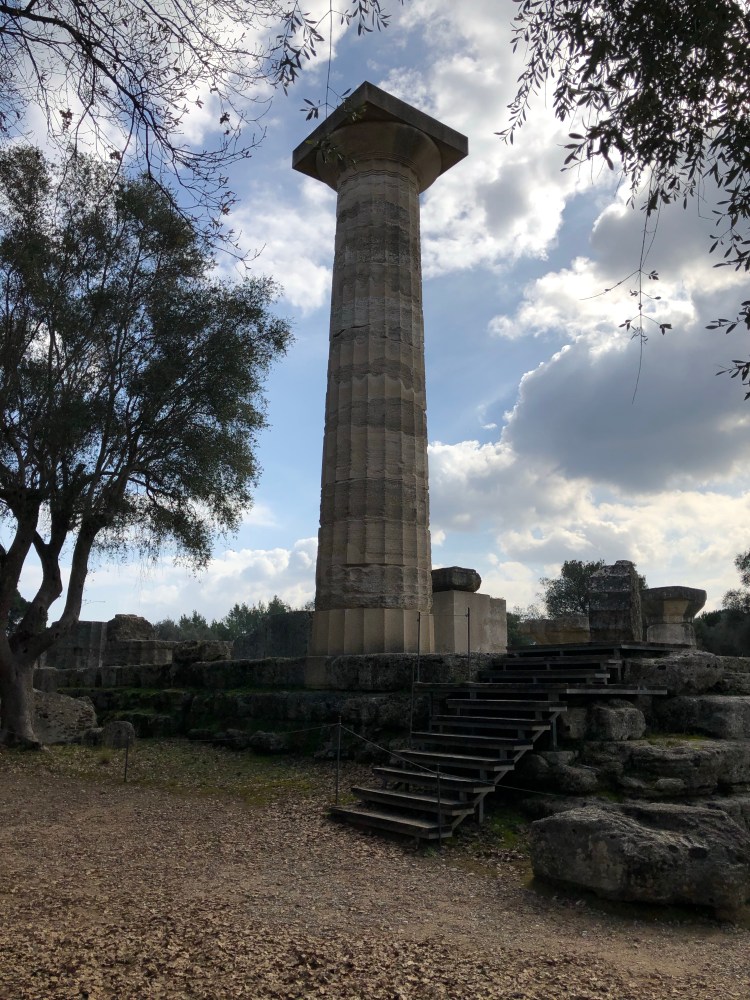
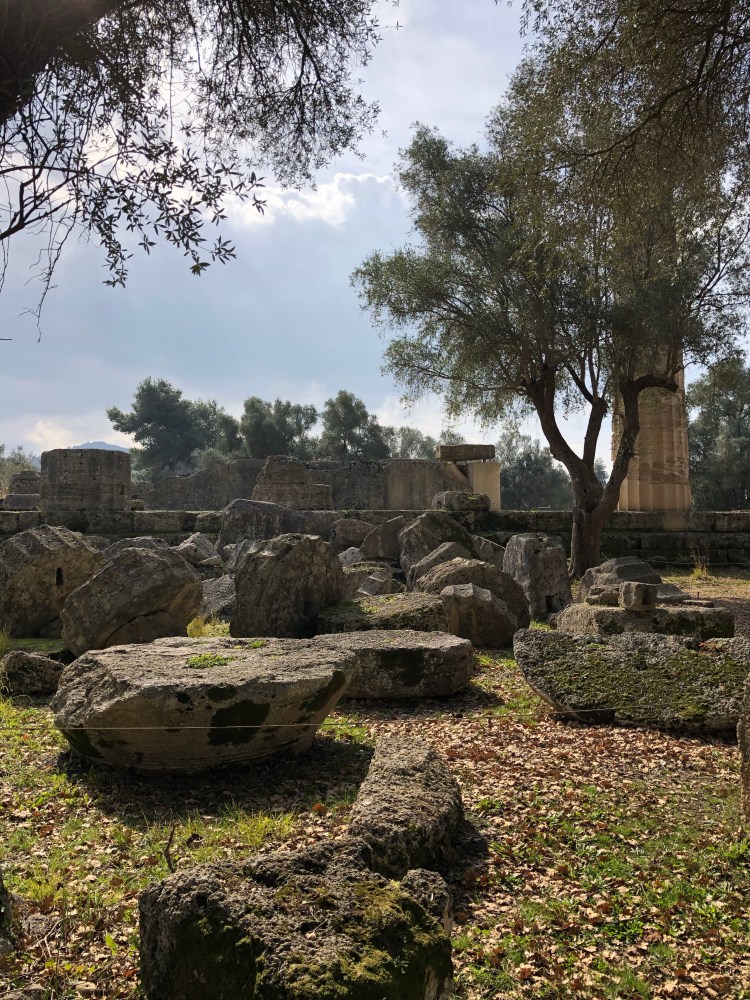
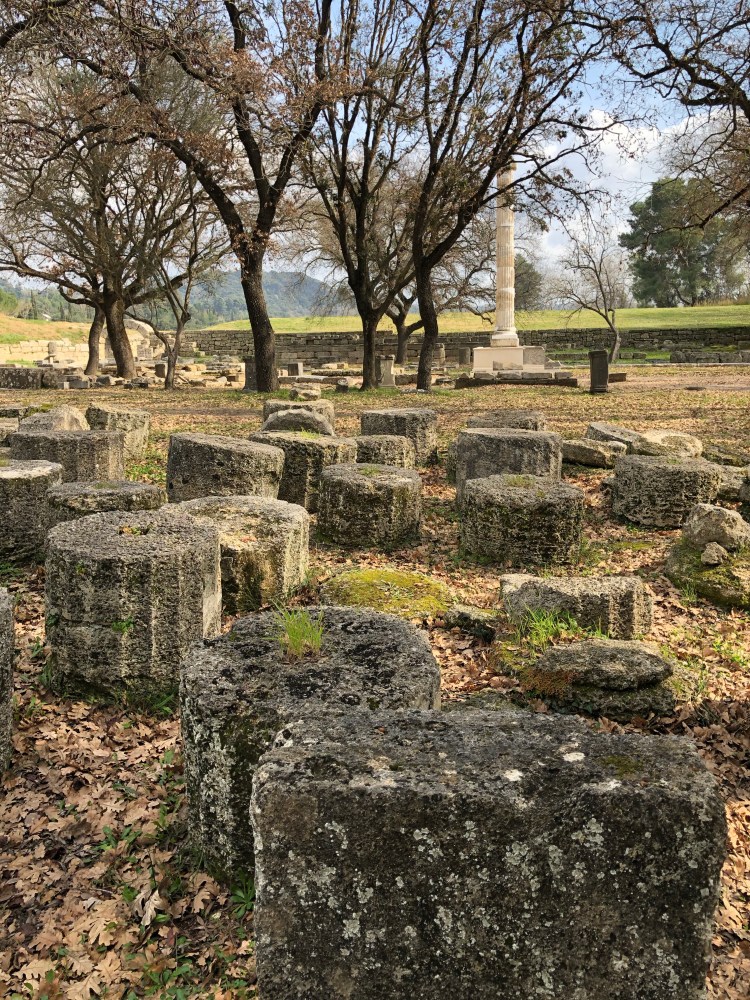
The Temple of Zeus (who was born on Kronos Hill nearby), thanks to some German archeologists, is being reconstructed. All that stands here is one single column.
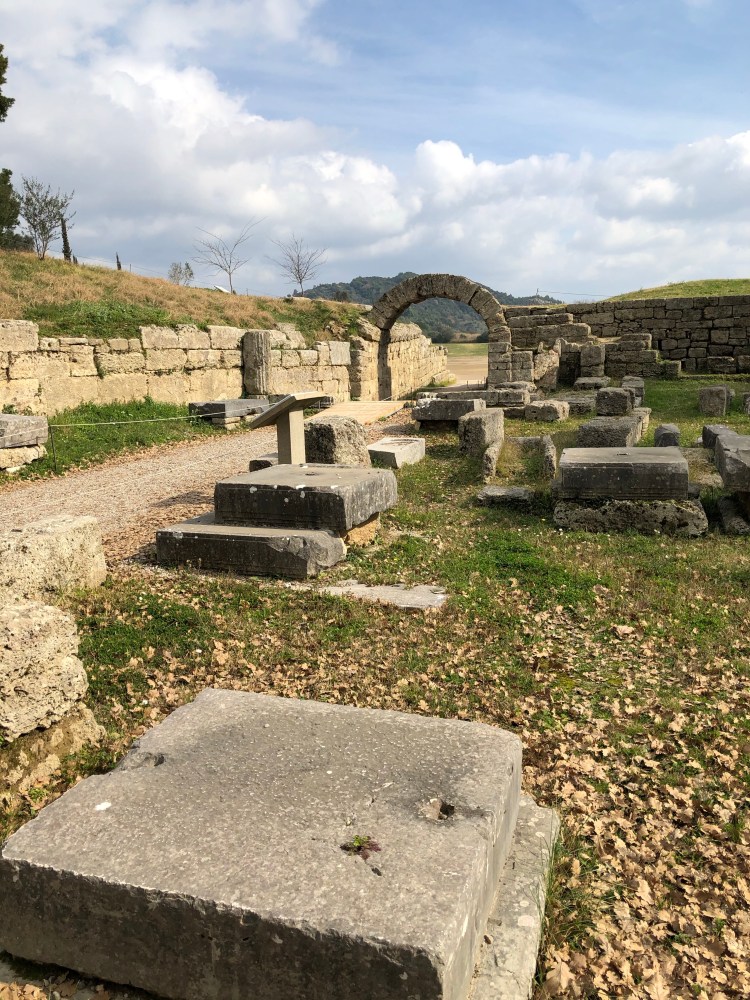
The pathway to the stadium was interesting. It was once lined with bronze statues of Zeus of which only 16 bases survived. Inscribed on the foot of each bases were the names of those who cheated as a warning to others! The statues were paid for with fines levied on the cheaters. The parent’s names were inscribed on there, too. They were the ones who paid the fines, I am sure!
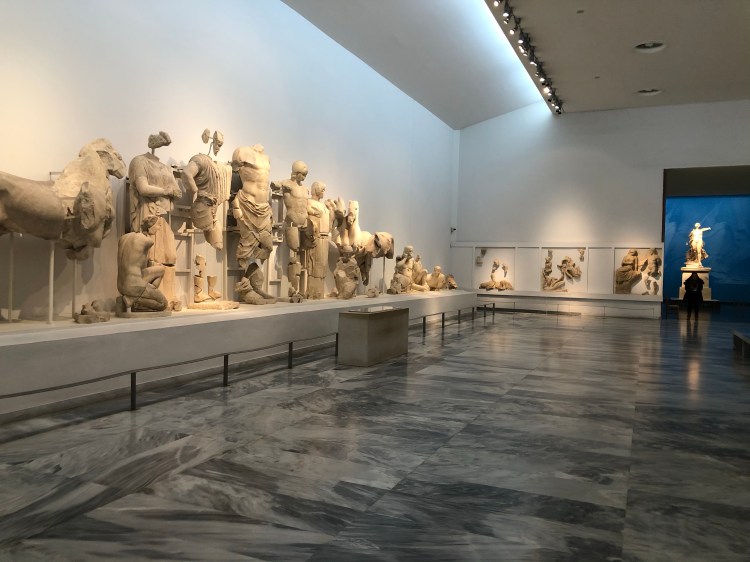
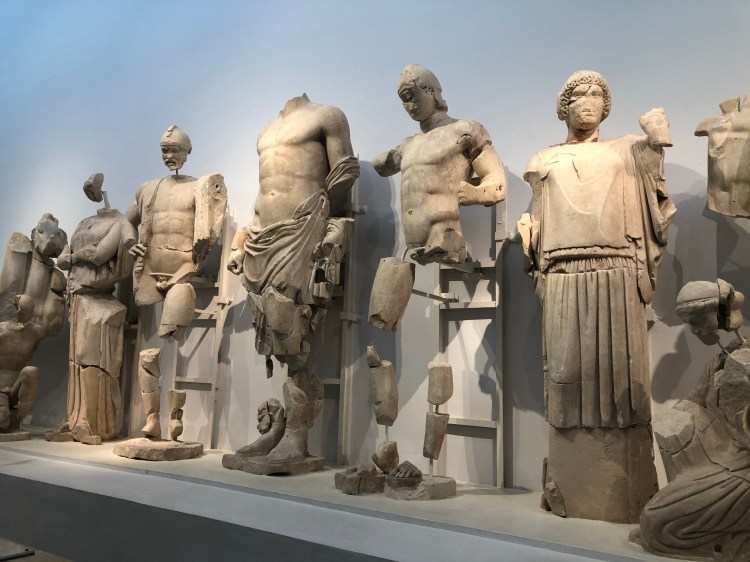
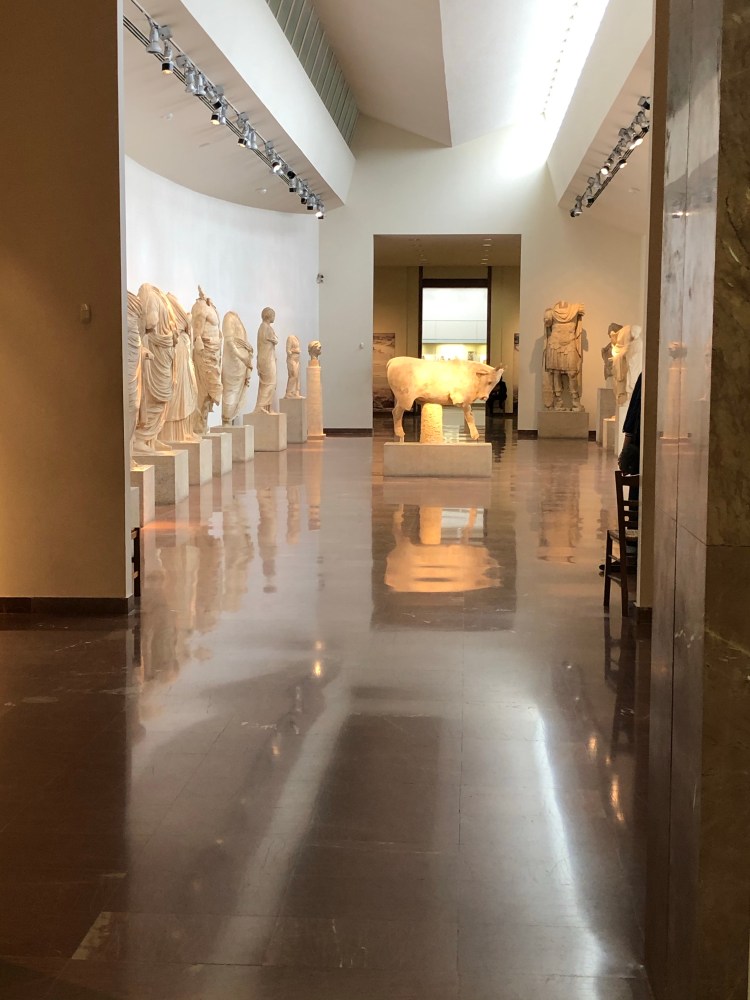
After seeing several more monuments we made our way to the archaeological museum where many local artifacts removed from the site are now displayed.
The museum was beautifully displayed with impressive treasures!
Hermes of Praxiteles
This statue was found during excavations at the temple of Hera in 1877. The messenger of the gods, charged by Zeus to take the infant Dionysos to the Nymphs, who were to nurse him, rests on the way having thrown his cloak over a tree trunk. In his raised right hand he was probably holding a bunch of grapes and the baby reaches for it.
This ancient site has one other real connection with our modern times. Every two years, in anticipation of the upcoming summer or winter Olympic games, the torch for the games is lit here in ancient Olympia. Just in front of the Temple of Hera the torch is lit in an elaborate ceremony. Then it is carried by runner to the first modern Olympic stadium in Athens, about a 185 kilometer run. There it is handed off to the host country representatives be taken to the site of the modern games in that year.
Venice was in its prime from about 1100 – 1500 AD. We departed Venice this week, during a one week semester travel break, to head back in time. We’re talking 4000 years before Venice peaked out, and 4500 years before our lives as we know them today.
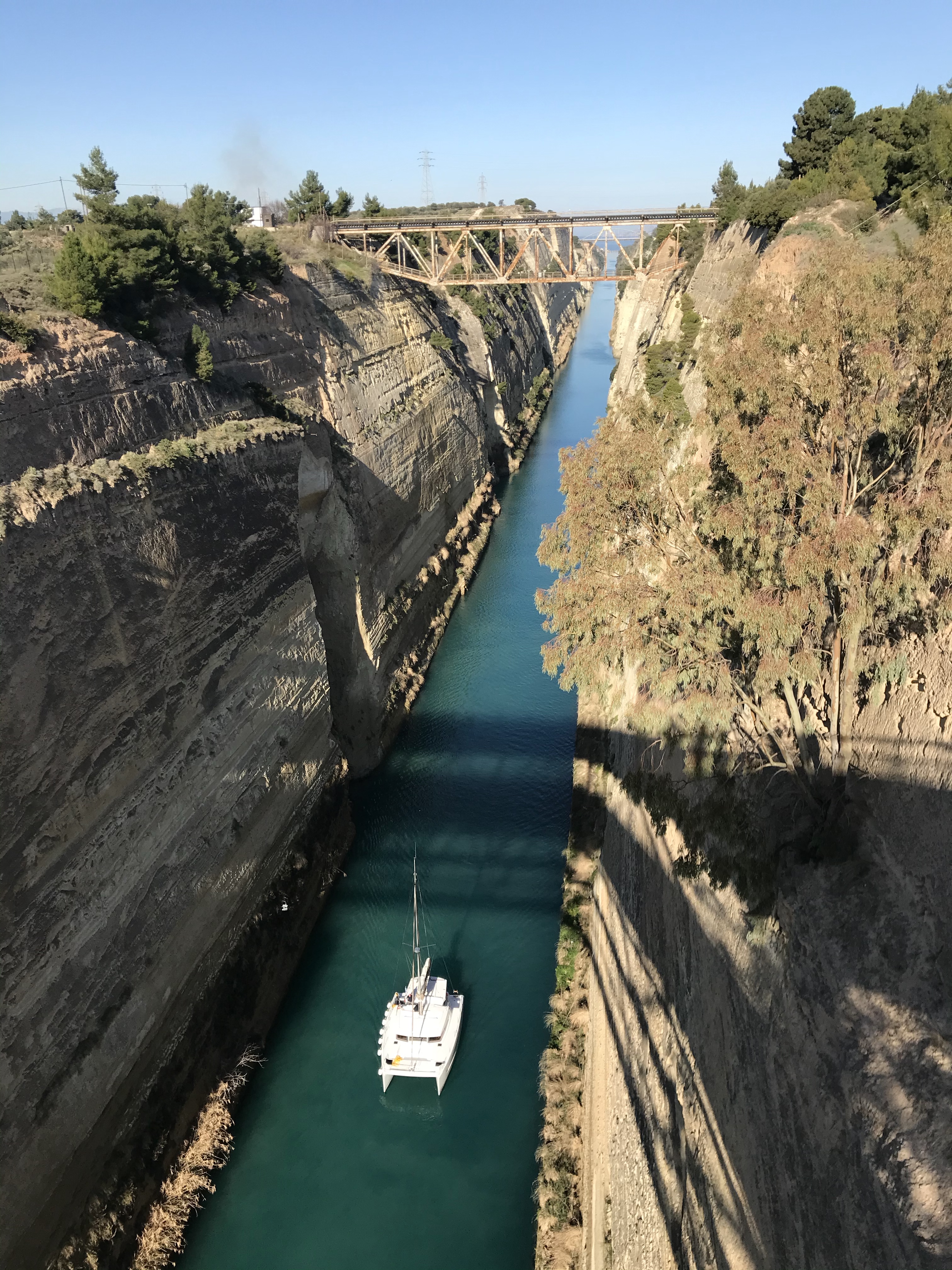
On Sunday we flew into Athens and holed up in a nice hotel near the base of the Acropolis. We will get to the Acropolis and ancient Athens in a few days still. Instead, on our first morning we loaded into a small shuttle with 10 other travelers and headed out of Athens, across the Corinthian Canal, and down into the Peloponnesus – the “island” that makes up most of southern Greece. Our first destination was Mycenae.
In the 1880s-90s engineering caught up with need. German engineers figured out how to cut a deep channel, about 100 meters deep, down through rock along the length of the run. The canal opened in 1893, where it was dedicated by King George II of Greece (cousin of Queen Victoria) and Emperor Franz Joseph of the Austrian Empire. The canal is deep and narrow, and boats with a draft of no more than about 8 meters can navigate through.
When I was 15 and on a long school trip through Europe, I actually went through the canal on board a tramp steamer from Venice to Athens. I remember waking up at 5 am to go out on deck and witness the passage. “Will the circle be unbroken?”
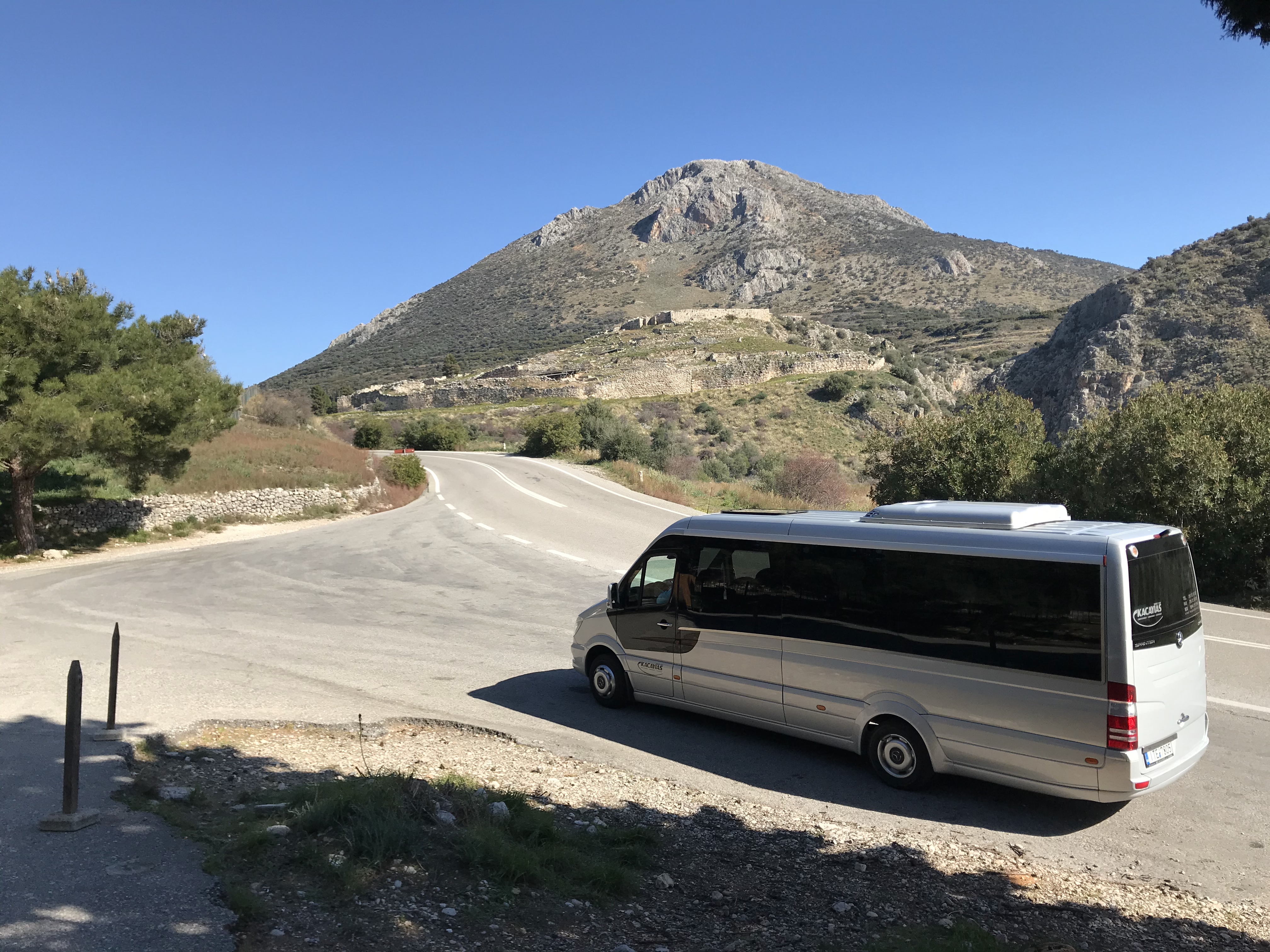
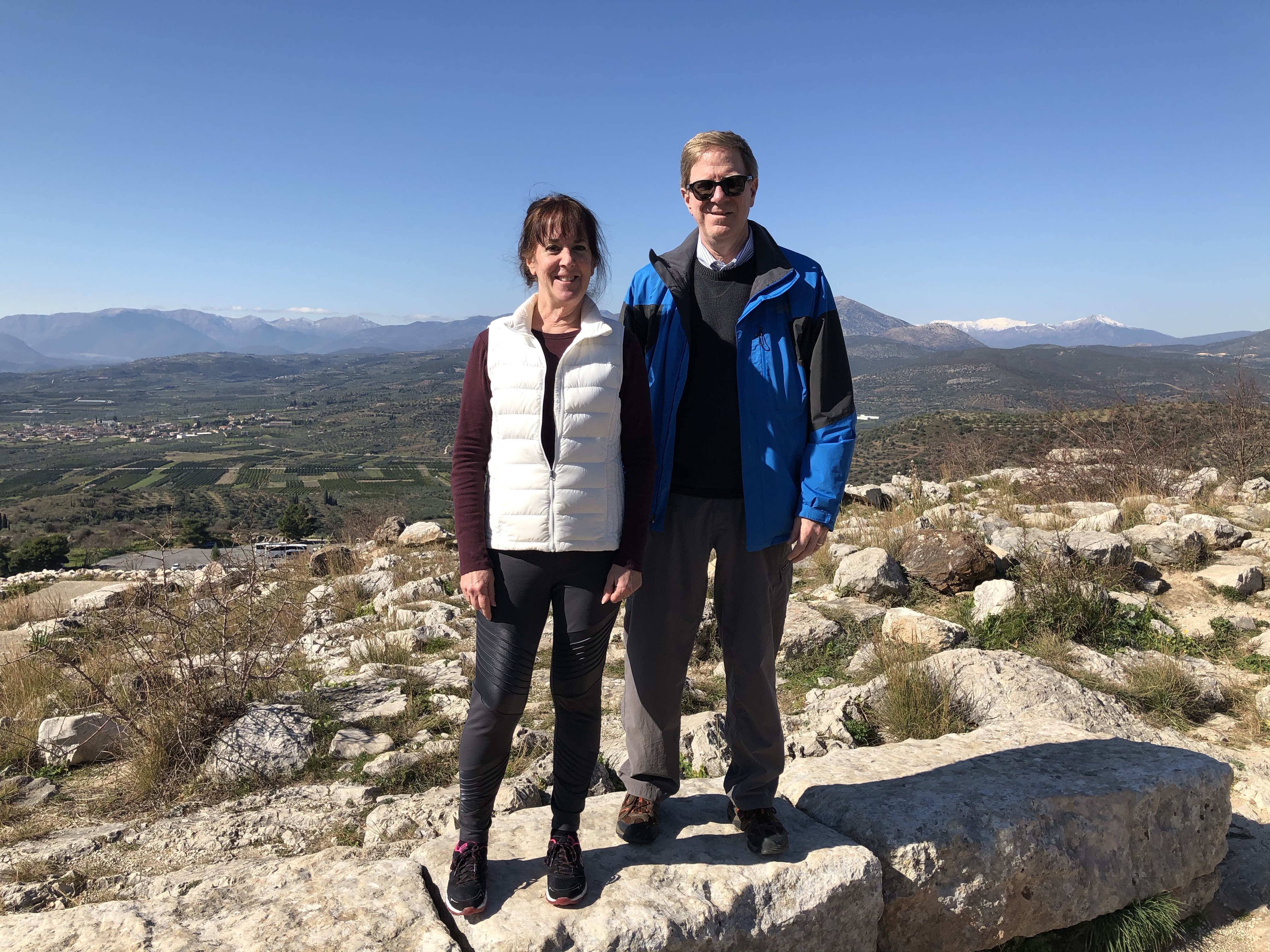
From there we crossed the Corinthian mountains, which used to be the northern-most border of ancient Sparta in its prime, down into the Argolida province and on to Mycenae. (Side note: Jason came from Argolida and his men were named the Argonauts). Mycenae was settled between 3500 and 2500 BC. By 2500 it was the most powerful society in the then-known world. The most famous king, of course, was Agamemnon, who took his army to Troy, sacked the city, and brought Helen back to his brother Menelaus who was king of Sparta.
Like many Greek towns, and paralleling the way towns were built and fortified for thousands of years, the center of the settlement was the walled fort at the top of a steep hill. On our way to Mycenae we passed many such forts, and they are each called “acropolis” which is Greek for “high city” (acro as in acrobat, polis meaning city). So although The Acropolis is associated with Athens, nearly every ancient town had an acropolis.
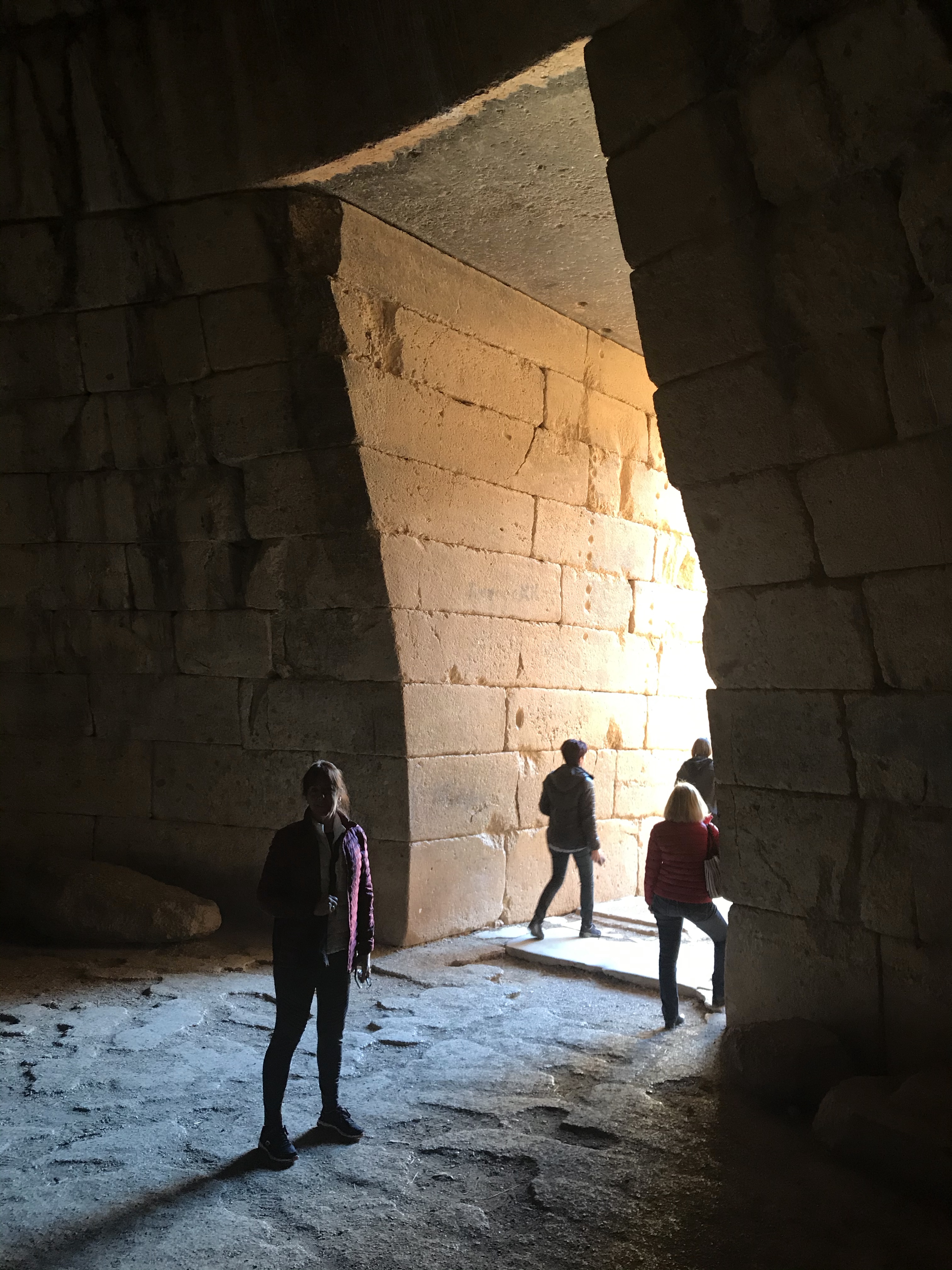
Archeological digs have unearthed much of the Mycenaean settlement. Near the very top of the acropolis are round burial circles, excavated to a depth of about 10-15 feet, in which were found the remains of 19 people. Clearly these were important people, to be buried in these small number of circles.
Agamemnon was gone from Mycenae for years while he took down Troy. The story goes that he took himself a mistress while there, and together they had another child. When he returned from Troy he brought the young woman and the baby with him, then asked his wife Clytemnestra (sister of Helen of Troy) if it would be ok for the new girl and his new baby to live with them all. (Yes, the 2 brothers were married to the 2 sisters). That night Clytemnestra killed Agamemnon by slicing him up. Some stories say he was killed by Aegisthus, who was Clytemnestra’s lover.
In one of the round burial circles was found the bones of an older man, a young girl, and those of a young baby. A gold death mask found in the tomb is said to be Agamemnon’s death mask, and is on display at the National Archeology Museum of Athens.
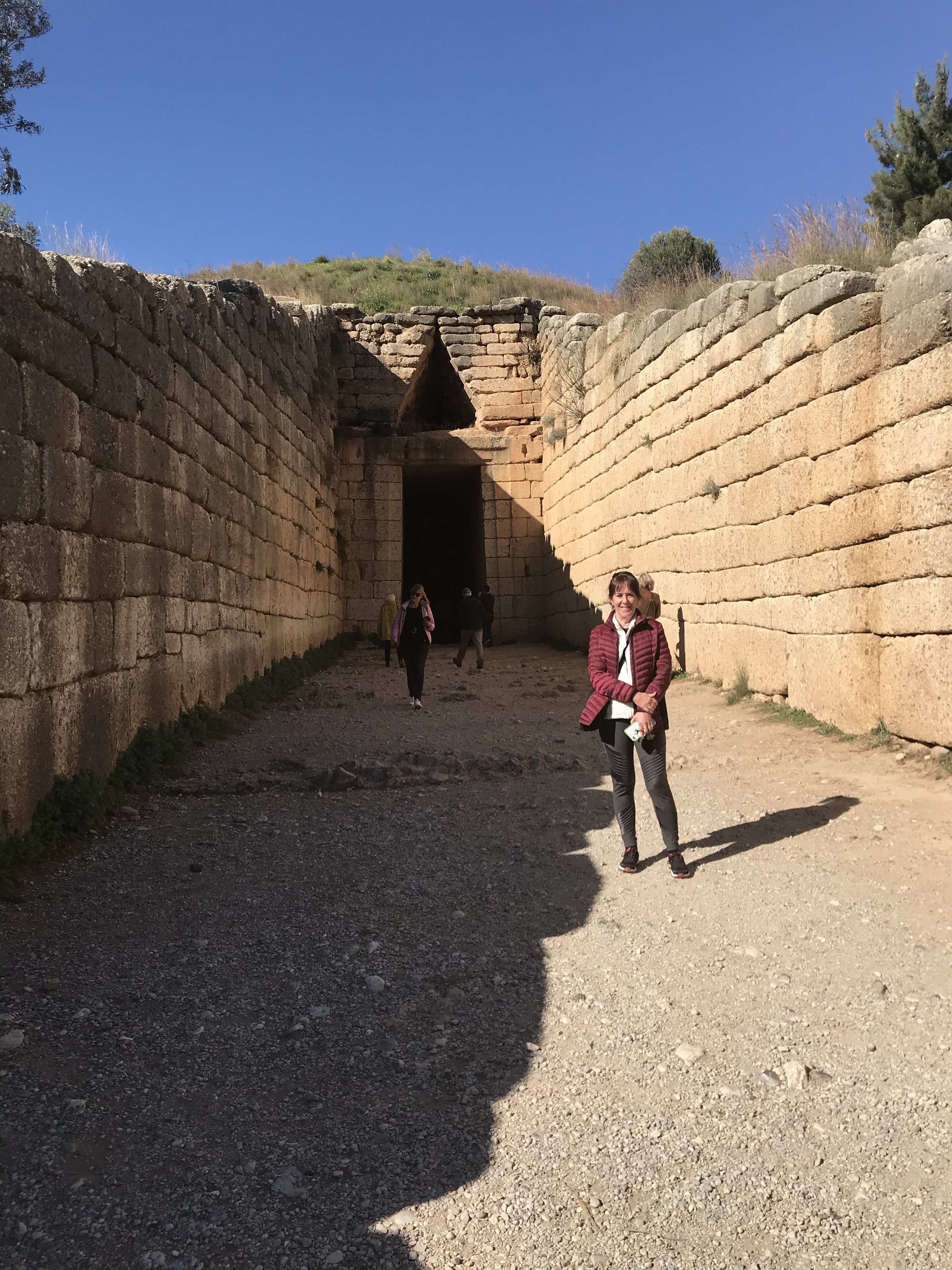
Nearby the acropolis of Mycenae is a massive burial mound, believed to be the tomb of some other great king. All of the ruins here and all across Greece have been mostly stripped and robbed of their treasures over the centuries, by Romans then by Christians in addition to rogue scavengers. It was only the excavations begun in the late 1800s that have recovered relics like the death mask. Today what remains are the ruins and the mythical stories that are passed down. Many of these started with Homer who is believed to have lived in the 9th century BC.
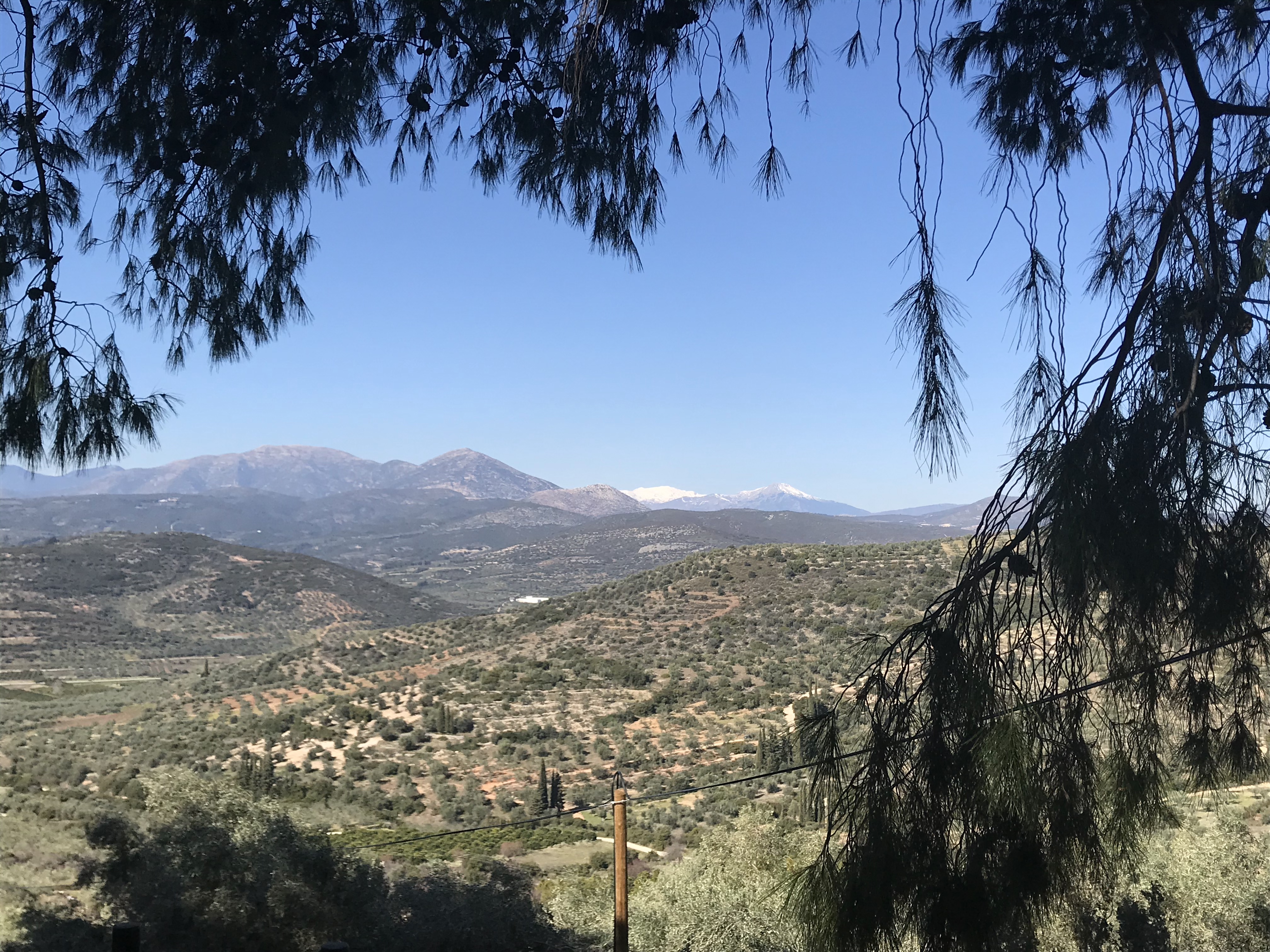
From the top of the acropolis you can see clear down the valley to the Aegean Sea. The Mycenaeans ruled both the land and the sea. They were there for hundreds of years, but for reasons unknown the culture declined. In the period between 1500 – 500 BC, this great city state of Ancient Greece descended into relative obscurity.
Much later on we hear once again about Mycenae. They were defeated in a mighty war by the rising Spartans, who also defeated the Athenians, and who then ruled over Greece. But this was during the Peloponnesian War in the 400s BC.
Then the Persians invaded Greece, and still later on first Philip of Macedonia and then his son Alexander became mega-conquerors and ruled the world.
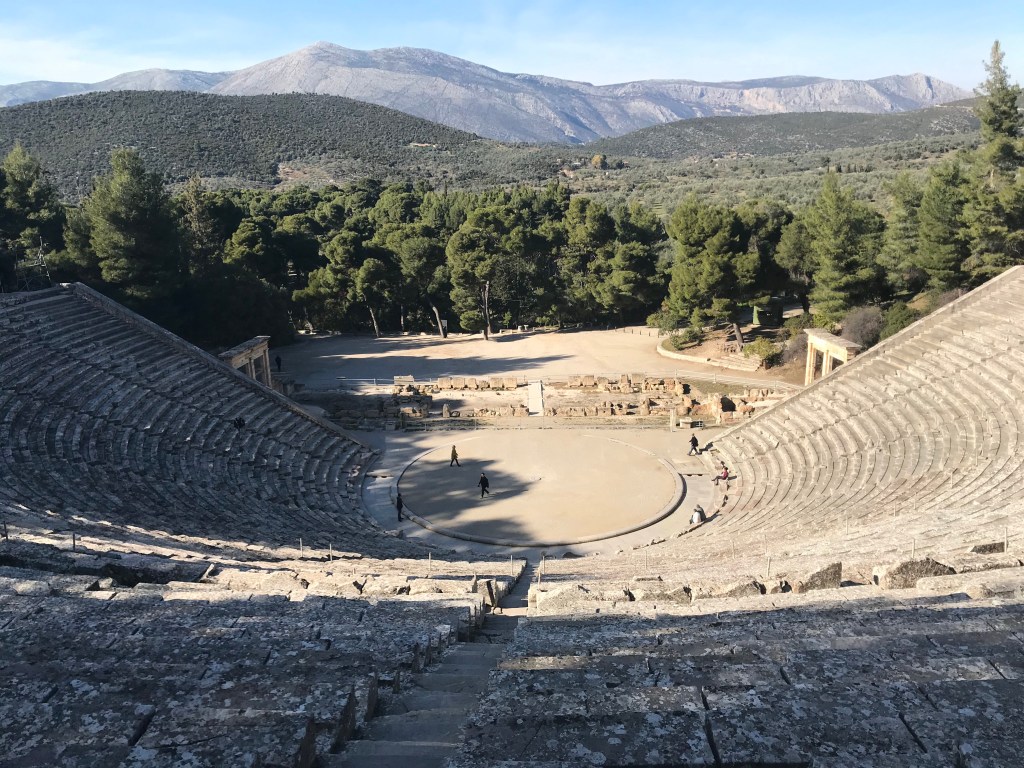
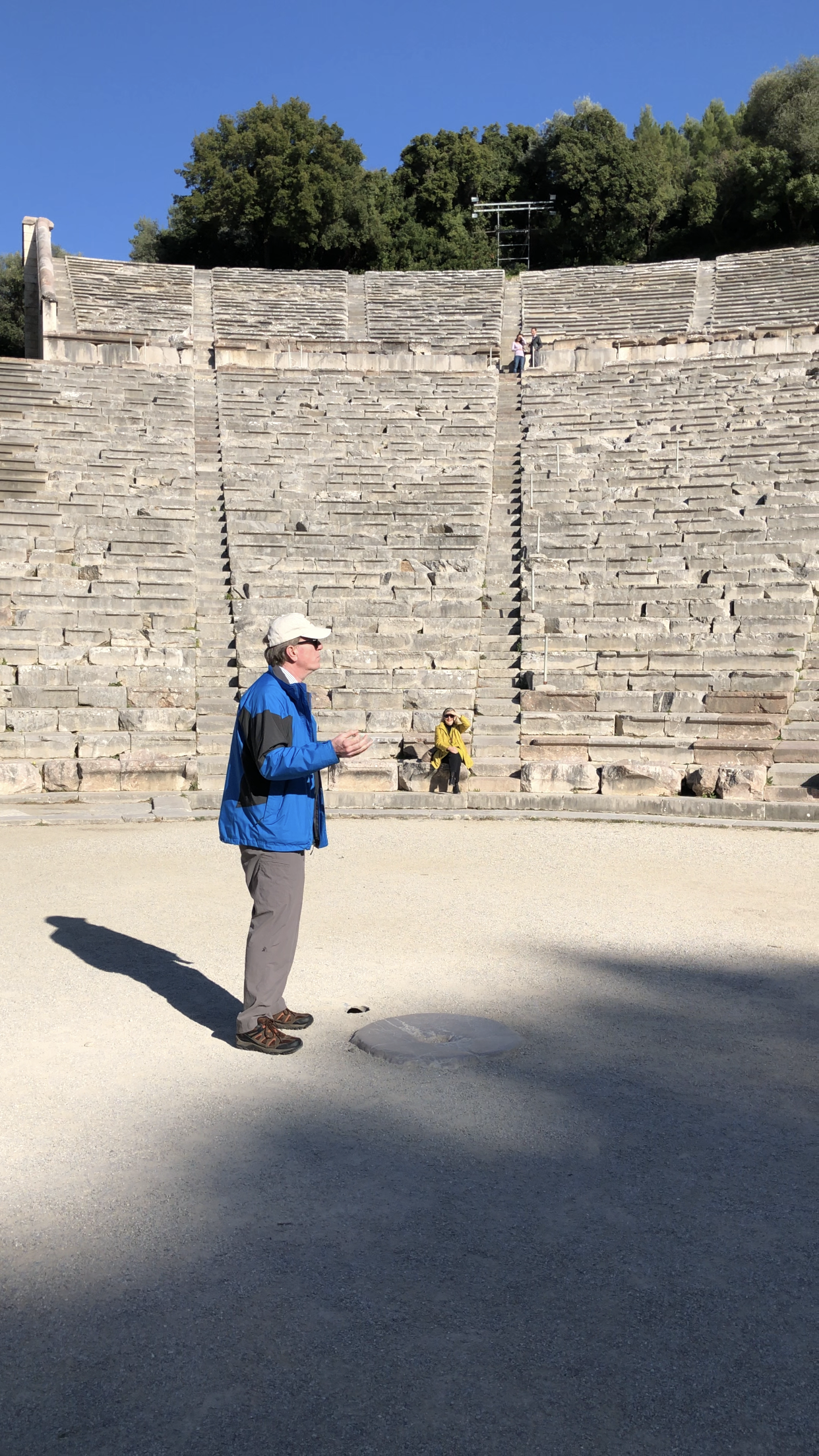
In the afternoon we continued south toward the sea, and stopped at Epidaurus. Popular from the 8th century BC until Roman times AD, this was a center for healing and theater. The natural theater, built into the side of the hill, can seat 8,000. Here only Greek tragedies and comedies were performed. The acoustics in the theater are said to be among the best in the world. On our quiet afternoon there, with no throngs of tourists about, one could stand in the center, speak in a regular voice, and be heard perfectly clearly at the very top row.
I broke the tradition by standing there and reciting a soliloquy from Hamlet. At least it maintained the tradition of tragedy.
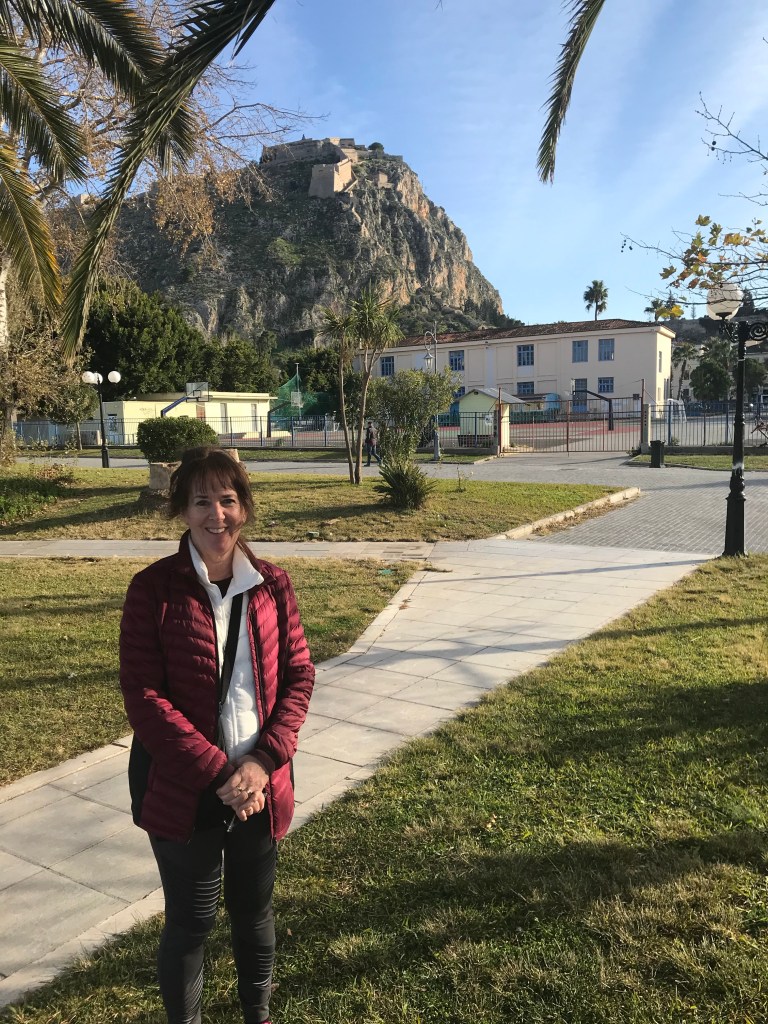
Finally, on to Nafplio, a port city on the Argolic Gulf opening out on to the Aegean Sea. A chance to wander around the old town and view the old medieval fort built on the overlooking cliff, and then a refreshing cappuccino sitting by the sea. Time to head for our hotel and a much deserved rest.
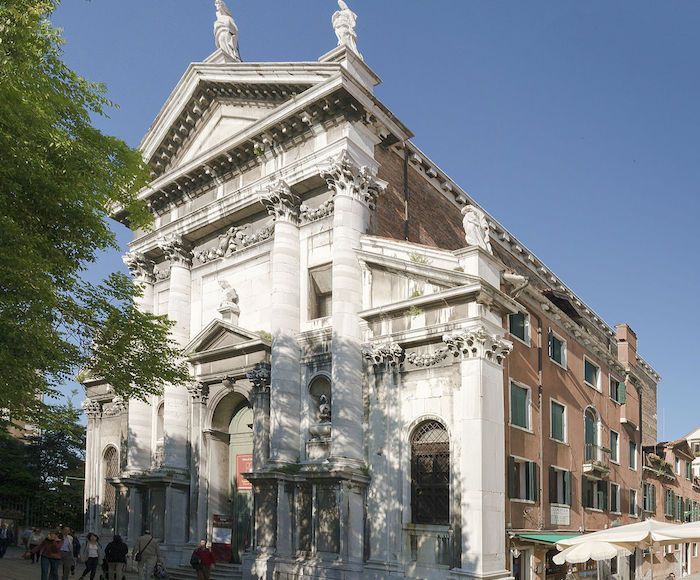
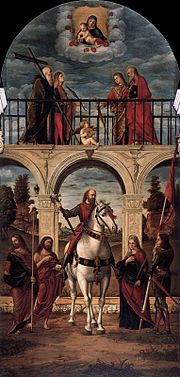
Just over the Ponte dell’Accademia, across the small campianello San Vidal on the San Marco side, is the Chiesa San Vidal (Church of St. Vitale). The church was founded in 1084 by Doge Vitale Faller, dedicated to his patron saint. More recent restorations in the 15th and 17th centuries make the church seem positively “modern.” Inside it sports one long nave, not a cross design, with side altars.
According to legend, San Vitale witnessed the execution of Saint Ursicinus of Ravenna. San Vitale was on the sidelines, encouraging him to die like a good martyr. Once Ursicinus was dead, Vitale took his body away for burial. In doing so, he caught the attention of the persecuting judge, Paulinus, who consequently ordered Vitale to be tortured and then buried alive. Vitale was thrown into a deep pit and covered with stones. This all happened about the time Nero was fiddling.
The Chiesa has a musical history. Dario Castello lived in the parish (around 1630), and served as head of the compagnia dei Musichi d’Instrumenti da fiato. Tradition has it that in the church was placed the sepulchre of the famous Venetian musician Baldassarre Galuppi (died in 1785). On the feast day of Saint Vidal, Bonaventure Furlanetto wrote and directed a three voiced vesper in which the famous double bass player Domenico Dragonetti had a solo (in 1799 he played a duet with Ludwig van Beethoven).
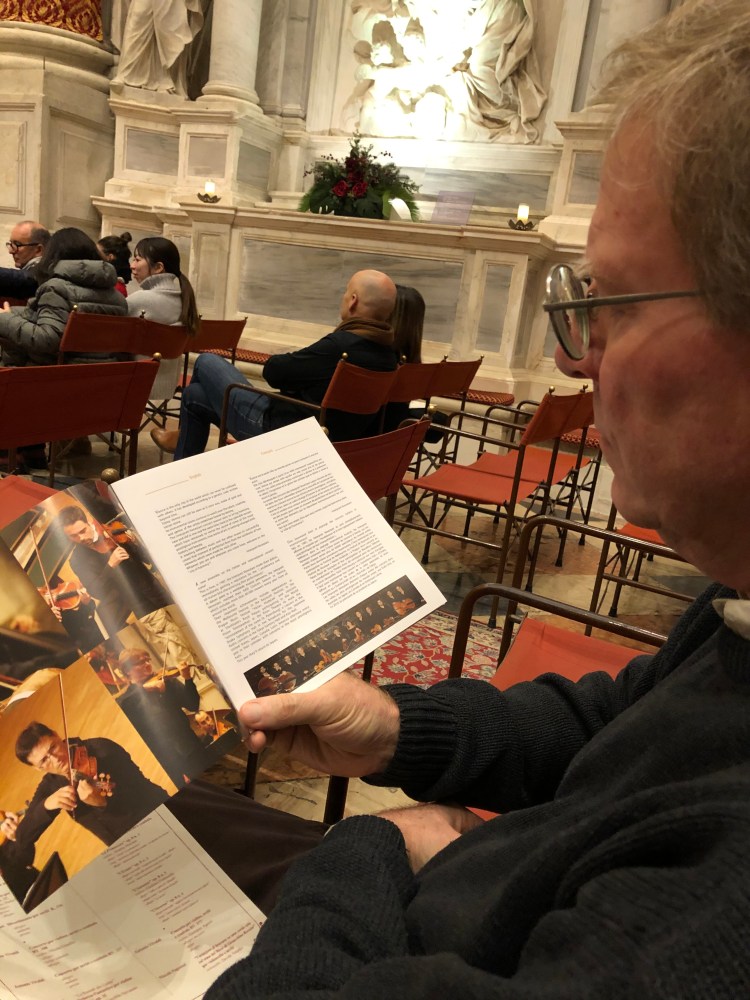
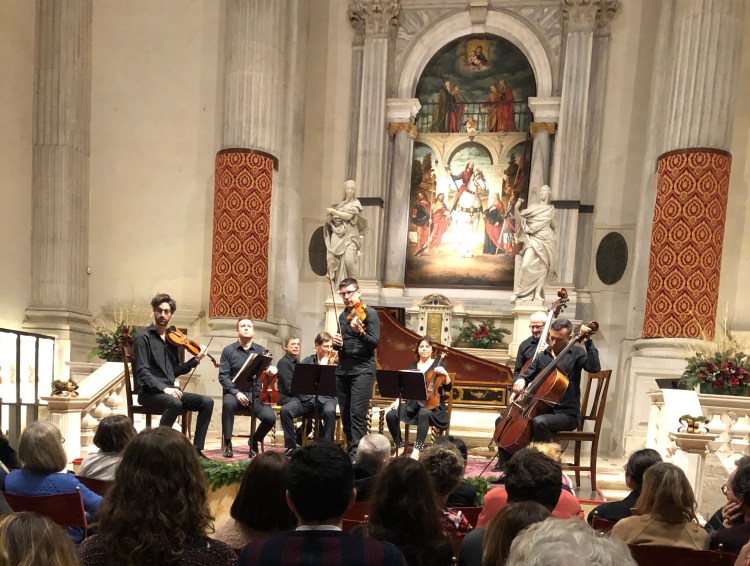
The musical tradition continues today. Now the Chiesa is home to Interpreti Veneziana, a troupe of musicians who stage concerts throughout the year. On Thursday this week we attended and listened to three pieces: 1) Vivaldi’s “Le Quattro Stagione” (The Four Seasons), 2) Vivaldi’s “Concerto for Violin, Strings and Harpsichord, and 3) Paganini’s “Variations of skill on a single string on the theme of Gioacchino Rossinni’s Mose for cello and strings.”
To listen to short segments of each, click the link below. The cello player was a hoot to watch!
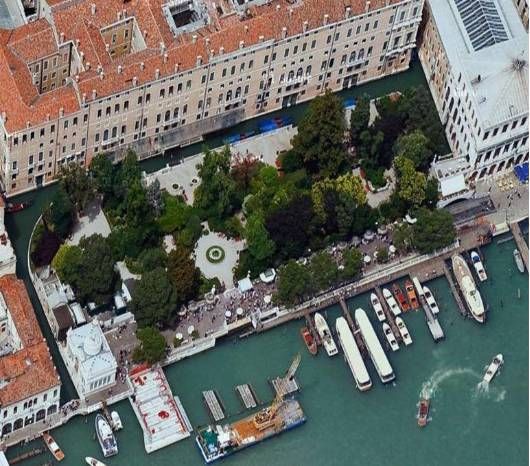
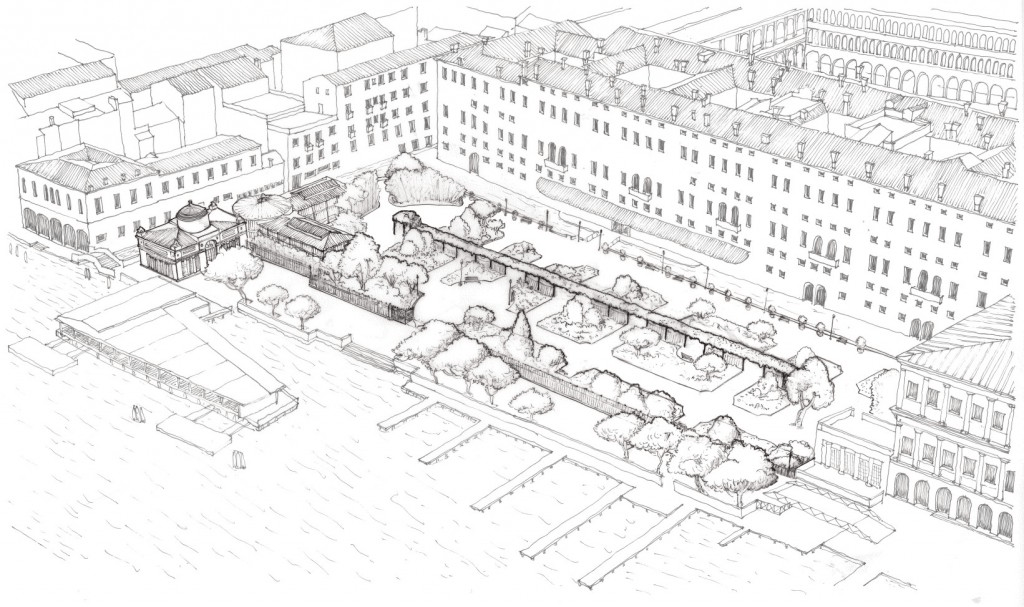
The Royal Gardens (Giardini Reali) are located near Piazza San Marco. The entrance is however hidden between the stalls in front of the back side of San Marco. The garden had been created by Napoleon (Here we go again!) and the young Viceroy Eugenio di Beauharnais. They wanted to use the Procuratie Nuove building as the site of the Royal Palace. The original design started from a garden with geometrically shaped flowerbeds. In 1808, the ancient granaries were demolished, which at that time were being used as barracks. From 1815, a greenhouse and a neoclassical pavilion, the Padiglione del Caffè, were added. In the late 19th century, the iron and cast iron pergola was built. Napoleon certainly messed it all up! In 1920, the Royal Gardens were handed over to the city council and opened to the public. Unfortunately, over time, the garden lost its grandeur.
The garden is currently reopened (just 2 months ago) and restored to its original state! This includes not only the trees and the plants, but also the pergola, the coffee house, the greenhouse and the drawbridge. Once it greens up this spring, it will be a lovely spot!





 2020 Vision of Venice