This past week the first excursion for students was to Campo Sant’Agostin. This is a tiny, quiet square in the San Polo sestiere (neighborhood), in the very center of Venezia.
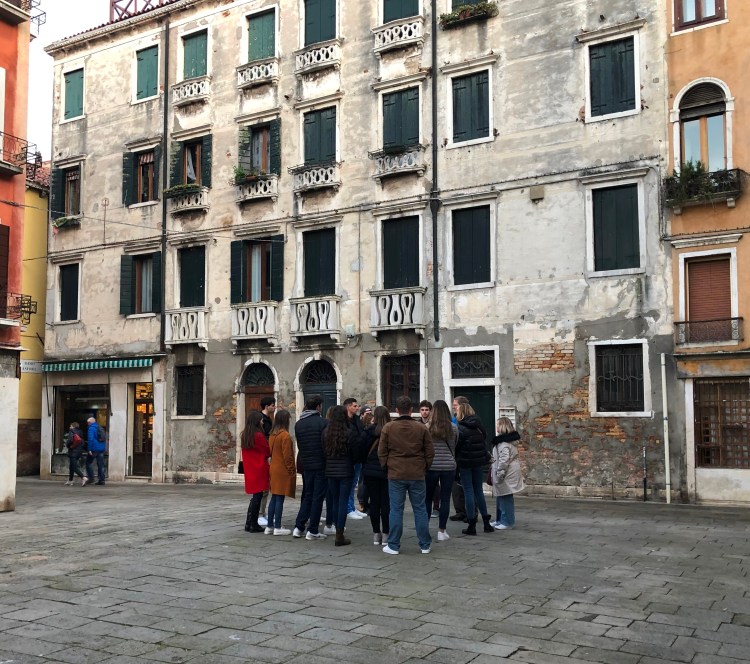
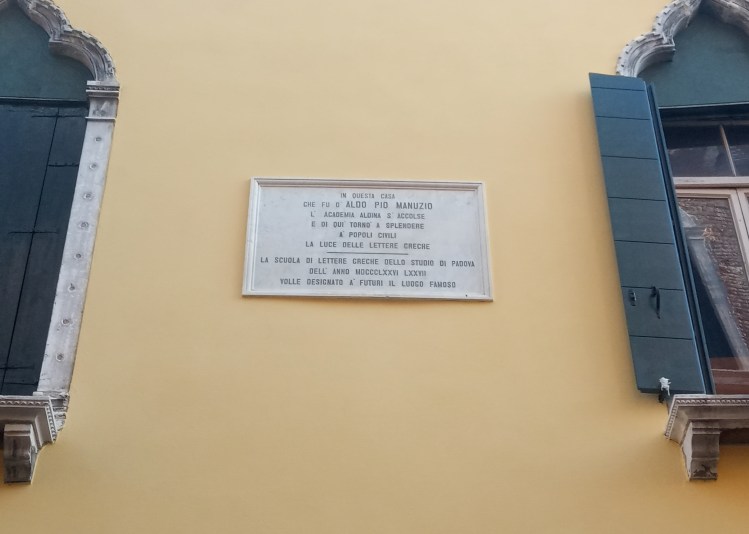
High on the second floor exterior wall of a yellow house just off the campo is a remarkable plaque, dedicated to the memory of Aldus Manutius. Born in 1449 near Rome, Manutius was educated in the classics in his formative years, and while he was subsequently tutoring he wrote two books on classical Greek philosophy that were published in Venice. He found his way to Venice in 1490, where he met Andrea Torresani and Pier Francesco. Francesco was a nephew of the Doge – good connection. With funding from these two contacts, he started Aldine Press. It was Aldine Press that was originally located at Campo Sant’Agostin. (Side note: the plaque is actually on the wrong building; the press was one block to the west).
Printing as we know it had only been invented a few years earlier, by Gutenberg in 1450 in Mainz Germany. But central Germany was not really at the crossroads of much back then. And a purge in Mainz led to a mass exodus of those with printing knowledge and technology. They came to Venice.
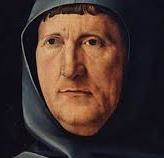
Between 1470 – 1500 more than 2 million books were printed in Venice. At the crossroads of world trade, Venice had access to raw materials (metals, ink, paper) and access to markets for produced books. Venice also had freedom of the press, because as a commercial operation that brought revenue to the city, the Doge allowed printers to do what they wanted. Printers here produced the classics for people to read for the first time. “How to” and DIY books became very popular all across Europe, including Luca Pacioli’s (pictured right) chapter in Summa de Arithmetica that essentially created double-entry book-keeping and accounting as we know it today. From that one book merchants all across Europe adopted a single standard for managing their affairs.
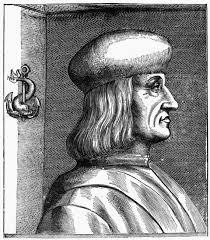
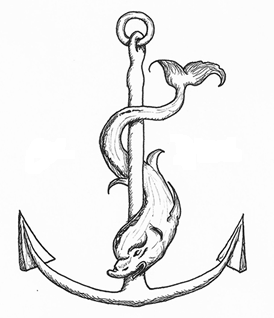
Manutius was central in this surge in printing, even though he showed up late. The logo for Aldine Press was the anchor and the dolphin, “speed in execution, firmness in deliberation.” There Manutius invented “italic” type, replacing the block letters used previously and making print easier to read. He is responsible for standardizing what we now know as punctuation. The Doge gave him a monopoly on his own works, eliminating competition from printing the same thing. Nice to have friends in high places!
He also invented the Octave as a book format. Printing presses usually started with paper that measured 12″ x 16.5″. Fold this in half and you get a “folio” (the format for the first printing of Shakespeare’s works in the early 1600s). Fold it again and you get the “quarto.” A third fold results in the “octave,” whose final dimensions end up being 4.1″ x 6″. This size can fit in your pocket, easy to carry around. And because each sheet of printed paper could now get eight images, the cost per book produced came down precipitously, putting reading in the reach of the general population.

As a measure of his importance in the world of printing and publishing, Doubleday adopted the same logo for their line of pocket-sized paperbacks.
 2020 Vision of Venice
Page – Thank you for this wonderful education about printing in Venice! While I knew about Venice being the center of trade in the world at that time, I did not know about its importance to the spread of literacy. And thank goodness that Luca Paccioli’s book was printed — without it, many CPAs would not have jobs! BTW – Did you know that Paccioli was a close friend of Leonardo di Vinci?
LikeLike
When you read the histories of people like Pacioli and Manutius, you come to realize there was a fairly tight network of the educated artists and literati in northern Italy in the 15th century. At some point they all seemed to know or encounter each other.
LikeLike